All Books
Self-Growth
Business & Career
Health & Wellness
Society & Culture
Money & Finance
Relationships
Science & Tech
Fiction
Topics
Blog
Download on the App Store

How to Be a Grown Up

The 14 Essential Skills You Didn’t Know You Needed (Until Just Now)

15 minRaffi Grinberg

What's it about

Ever feel like you missed the class on being an adult? This summary is your crash course. Learn the essential, unwritten rules for navigating your career, finances, and relationships with confidence, so you can finally stop faking it and start feeling like a capable, successful grown-up. Discover 14 practical skills you can use immediately, from mastering small talk and managing your money to building a professional network and handling difficult conversations. You’ll get simple, actionable advice to help you build the life you want, one essential skill at a time.

Meet the author

Raffi Grinberg is a former Google product manager who taught the company’s most popular career development course, helping thousands of employees navigate professional and personal growth. Frustrated by the lack of practical life advice available to young adults, he synthesized his experience into a clear, actionable guide. Raffi drew from his work at Google, his computer science degree from Yale, and his own journey into adulthood to create the essential roadmap he wishes he’d had.
Listen Now

Opens the App Store to download Voxbrief

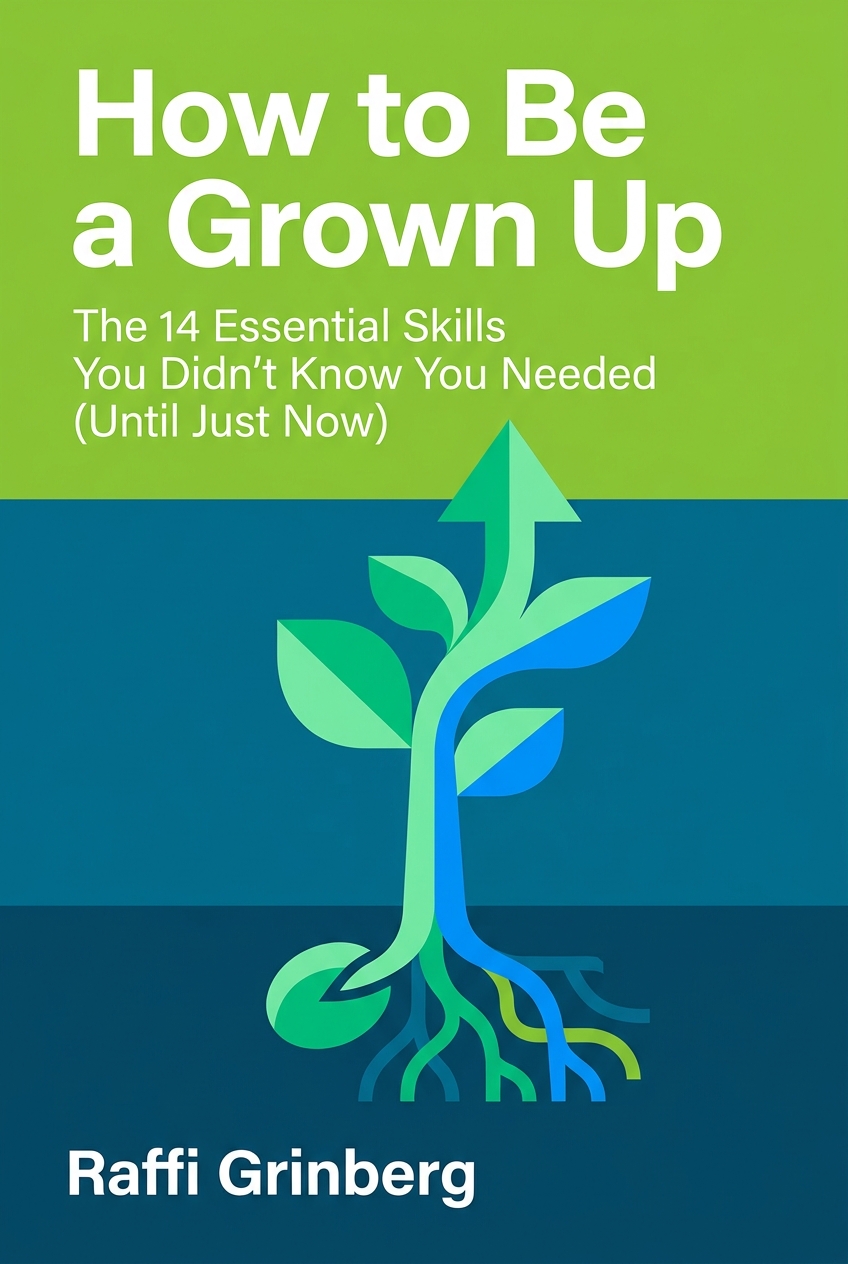
How to Be a Grown Up book cover

The Script

You’re in the back of a taxi, staring out the window at the blurred city lights, when the driver asks, “So, what do you do?” You give your standard answer, the one you’ve rehearsed a hundred times. He nods, then asks a follow-up about your weekend plans. You mention a project around the house, maybe a social gathering. It’s a perfectly normal, five-minute conversation. But as you step out onto the curb and the taxi pulls away, a strange feeling sinks in. The person you just described—the one with the tidy job title and the sensible weekend—feels like a character you’re playing. That person knows how to file their taxes, contributes to a retirement fund, and remembers to send birthday cards. Meanwhile, the real you is just trying to keep your head above water, wondering if everyone else got a secret instruction booklet that you somehow missed.

This feeling—the gap between the adult you’re supposed to be and the person you actually feel like—is a quiet, common anxiety. It’s the sense that while you’ve mastered the performance of adulthood, you’re still improvising the substance. You’ve accumulated the job, the apartment, and the responsibilities, but you’re waiting for the feeling of being a 'real' grown-up to kick in. It’s this exact disconnect that Raffi Grinberg set out to resolve. After graduating from Harvard and realizing he was completely unprepared for the practical realities of life, he felt a profound sense of bewilderment. He started compiling a list of all the things he wished someone had taught him, from negotiating a salary to handling loneliness. That personal list, born from post-collegiate confusion, grew into a crowdsourced project and eventually became this book—a practical guide for navigating the parts of life that don't come with a syllabus.

Module 1: The Foundation of Adulthood—Self-Authorship

We're going to start with the core idea that underpins the entire book. It's about moving from a life directed by others to a life directed by you. This is a deep psychological shift. The author argues that true long-term fulfillment, a state he calls LTF, is impossible without it. The first step is to recognize that your beliefs and desires are often not your own. Many of our goals—the prestigious job, the "right" kind of partner, the definition of success—are absorbed from parents, peers, and society. Grinberg calls these "hollow beliefs." They're unexamined ideas we've inherited. For example, the author realized his own pursuit of a consulting job at Bain & Company wasn't driven by personal passion. It was driven by the prestige his parents and peers valued. This was a classic hollow belief.

This leads to the next insight. To build a life you actually want, you must actively excavate and replace hollow beliefs with "hard-won beliefs." This requires conscious, deliberate work. Grinberg suggests a powerful exercise: create a simple document and list your deepest wants for your career, money, happiness, and relationships. For each want, trace its origin. Ask yourself: Where did this belief come from? Is it from your parents? A movie? Your high school social circle? This process helps you distinguish between what you truly value and what you've been told to value. It's an audit of your own mind.

Now, this isn't a one-time fix. Here's the thing: You must treat your personal growth as an active, ongoing project. The book is filled with exercises marked by a pencil icon for a reason. Passive consumption of information doesn't lead to change. You have to engage. The author suggests sharing your revised list of wants with a trusted friend. This act of sharing creates accountability. It forces you to be honest with yourself and solidifies your commitment to your new, self-authored goals. This journey moves you from what developmental psychologists call the "socialized mind," where you're defined by others' expectations, to the "self-authored mind," where you're guided by your own internal compass. This is the foundational skill of being a grown-up.

Module 2: Rewiring Your Mind—Cognitive and Critical Thinking

Now, let's turn to the internal tools you need to navigate the world. Grinberg dedicates significant attention to how we process information and emotion. He argues that most of what we encounter is, to put it bluntly, unreliable. The first step is to adopt critical thinking as a survival skill. He references a principle called Sturgeon's Law, which suggests that 90% of everything you read or hear is low-quality information. This applies to news, social media, and even advice from respected sources. For example, a famous Maya Angelou quote about feelings being more memorable than actions sounds profound. But upon reflection, the author questioned its utility. You can't control how others feel. So, what can you actually do with that advice? He argues we need a structured way to filter this noise.

This brings us to his practical method. You can use the "CAR" process—Comprehend, Analyze, Revise—to evaluate any claim. It's a simple, three-step mental model. First, Comprehend: What is the person actually saying? This might mean looking past the literal words to the underlying message. Second, Analyze: Do you agree? Use your own experience, logic, and knowledge to test the claim. Argue with it. Explore its nuances. Third, Revise: How does this new information change your worldview? If you agree, integrate it. If you disagree, form a counter-argument. This structured process prevents hollow beliefs from seeping into your mind. It's like a Brita filter for information. You have to pour the water slowly, giving your mind time to process, or the unfiltered, "dirty" opinions will just overflow into your worldview.

But flip the coin. It's also about our internal monologue. Grinberg introduces a core concept from Cognitive Behavioral Therapy, a form of psychotherapy known as CBT. The insight is that your thoughts create your feelings and drive your actions. A friend doesn't text back. The automatic thought, "She's mad at me," creates anxiety. But what if the thought was, "Her phone probably died"? The feeling would be entirely different. These initial, automatic thoughts are often filled with "thought errors" or cognitive distortions.

So what happens next? You have to learn to catch and correct these errors in real time. Grinberg focuses on four common ones. There's Jumping to Conclusions, like assuming your boss's "good job" was sarcastic. There's All-or-Nothing Thinking, using words like "always" and "never." There's Labeling, where you define yourself by one mistake, like thinking "I'm lazy" because you don't feel like working. And there's Emotional Reasoning, believing that because you feel guilty, you must have done something wrong. The key skill is to practice cognitive reframing to turn distorted automatic thoughts into balanced ones. You identify the error in your thought, then consciously write a more accurate, nuanced version. For example, "I always feel lonely" becomes "I'm feeling lonely tonight." This simple shift defuses the emotional bomb. Practicing this with a thought record, a simple journal exercise, can literally rewire your brain over time, making you more resilient and emotionally agile.

Read More