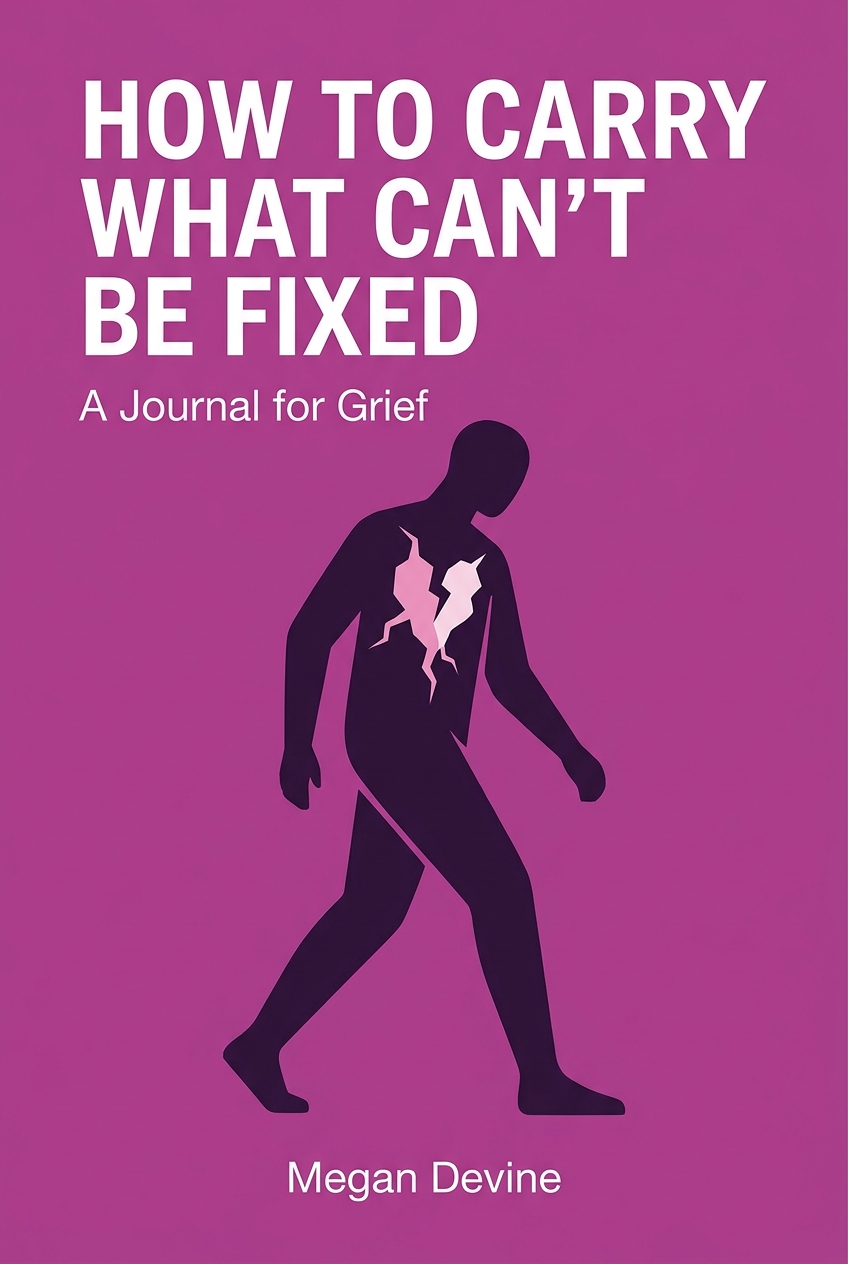
How to Carry What Can't Be Fixed
A Journal for Grief
What's it about
Tired of being told to "move on" from your grief? What if, instead of trying to fix your pain, you could learn to carry it? This journal offers a new path forward, one that honors your loss without letting it consume you. You'll discover practical, gentle exercises to help you navigate the complex emotions of grief on your own terms. Learn how to manage pain, find meaning after loss, and build a life that holds space for both your sorrow and your joy. This isn't about getting over it; it's about learning to live with it.
Meet the author
Megan Devine, LPC, is a psychotherapist, writer, and grief advocate who is considered one of the leading voices in a new, culture-shifting conversation around grief. Her pioneering work is born from personal tragedy: after witnessing the accidental drowning of her partner, she used her clinical background to create a new model for navigating loss. Megan is dedicated to helping people live through the things they never thought they'd have to live through, offering a more compassionate, validating approach to the pain of grief.
The Script
A master kintsugi artist is commissioned to repair two identical porcelain bowls. Both were shattered in the same fall, from the same height. The first bowl is brought to him with every shard, every sliver of glaze, every grain of porcelain dust, all carefully swept into a silk-lined box. The second bowl arrives as a collection of the largest, most recognizable pieces, with all the tiny, sharp, inconvenient fragments having been discarded. For the first bowl, the artist’s work is slow, painstaking, but clear. He can see the whole, even in its brokenness. He can trace the lines of fracture, honor the damage, and use his lacquer and gold to create a new, beautiful, and complete object. The bowl is now different, but it is whole.
But the second bowl presents a profound challenge. With so many pieces missing, there is no way to truly reassemble it. The gaps are too wide, the original form lost. The artist cannot 'fix' it. Instead, he must do something else entirely. He must find a way to honor the pieces that remain, to support their jagged edges, and to create something that can hold space, even if it can no longer hold water. He must carry the brokenness. This is the reality of profound loss. We are told to gather the big pieces—to 'move on,' to 'find closure'—while being encouraged to sweep away the millions of tiny, sharp fragments of our daily reality. We are handed a cultural repair kit that doesn't work because it denies the very nature of our shattering. What do we do when we realize our grief is a reality to be carried?
This question became the life's work of Megan Devine, a psychotherapist, after a sudden, devastating loss of her own. In 2009, she watched her partner, Matt, drown in a freak accident. In the aftermath, armed with her professional training, she found that the standard models of grief were not only unhelpful, they were insulting. They treated her experience like the second bowl, demanding she discard the parts that made others uncomfortable. She realized that our culture's entire approach to grief is flawed. Her book is a testament to lived experience. It grew from her own unbearable experience, her clinical work with other grieving people, and the radical conclusion that some things in life cannot be fixed, but they can be carried.
Module 1: Redefining the Rules of Grief
Our society treats grief like an illness. A temporary condition with a clear recovery path. Get well soon. Move on. But Devine argues this is a fundamental misunderstanding. This module offers a new framework. It’s about surviving, not solving.
First, grief is an experience to be carried. This idea is the foundation of the entire book. It directly challenges the self-help narrative that pushes for healing and closure. Devine rejects the pass/fail test for the human heart. You don't have to choose between being "stuck" in sadness or "moving on" to happiness. There is a middle way. It is the path of living alongside your loss, integrating it into your life instead of trying to surgically remove it. This is about acknowledging a new, permanent reality.
Now, if grief isn't a problem, what is it? Devine explains that grief is a full-body experience that depletes your physical and mental energy. It's not just sadness. It's insomnia, confusion, memory loss, and a deep, physical exhaustion. The author introduces a powerful metaphor. Imagine you have one hundred units of brainpower on a normal day. When you're grieving, sadness and trauma consume ninety-nine of those units. You're left with just one unit for everything else. This explains why you might forget your keys or struggle to concentrate. It's a physiological response. Devine calls this state the "Daily Fog," a kind of awake sleep cycle where your mind goes offline to try and process the unthinkable.
Given this reality, how do you function? The author suggests you must create new, personal rules for survival. The old rules of productivity and social expectation no longer apply. In the early stages of grief, survival is the only goal. Devine shares her own list. Drink water. Eat something, anything. Get outside. Shower. Safety first—if you start crying while driving, pull over. These are small, compassionate acts. The book encourages you to create your own list. What nourishes you? What feels like the absolute minimum you can do today? A "win" is no longer closing a deal. A win is brushing your teeth.
And here's the thing. You don't have to do it gracefully. You don't have to accept it. In fact, refusing to accept the loss is a valid and necessary part of grief. The word "acceptance" is often held up as the final stage, the goal. Devine says, "Survive it, yes. Accept it, no." There must be space to rage against what has happened. The book provides exercises for this, like filling a page with the word "NO" over and over. It's a way to honor the part of you that is screaming that this is not okay. Because it isn't. Rushing to find a silver lining denies the sheer, overwhelming reality of the pain.