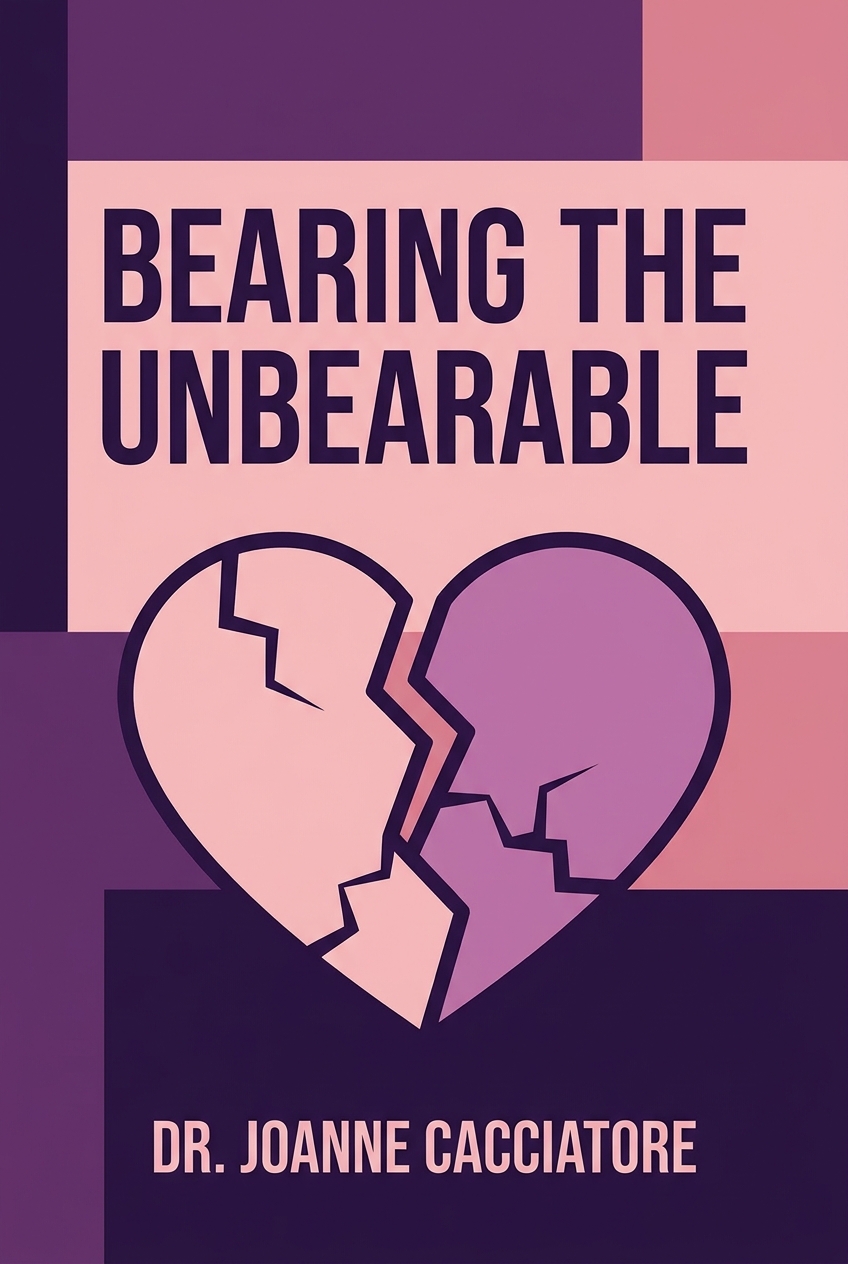
Bearing the Unbearable
Love, Loss, and the Heartbreaking Path of Grief
What's it about
How do you navigate the overwhelming pain of grief when it feels like no one understands? This book offers a compassionate guide for when you're lost in sorrow, showing you that your grief is not a problem to be solved, but a natural, sacred response to profound loss. Discover how to honor your pain without letting it consume you. You'll learn why common advice often fails and find gentle, practical ways to sit with your suffering, cultivate self-compassion, and find a way to carry your love and your loss forward, not just "get over" it.
Meet the author
Dr. Joanne Cacciatore is a globally recognized expert on traumatic grief, a bereaved mother herself, and the pioneering founder of the MISS Foundation. This profound personal and professional experience led her to establish the Selah Carefarm, a unique sanctuary where grieving families live and work alongside rescued animals. Her work, deeply rooted in both scientific research and lived reality, offers a compassionate guide for navigating the most heartbreaking losses and finding a way to bear the unbearable.
Opens the App Store to download Voxbrief

The Script
A master ceramicist stands before two lumps of clay, spun from the same earth, mixed with the same water, weighed to the same gram. He centers the first on his wheel, and with practiced, gentle pressure, raises a perfect cylinder. The walls are even, the lip is clean, the form is flawless. He sets it aside to dry. He centers the second lump. As his hands work, a tremor runs through the clay. An air bubble, hidden deep within, causes the wall to bulge and then collapse. The form slumps, beautiful but broken. One is destined for the gallery, the other for the reclaim bucket. For the ceramicist, this is a simple matter of material integrity. One is useful, the other is not.
But what if the objects were not clay pots, but human lives? What if two people experience an identical, shattering loss? One seems to navigate the aftermath with a semblance of grace, their life still holding a recognizable shape. The other collapses, their world folding in on itself, the form of their life broken beyond recognition. Our culture often treats this second person like the flawed pot—something to be fixed, reclaimed, or quietly discarded. We offer solutions and timelines, treating their grief as a problem to be solved rather than a sacred process to be honored. This profound misunderstanding of grief—and the isolation it creates—is what drove Dr. Joanne Cacciatore to write this book. A researcher, therapist, and Zen priest, her work is born from decades of sitting with the shattered, bearing witness to those whose lives have collapsed under the weight of unbearable loss, particularly the death of a child. She saw that our society lacked a language for this kind of pain and set out to create a space where the broken form is a holy ground.
Module 1: The Great Misunderstanding of Grief
We live in a culture that has declared war on sadness. From the moment of loss, we’re bombarded with messages to "look on the bright side" or "be strong." Dr. Cacciatore argues this is a profound and harmful misunderstanding. Grief is a natural, human response to love. To deny grief is to deny the love that created it.
The book’s central thesis is that grief and love are two sides of the same coin. As Dr. Cacciatore states, "When we love deeply, we mourn deeply; extraordinary grief is an expression of extraordinary love." This reframes grief entirely. It moves from being a sign of weakness or mental illness to being a testament to a powerful connection. For example, a mother named Maureen understood her intense pain after her own mother's death as a direct declaration of her love. Her grief was the physical and emotional space that love now occupied.
This brings us to a critical insight. Our culture pathologizes grief, causing isolation and harm. Instead of offering compassion, society often pressures the bereaved to suppress their feelings. This turns a natural process into a source of shame. A mother named Mona, who lost her son Ben, grew weary of people telling her to have another baby or that "everything happens for a reason." These platitudes violated her grief and made her feel utterly alone. When these social pressures fail, our system often medicalizes the pain, diagnosing it as depression or PTSD. A grieving mother who lost her family in a fire was repeatedly told she was mentally ill for having normal reactions to an unthinkable tragedy. The author’s point is sharp: if grief is a disease, then love must be a disease too.
So what's the alternative? The book suggests a radical shift. Healing requires "being with" grief, not bypassing it. This means creating an emotional home for our pain, allowing it to exist without judgment. It’s about moving with the agony, not trying to go around it. This is a courageous act. It means turning toward the pain when every instinct tells you to run. For example, a father named Jim, who lost his son to suicide, initially avoided all reminders of his son. He withdrew from friends and removed photos. His grief came out "sideways" as rage and insomnia. His healing only began when he learned to pause and sit with his feelings through meditation and journaling. He learned to "be with" the pain, and in doing so, he began to integrate it.
Module 2: The Experience of Traumatic Grief
Not all grief is the same. The book gives special attention to traumatic grief, the kind that follows a sudden, violent, or "out-of-order" death, like the death of a child. This kind of loss shatters our sense of safety in the world. It’s a full-body "NO!" to reality. Understanding its unique landscape is crucial.
The first stage is often a kind of psychic protection. The initial shock of traumatic loss creates a state of emotional anesthesia. The mind shields itself from the full horror of the event. One mother, told bluntly by a doctor that her son had died, reported that she "left my body." She didn't cry for months. She existed in a fog, as if watching a movie of her own life. This numbing is a survival mechanism, a necessary buffer against an unbearable reality.
But as the shock wears off, something else emerges. The pain that follows is profound, complex, and demands to be felt. Dr. Cacciatore describes it as an agony rising from the "innermost pit of our bellies." It's accompanied by a host of unfamiliar and distressing feelings: deep despair, agitation, and anhedonia, which is the inability to feel pleasure. Bereaved parents often report a persistent, physical yearning for their child. This is the love for them with nowhere to go. It’s a sign that the love is still very much alive.
And it doesn't stop there. Grief manifests across our entire being: emotionally, physically, and socially. Cognitively, it can be hard to concentrate. Physically, it can cause changes in appetite, sleep, and even chest pain. Socially, it can strain relationships. Friends and family, made uncomfortable by the raw reality of death, may pull away or offer unhelpful advice. The author makes a powerful distinction. She contrasts the "darkness" of grief with the "coldness" of others' dismissive comments. She argues this social coldness—the invalidation and isolation—is often more damaging than the grief itself. It’s what can truly unhinge a person.