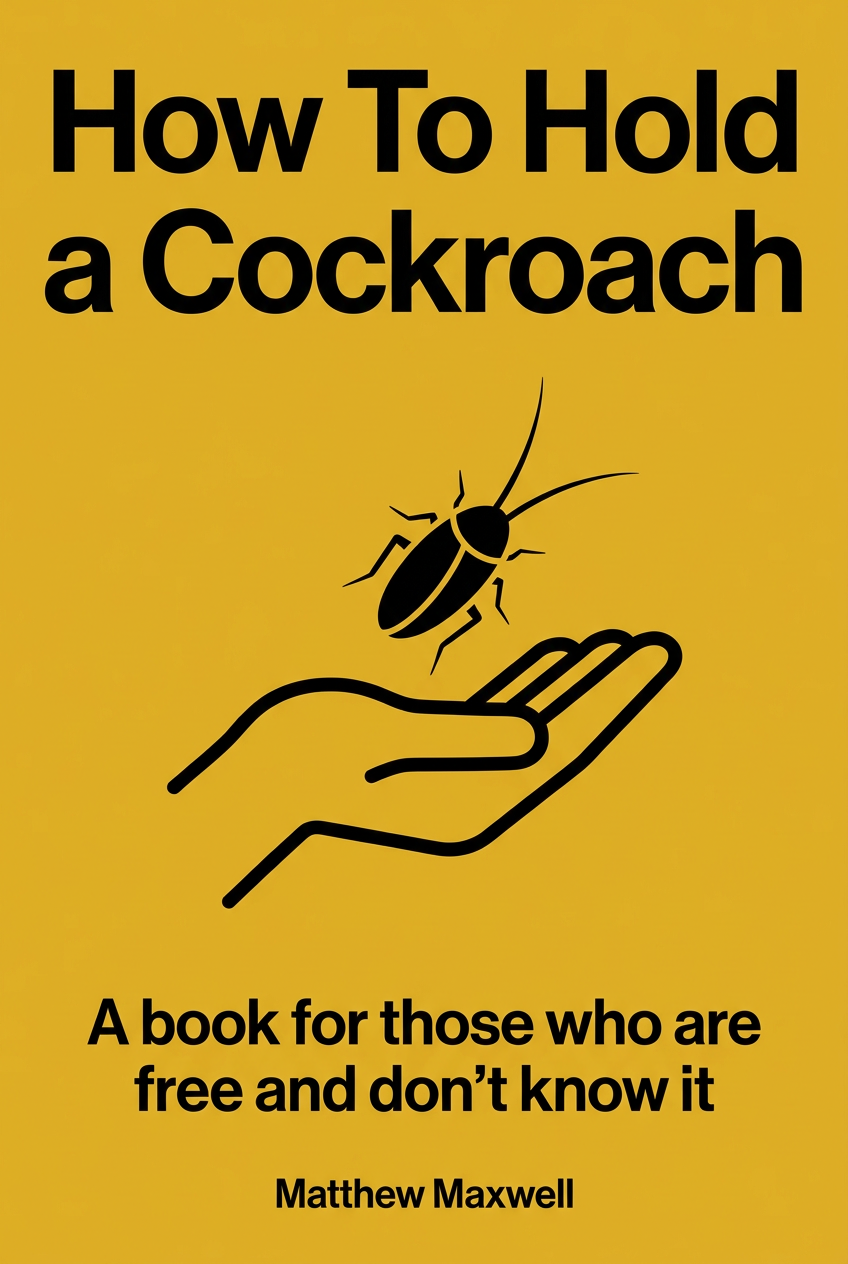
How To Hold a Cockroach
A book for those who are free and don't know it
What's it about
Are you truly living, or just going through the motions? This book summary is your wake-up call, a guide to breaking free from the invisible cages of fear, routine, and self-doubt that hold you back from the adventurous, authentic life you were meant to live. Discover how to confront your deepest anxieties—your "cockroaches"—and transform them into sources of strength. You'll learn practical, unconventional strategies to reclaim your innate freedom, embrace discomfort, and finally start living with the unshakeable confidence of someone who knows they are already free.
Meet the author
Matthew Maxwell is a renowned behavioral psychologist and resilience expert who has helped thousands of individuals overcome profound phobias and self-limiting beliefs through his clinical practice. His groundbreaking work is rooted in his own decade-long struggle with debilitating anxiety, a journey that led him to develop the radical acceptance techniques he now shares. Maxwell's methods teach that true freedom isn't the absence of fear, but the courage to face it, a principle he discovered not in a lab, but in his own life.
Opens the App Store to download Voxbrief

The Script
We treat disgust as a moral failing—a primitive, irrational prejudice to be overcome with logic and willpower. We tell ourselves that the shiver we feel at the sight of a cockroach, the revulsion at a spoiled smell, or the unease from a dissonant sound is a flaw in our character, a weakness to be suppressed. Yet, what if our revulsion is a feature, not a bug? What if that deep, instinctual recoil is actually a highly sophisticated form of intelligence, a biological early-warning system honed over millennia to detect subtle patterns of decay, disease, and structural failure long before our conscious minds can piece together the evidence? We've been taught to override our most ancient and reliable sense, convinced that intellectual analysis is superior to the body's immediate, visceral truth. We try to argue ourselves out of disgust, only to find ourselves walking straight into the very danger our instincts were trying to avoid.
This exact paradox—the wisdom hidden within our most primal revulsions—became the central obsession for Matthew Maxwell. After two decades as an industrial designer, Maxwell grew fascinated by the recurring pattern of catastrophic failures he witnessed in products and systems. He noticed that long before a bridge collapsed or a company went under, there were always subtle, almost perceptible signs of decay—the kinds of 'off' details that people instinctively recoiled from but were trained to ignore in favor of spreadsheets and projections. He began to see that our visceral response to a cockroach is about the environmental breakdown it represents. This realization launched a decade-long investigation, culminating in "How To Hold a Cockroach," a book that teaches us to reclaim our most powerful, and most maligned, form of intelligence.
Module 1: The Origin of Our Stories
The book opens with a simple scene. A boy sees a cockroach on his table. His reaction is immediate and violent. He feels disgust, fear, and a powerful urge to destroy it. This is a deeply felt, gut-level response.
This leads to the first major insight. Our strongest emotional reactions are often learned, not inherent. Maxwell traces the boy's reaction back to a single, formative memory. As a child, he saw his mother shriek in terror at a cockroach. In that moment, a story was born. The story was simple: cockroaches are gross, dangerous, and scary. Over time, this story hardened into what felt like an undeniable fact. His mind then started collecting evidence to support this "fact," reinforcing the belief every time he saw someone else react with disgust.
Now, here's where it gets really interesting. The book presents a parallel chapter. The same boy looks at himself in the mirror and feels a similar wave of negative emotion: shame, self-hatred, and a feeling of being unwanted. Again, Maxwell traces this back to a childhood memory. The boy's mother, in a moment of frustration, yelled "Go away, boy!" This single event created a core belief: "I am bad, unwanted, and unlovable." Just like with the cockroach, his mind began filtering his experiences to confirm this story. Every time someone left a conversation or whispered nearby, it became "proof" of his unworthiness.
The key takeaway here is profound. The mind uses the same mechanism to build stories about the outside world and our inner world. The structure is identical. First, a triggering event. Second, an emotional interpretation that forms a belief. Third, the continuous collection of evidence to prove that belief is true. Whether it's a bug on the table or your own reflection in the mirror, the process is the same. Recognizing this pattern is the first step toward dismantling it. We suffer because we mistake these inherited, reinforced stories for objective reality.
Module 2: The Power of Questioning
So, if we're trapped by these stories, how do we get out? The book proposes a simple but radical intervention: curiosity.
Back to the boy and the cockroach. He’s about to crush it, but he hesitates. A new thought enters his mind. How much does he actually know about cockroaches? He remembers that in some cultures, people handle them with delight. This sparks a moment of genuine curiosity. He looks at the cockroach with fresh eyes, not through the lens of his mother's fear. As he does this, something shifts. His disgust softens into a strange sense of compassion. He even thinks, "Maybe cockroaches aren’t all that different from me."
This is the central pivot of the book. Questioning a deeply held belief defuses its emotional power. The moment the boy stops reacting and starts questioning, the story's grip loosens. He moves from a state of automatic judgment to one of open inquiry.
And it doesn't stop there. He applies the same logic to himself. Remembering his experience with the cockroach, he looks in the mirror again. This time, he asks a question instead of seeing a "bad, unwanted" person: "Who am I, really?" He realizes his self-hatred is based on the story he learned as a child and the "evidence" he collected. By looking at his reflection with curiosity, he feels a flicker of self-compassion for the first time.
This principle extends to all areas of life where we feel pain. The book explores this with love, the past, and the future. When the boy looks at a photo of a lost love, he feels anger and regret. His story is that "love is painful." When he thinks of his past, he feels despair because his story is that "the past is a tragic heap of mistakes." But in each case, the solution is the same. He stops, remembers the cockroach, and asks, "What are you, really?"
This leads to a crucial insight: suffering is caused by our interpretation of events. What he believed about love hurt him. His story about the past depressed him. By injecting curiosity into the equation, he creates space for a new interpretation. This allows him to feel release, forgiveness, and even hope.