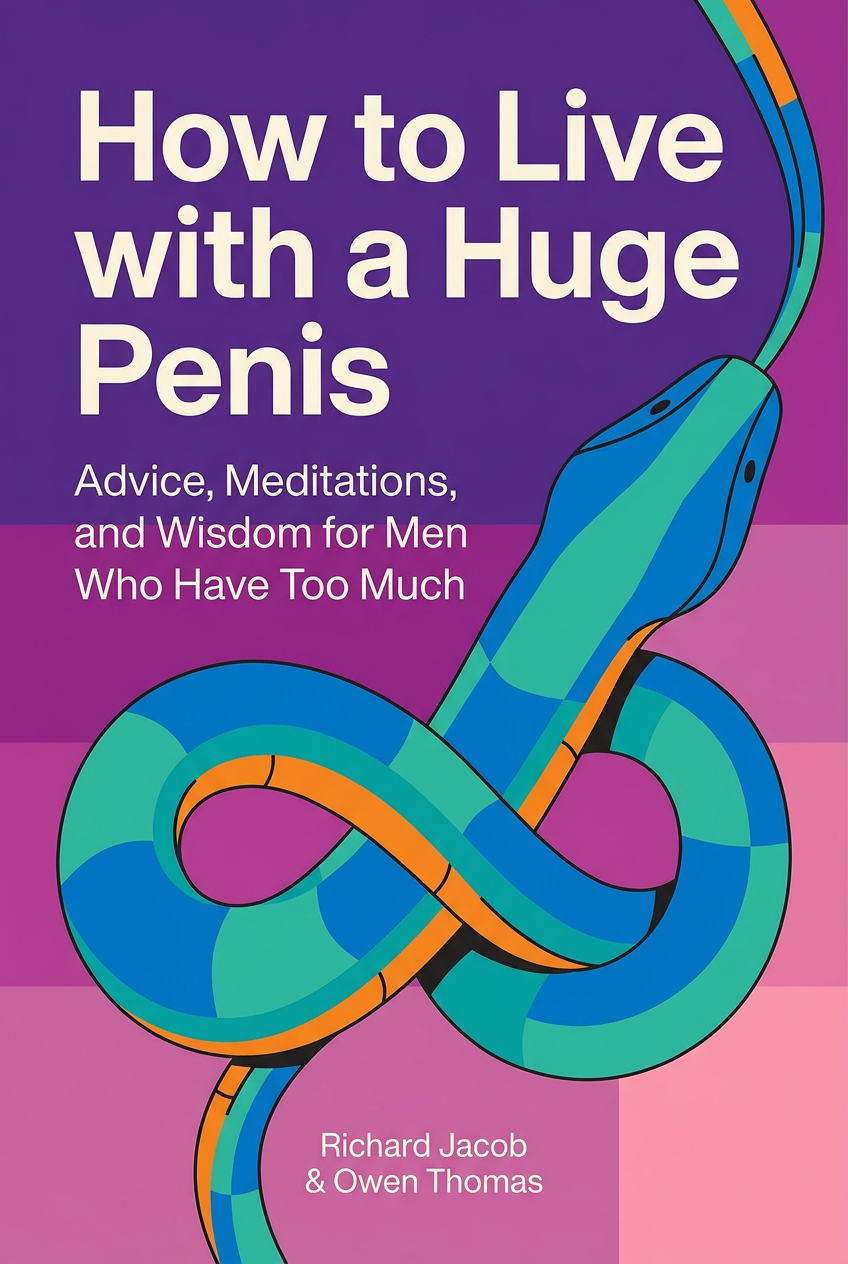
How to Live with a Huge Penis
Advice, Meditations, and Wisdom for Men Who Have Too Much
What's it about
Struggling with the unique challenges of being exceptionally well-endowed? This guide offers real-world advice and tongue-in-cheek wisdom for navigating the social, physical, and emotional burdens that come with having "too much of a good thing." It's your handbook for turning a potential problem into a source of confidence. You'll discover practical tips for everything from dating and relationships to simply finding pants that fit. Learn how to handle unwanted attention, embrace self-acceptance, and find humor in the oversized hand you've been dealt. Stop feeling awkward and start living large, in every sense of the word.
Meet the author
Richard Jacob, M.D., is a respected physician and Owen Thomas is an award-winning journalist whose groundbreaking book has helped countless men navigate a uniquely challenging experience. Their collaboration began after Dr. Jacob observed the profound psychological and physical issues his patients faced, inspiring Thomas to give a voice to their stories. Together, they combined medical expertise with empathetic storytelling to create this essential guide, offering practical advice and heartfelt wisdom for a sensitive and often misunderstood topic.
Opens the App Store to download Voxbrief

The Script
Think of the most celebrated human traits—intelligence, beauty, wealth, talent. We see them as winning tickets in life's lottery, golden keys that unlock every door. Our culture is a vast machine built to admire and pursue these advantages, assuming they are unalloyed blessings. But this assumption misses a crucial, hidden dynamic: every celebrated advantage casts a shadow. For every door it opens, it can quietly lock another. The very quality that elevates a person can also become a source of profound, unspoken alienation, creating a unique set of problems that are invisible to everyone else. It’s a strange paradox where the thing the world envies becomes a private burden, a source of misjudgment and isolation that you can't complain about without sounding ungrateful or absurd. This creates a specific kind of loneliness, the kind that comes from being misunderstood precisely because of the thing that makes you stand out.
This exact paradox of the 'blessed curse' is what caught the attention of Dr. Richard Jacob, a respected psychiatrist, and his friend, the writer Owen Thomas. Through his practice, Dr. Jacob noticed a recurring pattern: patients whose exceptional qualities—be it immense success or physical attributes—were the unacknowledged source of their deepest anxieties. They felt trapped by the very thing others admired. Thomas, a keen observer of life's absurdities, saw the same theme playing out in social dynamics everywhere. They realized there was no guide for navigating this strange territory. So, they chose the most outrageously literal example of such a 'problem' to write a genuinely helpful, humorous, and deeply empathetic book. It began as a joke between friends but quickly evolved into a serious, if satirical, exploration of navigating any perceived advantage that secretly makes life more complicated.
Module 1: Framing Difference as a Medical Condition
The book's first move is to establish its central joke with absolute seriousness. It presents Oversized Male Genitalia, or OMG, as a debilitating medical condition. This reframing is the foundation for the entire satire.
The authors define OMG as a "genetic birth defect" affecting an estimated one million American men. They describe it as having no adverse physical effects but causing "serious psychological problems." This immediately subverts the common cultural narrative. It sets up a world where a trait often associated with pride becomes a source of profound shame and suffering. The book claims the suicide rate among OMG sufferers is 30 times the national average. This shocking, albeit fictional, statistic forces the reader to confront the psychological weight of stigma, regardless of its source.
From this foundation, the book details how this stigma creates real-world consequences. The authors invent a system of institutional discrimination to satirize how society marginalizes those who are different. They claim four U.S. states legally require men with OMG to register with the police. In this fictional world, an officer in Mississippi can search a man’s underwear during a traffic stop. In Vermont, a man must have his penis photographed at the DMV. These absurd scenarios mirror real-world prejudices. They show how easily fear and misunderstanding can be codified into humiliating and dehumanizing rules.
So what's the next step? The book argues that the path forward is through community. Brotherhood and self-acceptance are presented as the primary tools for coping. The narrative introduces the book's authors, Dr. Richard Jacob and Reverend Owen Thomas, as guides. Dr. Jacob shares a personal story of despair, transformed by Reverend Owen’s spiritual counsel. The Reverend’s advice is blunt: "God’s kicking your ass ‘cuz he thinks you’re man enough to take it." This reframes the condition from a curse into a challenge that forges exceptional character. The book itself, a collaborative FAQ, models this supportive dialogue. It aims to build a sense of community among sufferers, proving that shared vulnerability is a source of strength.
Module 2: The Burden of History and the Quest for Normalcy
Now, let's explore how the book uses history to deepen its satire. It retroactively diagnoses famous historical figures with OMG, using their achievements and struggles as "evidence." This technique is both hilarious and surprisingly effective at illustrating the book's core themes.
The authors propose that many of history's great minds were secretly burdened by this condition. For instance, they suggest Albert Einstein’s theory of relativity was born from his lamentations over his own anatomy. Benjamin Franklin’s many inventions were supposedly practical solutions to OMG-related problems. This recasting of history serves a powerful purpose. It normalizes the "condition" by associating it with genius and success. The book reinterprets historical greatness as a direct response to personal suffering and alienation.
This historical tour continues with figures like Napoleon Bonaparte. The "Napoleonic complex" is cheekily redefined. His ambition was driven by the discovery of his huge penis by his generals. Abraham Lincoln’s famous melancholy is linked to the stress of his condition. Even his assassination is re-contextualized with a fabricated quote about his "strange penis." In each case, a well-known historical fact is twisted to fit the OMG narrative. This reinforces the idea that what we see on the surface often hides a deeper, more personal struggle.
But flip the coin. This historical revisionism also highlights the absurdity of pathologizing every human difference. The book includes a diagnostic questionnaire to determine if one has OMG. The questions are ridiculous. "Have you ever pinched your penis under a toilet seat?" "Can you touch your spine with the tip of your penis?" A "yes" to four or more questions suggests a diagnosis. This mocks the clinical tendency to categorize and label complex human experiences.
And it doesn't stop there. The authors turn to the animal kingdom to make another point. They argue that what is considered "freakish" in humans is common in nature, challenging the very idea of a universal "normal." The book details the massive genitalia of whales, elephants, and the Argentine Blue-Billed Duck. It even notes the barnacle, which has the greatest penis-to-body-size ratio in the world. By placing the human "sufferer" in a broader biological context, the book dismantles the shame associated with being an outlier. It subtly asks: if nature is this diverse, why are our social standards so narrow?
Module 3: A Practical Guide to Social Survival
We've covered the condition and its history. Next up: how to actually live with it. This is where the book provides absurdly specific "practical" advice for navigating a world that doesn't understand.
The authors first tackle the issue of teasing. Their advice is surprisingly sound, despite the comedic context. When faced with ridicule, you should stand your ground and educate. One story tells of "Eric G.," who was teased at a fan convention and fled in shame, leading to years of isolation. The book’s advice is to question the teaser’s premise. Why is having a larger body part a bad thing? It suggests that if the teasing continues, those people aren't worth keeping as friends. This is a simple but powerful lesson in setting boundaries and choosing your community wisely.
Building on that idea, the book addresses morbid curiosity from others. It offers two paths: intimidation or education. Reverend Owen, the more aggressive guide, advocates for confrontation to deter gawking. Dr. Richard, in contrast, recommends a calm, informative approach. He suggests explaining OMG as a medical condition to reduce fear. This duality acknowledges that there isn't one right way to handle prejudice. The best response depends on the situation and your own personality.
So here's what that means for more serious situations. The book explores scenarios of outright exclusion and fear. In one example, a man is arrested during a college nude run because his penis makes others uncomfortable. In another, a man’s date pepper-sprays him out of sheer shock. The consistent advice is proactive communication. To avoid panic and misunderstanding, you must disclose your condition early and thoughtfully. The element of surprise is your enemy. By warning others beforehand, you give them time to process and react with reason instead of fear. This is a powerful metaphor for any difficult conversation, whether in personal relationships or professional settings. You manage expectations to control the outcome.