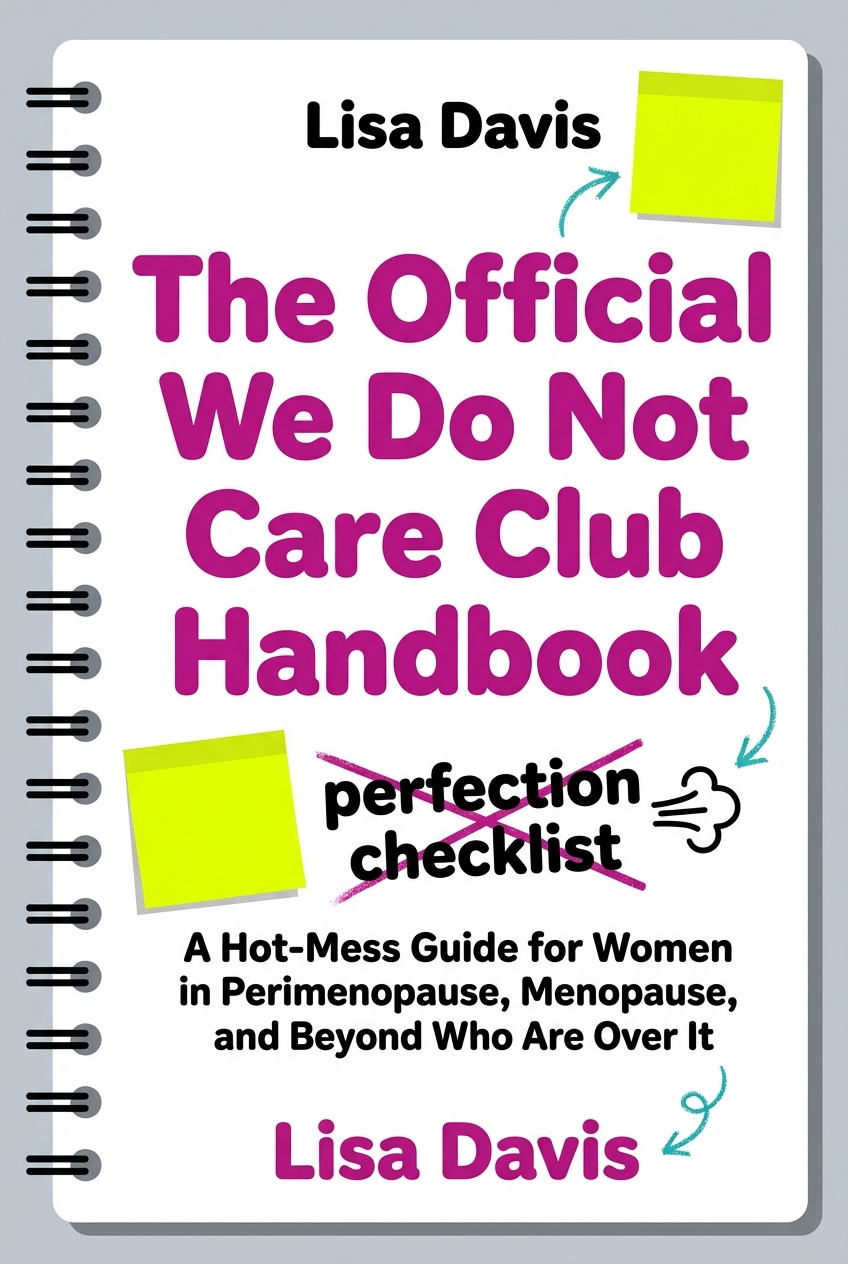
The Official We Do Not Care Club Handbook
A Hot-Mess Guide for Women in Perimenopause, Menopause, and Beyond Who Are Over It
What's it about
Tired of feeling like a hot mess while navigating menopause? What if you could trade the confusion and frustration for a permission slip to finally stop caring about the wrong things? This guide offers a refreshing, no-nonsense approach to reclaiming your sanity, confidence, and sense of humor. Learn how to embrace the chaos with practical tips and hilarious, real-world advice. Discover how to manage your symptoms without losing your mind, set boundaries that actually stick, and join a community of women who are totally over it, just like you. It's time to find joy in the journey and start living your best, most unapologetic life.
Meet the author
Lisa Davis is an award-winning health journalist and certified menopause coach who has spent over two decades empowering women to navigate their well-being with evidence-based candor. After her own frustrating journey through perimenopause left her feeling isolated and dismissed, she dedicated her work to creating the frank, funny, and supportive resource she wished she’d had. Her mission is to help women reclaim their power and find humor and community during this often-challenging life stage.
Opens the App Store to download Voxbrief

The Script
We are told that empathy is a superpower. The ability to feel what others feel, to connect with their struggles, is presented as the highest form of emotional intelligence. But what if our capacity for empathy is actually a limited resource, like a battery that drains with every news alert, social media outrage, and colleague’s minor crisis? We try to recharge it with self-care routines and mindfulness apps, yet we still feel depleted, spread thin by a thousand well-meaning obligations. The relentless demand to feel deeply about everything, all the time, doesn't make us more connected; it makes us brittle. This constant, low-grade emotional expenditure is the silent burnout that no one talks about, leaving us with nothing left for the people and goals that truly matter.
The real art is learning to care less, with strategic precision. This realization didn't come from a productivity seminar or a spiritual retreat, but from the front lines of high-stakes corporate consulting. Lisa Davis, a behavioral strategist who spent fifteen years advising Fortune 500 executives on burnout prevention, noticed a pattern: the most resilient and effective leaders were the most selective, not the most empathetic. They had an almost instinctual ability to triage their attention and emotional energy. Davis began documenting these tactics for herself and her overwhelmed peers, forming the basis of what she called the 'We Do Not Care Club'—a set of principles for reclaiming your focus by consciously choosing indifference.
Module 1: The New Reality of Menopause
Menopause isn't what it used to be. For previous generations, it was often a quiet, private event that signaled the end of a woman's active life. Today, that script has been completely rewritten. The first major shift is understanding that menopause is a gradual, multi-year transition. This process, called perimenopause, can begin in your late 30s or 40s. It starts with subtle hormonal shifts long before your periods actually stop. Your ovaries begin producing estrogen less consistently. In response, your body releases more follicle-stimulating hormone, or FSH, trying to jump-start the process. A high FSH level is a key biological sign that the transition is underway.
This leads to a crucial realization for modern women. Your experience of menopause will be fundamentally different from your mother's or grandmother's. The baby boomer generation was the largest cohort of women to go through menopause simultaneously, turning it from a private struggle into a major public health conversation. The archetype of a menopausal woman is no longer a retired grandmother. She is often a working professional, perhaps still raising children while also caring for aging parents. The old advice to simply "lie down until it's over" is completely out of touch with modern reality.
So what does this mean for you? It means you must become the CEO of your own health journey. You can't rely on outdated advice or assume your experience will mirror your family's history. Factors like smoking, body weight, and whether you've had children can all influence when perimenopause begins. For instance, being thin or a smoker may lead to an earlier onset, while having children later in life might delay it. The key is to recognize the common signs. These include hot flashes, night sweats, insomnia, mood swings, and trouble concentrating. If you're experiencing several of these, especially with changes in your menstrual cycle, it's time to partner with a doctor. Key diagnostic tools include an FSH test and an estradiol level check. Finding a physician who takes these symptoms seriously is non-negotiable.
Module 2: The Constellation of Symptoms
Now let's move to the symptoms themselves. One of the most confusing aspects of perimenopause is how the symptoms can feel so disconnected. You might have trouble sleeping one month, joint aches the next, and then sudden headaches. It’s easy to feel like you're just falling apart. The author's core insight here is that perimenopause manifests as a constellation of interconnected symptoms. Like stars that form a pattern only when you step back, symptoms like insomnia, itchy skin, mood swings, and memory loss are all linked to the same root cause: hormonal fluctuation. For example, night sweats lead to poor sleep. Poor sleep contributes to brain fog and irritability. Seeing the pattern is the first step toward effective management.
This is why Hormone Replacement Therapy, or HRT, is often presented as a broad-spectrum treatment. HRT can act as an "umbrella" treatment that addresses the root hormonal deficiency. By replenishing estrogen and progesterone, HRT can simultaneously alleviate a wide range of issues, from hot flashes and vaginal dryness to joint pain and memory lapses. It simplifies treatment by targeting the underlying cause. However, it's not a magic bullet. HRT is a complex decision with its own set of risks and benefits that require careful, personalized consideration with your doctor. It's a powerful tool, but not the only one.
And here's the thing. Effective symptom management combines medical options with proactive lifestyle changes. You have more control than you think. For instance, studies show that regular aerobic exercise can cut the frequency of hot flashes in half for sedentary women. Relaxation techniques like yoga and meditation can work wonders for insomnia and mood swings. For specific issues, there are targeted non-hormonal solutions. Kegel exercises, which strengthen the pelvic floor muscles, are highly effective for urinary incontinence. For vaginal dryness, over-the-counter lubricants or local estrogen treatments like a cream or vaginal ring can provide relief without requiring systemic hormones. The point is to build a toolkit of strategies, both medical and behavioral, to find what works for you.