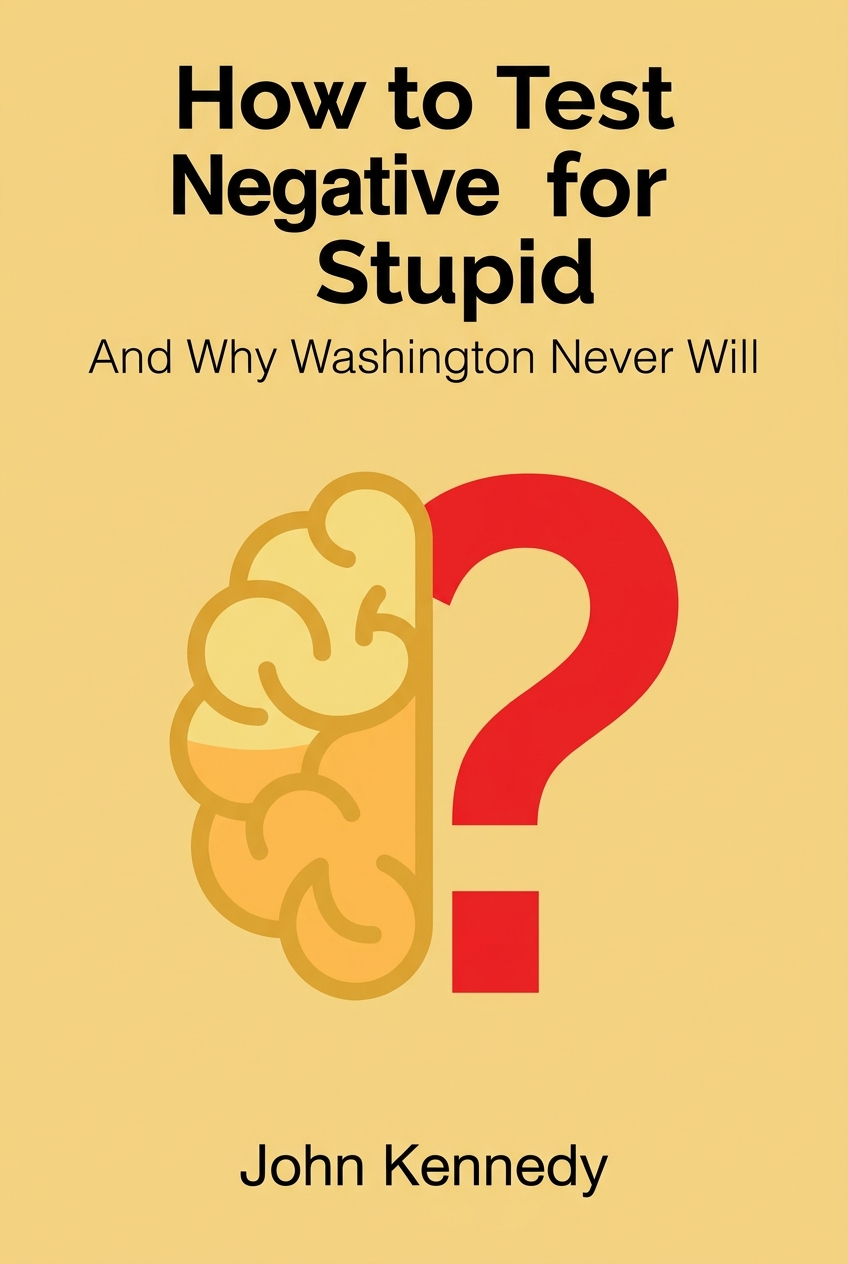
How to Test Negative for Stupid
And Why Washington Never Will
What's it about
Tired of feeling like you're surrounded by nonsense? Learn how to cut through the noise and make smarter decisions with a dose of common sense from Senator John Kennedy. This isn't just another political rant; it's your guide to thinking clearly in a world gone mad. Discover Kennedy's sharp-witted rules for spotting foolishness in business, media, and your own life. You'll gain practical tools to argue more persuasively, identify flawed logic, and understand why, despite our best efforts, the powerful so often get it wrong. Stop getting frustrated and start getting smarter.
Meet the author
As a United States Senator representing Louisiana, John Kennedy has spent years on the front lines of American politics, witnessing firsthand the decision-making that shapes the nation. This unique vantage point, combined with his sharp wit and no-nonsense approach, provides the foundation for his incisive critique of Washington's bureaucratic follies. His book is born from a genuine desire to empower everyday citizens with the common sense and critical thinking that often seems absent inside the Beltway.
The Script
Our minds are built for a world that no longer exists. For millennia, the ability to quickly sort information into 'good' or 'bad'—friend or foe, edible or poisonous—was a life-or-death skill. This rapid-fire judgment system, honed by scarcity and immediate danger, served us well. But in our modern world of overwhelming information and complex, long-term problems, this same instinct has become a liability. We're now armed with a stone-age brain navigating a digital age, and the result is a constant, low-grade state of intellectual malpractice. We mistake familiarity for accuracy, confidently defend opinions we can't explain, and follow mental shortcuts that lead us directly off a cliff. This is a sign that our brain’s ancient, life-saving hardware is now causing the very errors we’re trying to avoid.
The most dangerous part is that this faulty process feels right. It feels like clear thinking. The person who first quantified this mismatch was a trial lawyer who saw it play out in real-world, high-stakes situations. For over twenty years, John Kennedy watched brilliant people—judges, expert witnesses, and seasoned attorneys—make catastrophically stupid decisions under pressure. He noticed their failures were due to a series of predictable cognitive glitches. Kennedy began cataloging these mental traps, first to win his cases, and later to create a system for anyone to spot and sidestep the universal patterns of poor judgment. This book is the result of that decades-long courtroom observation, a field guide to the blind spots that make smart people act stupidly.
Module 1: The Insider's View of Washington's Oddities
Washington, D.C. often projects an image of grandeur and power. But the day-to-day reality is frequently less glamorous and far more peculiar. Kennedy pulls back the curtain on the strange mechanics of the U.S. Senate. He reveals a world governed by archaic rules and performative rituals that can feel completely disconnected from the urgent problems they are meant to solve.
First, the Senate floor is often a stage for an audience of zero. When you see a senator giving a passionate speech on C-SPAN, the chamber is usually almost empty. The only people present are typically the speaker, the presiding officer, and a few staffers. These speeches are recorded for video clips. These clips are then sent to home-state media as proof of influence. It’s a form of political theater designed for an external audience, not for internal deliberation.
Then there's the issue of the rules themselves. The Senate's procedures are bewilderingly complex and often hinder real debate. Kennedy describes the rulebook as reading like it was "put together by a heroin addict with a socket wrench." For instance, even on a final vote for a major bill, debate can be limited by "time agreements." These agreements might only allow a few senators to speak for a minute or two each. This structure stifles the kind of deep, deliberative discussion the public imagines. It's a system that prioritizes procedure over substance.
And here's the thing. Individual senators hold immense power to grind the entire legislative process to a halt. A single senator can object to a bill and hold it up indefinitely. This is a double-edged sword. It can be used to block bad policy. But it also means that passing good legislation is intentionally difficult. To even bring a bill to the floor for a vote, a senator often needs approval from their committee chair, the ranking member, and the majority leader. If any one of them says no, the bill can die quietly without ever seeing the light of day. It’s a system that concentrates enormous power in the hands of a few leaders.
Despite all this, Kennedy notes that collegiality and humor are essential survival tools. The high-pressure environment is thick with tension. To manage it, senators often rely on personal rapport and jokes. Weekly party lunches can become informal places to ease friction. Kennedy shares stories of teasing colleagues or sharing Louisiana food to build bridges. This humor is a necessary mechanism to maintain working relationships when policy disagreements become intense. It allows opponents on one issue to become partners on the next.