All Books
Self-Growth
Business & Career
Health & Wellness
Society & Culture
Money & Finance
Relationships
Science & Tech
Fiction
Topics
Blog
Download on the App Store

How To

Absurd Scientific Advice for Common Real-World Problems

11 minRandall Munroe

What's it about

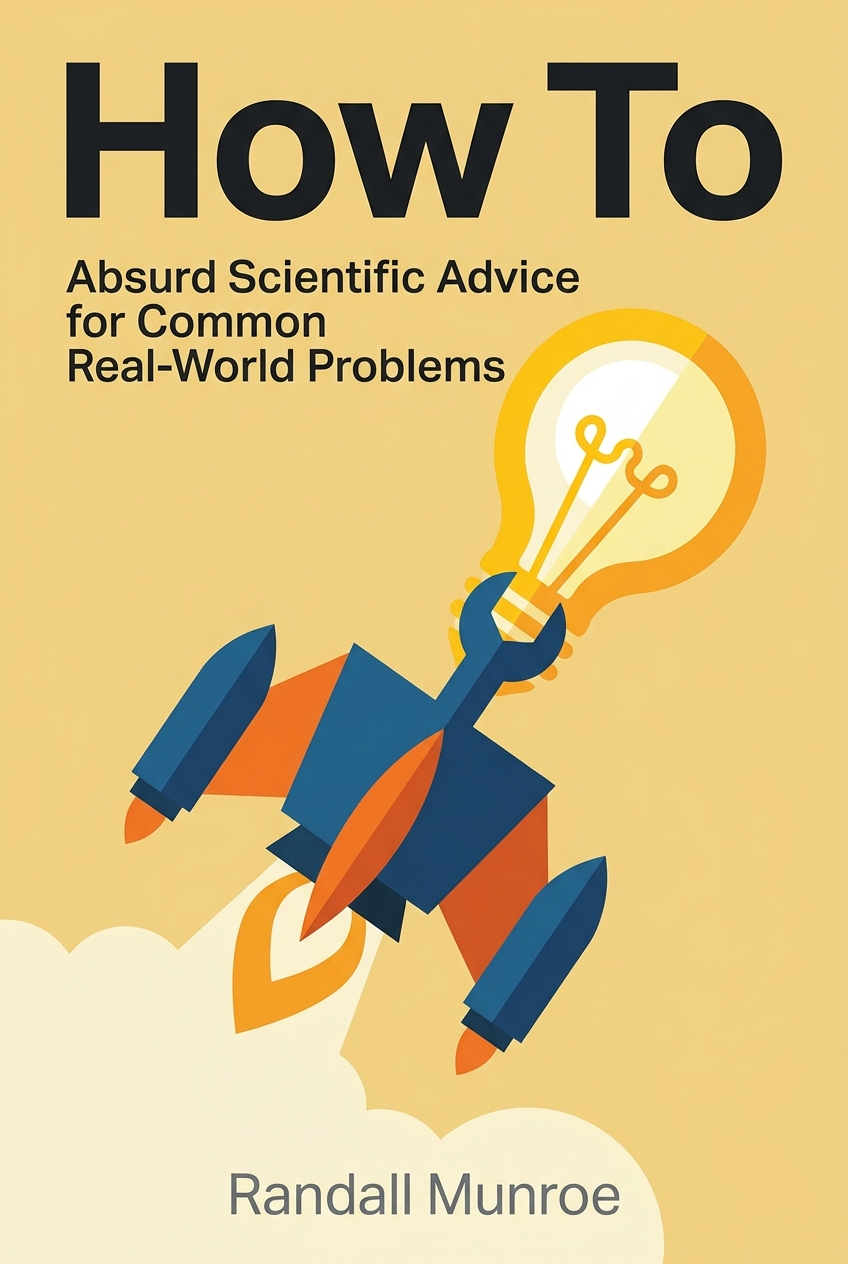
Ever wondered if there's a wildly impractical, yet scientifically sound, way to solve your daily problems? Discover how to apply the principles of physics, chemistry, and engineering to everyday tasks, turning the mundane into an epic, and often hilarious, scientific adventure. You'll learn the absurdly complex methods for everything from crossing a river to powering your home. Munroe, the mind behind xkcd, breaks down the extreme science behind taking a selfie, making friends, and even disposing of this book, all with his signature wit and elaborate illustrations.

Meet the author

Randall Munroe is the creator of the wildly popular webcomic xkcd and a former NASA roboticist who built and programmed robots at Langley Research Center. This unique background combining scientific rigor with playful, imaginative problem-solving inspired him to explore absurdly complex solutions for simple tasks. Through his work, Munroe has become a beloved voice for millions, using humor and meticulous research to make science accessible, engaging, and hilariously impractical for everyday life.
Listen Now

Opens the App Store to download Voxbrief

How To book cover

The Script

The most effective path between two points is rarely a straight line. Often, it involves a submarine, a thermal lance, or calculating the orbital mechanics of a thrown object. Our minds are trained for efficiency, to find the quickest, most sensible solution to any given problem. We want to cross a river, so we look for a bridge. We need to power a house, so we connect to the grid. This instinct for the practical is what built civilization. But what if the goal wasn't just to solve the problem, but to truly understand it? What if, instead of finding the simplest solution, we sought out the most gloriously impractical one? This approach doesn't just get you an answer; it forces you to see the hidden physics and unspoken rules governing the world around you. It reveals that the most 'correct' solution is often the most boring, and that true insight lies on the scenic route, the one that might involve vaporizing a mountain or harnessing the power of a tectonic plate.

This exact impulse—to solve simple problems with absurdly complex science—is the lifeblood of Randall Munroe’s work. As the creator of the beloved webcomic xkcd, Munroe has spent years answering his audience’s strangest hypothetical questions, from what would happen if you tried to hit a baseball pitched at 90 percent the speed of light to how many LEGO bricks it would take to build a bridge from London to New York. After receiving a degree in physics and briefly working for NASA, he turned his full attention to this unique brand of scientific exploration. 'How To' was born from this same curiosity, shifting from 'what if?' to the even more ludicrous 'how to,' applying rigorous, peer-reviewed scientific principles to tasks like mailing a package, digging a hole, or making an emergency landing, with hilariously over-engineered and deeply educational results.

Module 1: The Millionaire Mentality

So, what is the foundational element of building wealth? Getty argues it’s a specific mindset. He calls it the "Millionaire Mentality." This is about a deep, personal, and unwavering focus on profitability and cost-consciousness.

The first step is to develop a "profit-minded" perspective in every action. This means you stop thinking like an employee who just collects a paycheck. You start thinking like an owner, even if you aren't one. Getty tells a fantastic story about a superintendent named George Miller. Miller was a good employee, but he was on a fixed salary. He did his job. Nothing more. Getty decided to change his compensation. He switched him from a salary to a percentage of the profits. The transformation was immediate. Miller suddenly saw waste everywhere. He found efficiencies he'd ignored for years. He started treating the company's money like his own. Both he and Getty became much richer as a result. That shift, from a salaried mindset to a profit-sharing mindset, is the core of this principle.

Building on that idea, you must embrace extreme frugality and efficiency as competitive weapons. Getty was famous for his thrift, but he saw it as a strategic advantage, not just penny-pinching. He criticized the corporate bloat he saw everywhere. His own office was often the mud-splattered car he drove between oil fields. He tells the story of an executive who saved his company over $25,000 a year by finding a production shortcut that saved less than half a cent per unit. It's about recognizing that small, consistent savings scale into massive advantages over time. This is especially true for independents and startups trying to compete with giants. Frugality gives you runway. It keeps you lean and agile.

Finally, Getty insists that true business education comes from hands-on experience. He started his career not as an executive, but as a roustabout and tooldresser in the Oklahoma oil fields. He performed manual labor. He got his hands dirty. This wasn't just for show. It gave him an irreplaceable understanding of the business from the ground up. It earned him the respect of his crews. When he faced a supposedly "insoluble" drilling problem in Seal Beach, he didn't call a consultant. He went to his crew. Their on-the-ground perspective led to an innovative solution that the "experts" had missed. You have to get out of the office and see the work being done.

Read More