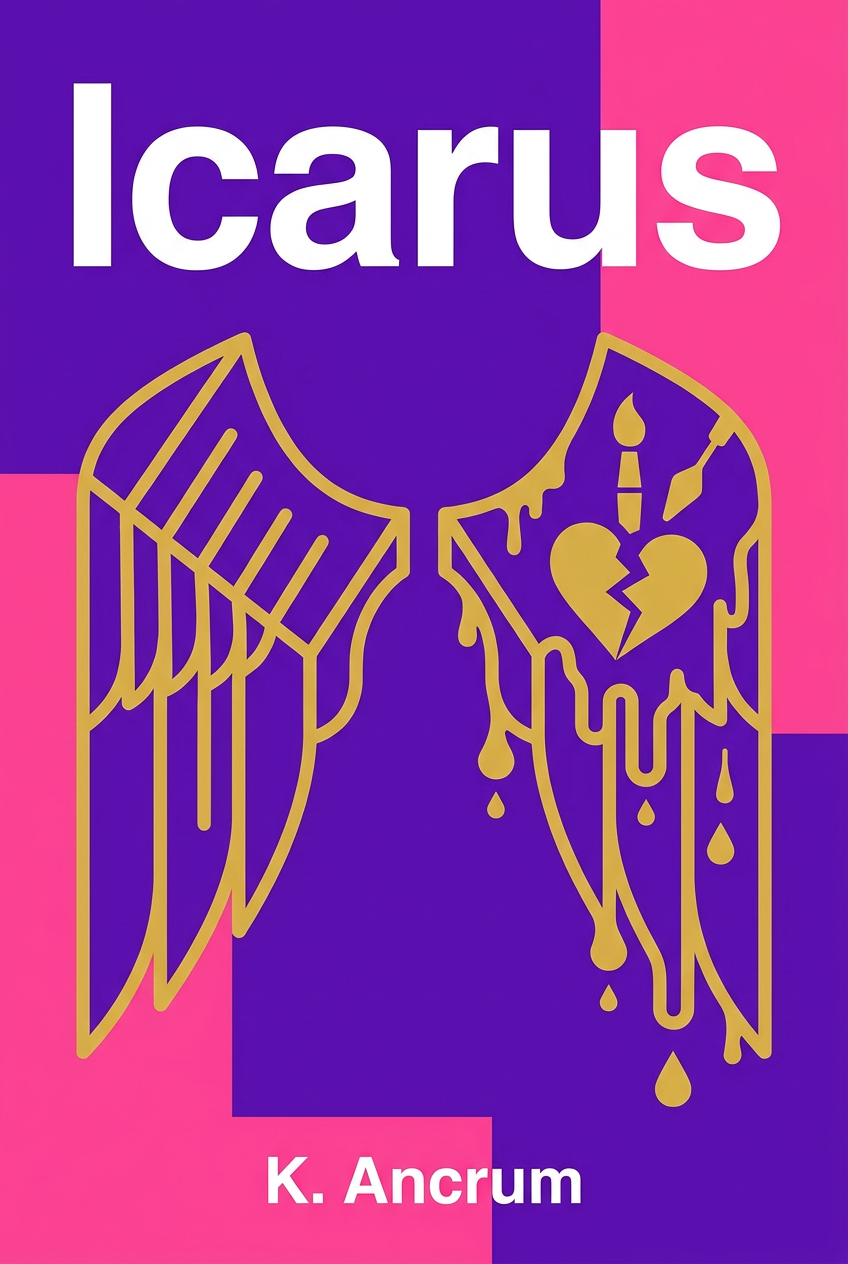
Icarus
A Suspenseful YA Queer Romance about Star-Crossed Lovers and Art Theft
What's it about
Have you ever been so drawn to someone that you'd risk everything, even your own freedom, just to be near them? This story plunges you into a world where love and danger are intertwined, forcing you to question how far you'd go for the person you desire most. You'll discover the story of Icarus, a boy who feels trapped until he meets a mysterious, wealthy stranger. As their intense connection deepens, you'll uncover a hidden world of high-stakes art theft and dangerous secrets. Learn how their star-crossed romance navigates a life of crime, testing the boundaries of trust, loyalty, and what it truly means to be free.
Meet the author
K. Ancrum is a critically acclaimed, award-winning author whose stunning young adult novels, including The Wicker King, are celebrated for their diverse representation and intricate plotting. Drawing on her expertise as a Chicago-based art director and her passion for creating complex queer characters, Ancrum masterfully weaves suspense, romance, and artistic intrigue. Her unique perspective brings a rare authenticity to stories of found family and high-stakes adventure, making her a vital voice in contemporary YA fiction.
Opens the App Store to download Voxbrief

The Script
Think about the last time you bought a gift for someone important. Maybe it was a simple keychain or a rare first-edition book. Now, imagine you have two of these gifts, identical in every way. One you give to a friend who treats it with casual affection, tossing it on a nightstand where it gathers dust among spare change and receipts. The other you give to someone who builds a velvet-lined box for it, polishing it weekly, treating it as a sacred relic. The gifts are the same, but the act of giving—and the meaning imbued by the receiver—transforms them into two entirely different things. One becomes a casual token of friendship, the other, a heavy artifact of devotion, almost a burden.
This is the space where Icarus, the boy in the myth, lives. He isn't just a boy who flew too close to the sun; he's a gift. He's a treasure given by a desperate father to a lonely king, an object to be possessed and guarded. The story we all know is about the fall, the final, dramatic plunge into the sea. But what about the life before that? What is it like to be someone else’s most prized possession, to have your own life's value determined not by who you are, but by what you mean to your keeper? K. Ancrum was captivated by this question, by the quiet, suffocating life of the boy in the tower before the wings were ever built. She wanted to explore the story of the cage—the gilded, loving, and terrifying cage of being owned.
Ancrum, a creator known for her intricate and character-driven young adult thrillers, saw a gap in the myth. The story always focused on Daedalus's genius or Icarus's fatal pride, but it skipped over the humanity of a boy trapped by someone else's love. In her work, she often peels back the layers of familiar stories to find the quiet, intense relationships hidden within. For Icarus, she set out to write the missing part of the legend: the story of a boy who, long before he fell from the sky, was desperate to simply stand on his own two feet on the ground. She wanted to give a voice to the boy who was a person suffocating under the weight of being treasured.
Module 1: The Gilded Cage of Inheritance
The story introduces us to Icarus. He is his father's son in every sense. He shares his father's looks, his artistic talent, and his profession: art thief. Their life is one of business, a workshop. Icarus’s bedroom is a repurposed closet. His nights are spent executing his father's meticulous heists. This world is stable. It's efficient. And it's devastatingly lonely. This brings us to a critical insight. Inheritance is fundamentally about burdens. Icarus inherits not just skills but also a life of crime, secrets, and isolation. His identity is confined by this family legacy. He is trapped in a world built by his father, Angus.
This secret life takes a severe psychological toll. Icarus is forbidden from forming deep friendships. He can't invite people over. He can't go to parties. Every social interaction is a risk. It might lead to questions he can't answer. This forces him to live a double life. At school, he is funny and outgoing. But it’s a performance. Underneath, he is hyper-vigilant and calculating. This leads to the second key idea: A life of secrecy breeds profound loneliness and warps your perception of freedom. For Icarus, freedom is a number. He believes he needs exactly $20,000 to escape and start over. Money is his only perceived path to liberation. His entire existence is a transaction, a countdown to escape.
And here's the thing. Despite this intense isolation, the human need for connection persists. Even in a constrained life, the craving for genuine connection is a powerful motivator. Icarus is acutely sensitive to the ordinary things he's denied. A simple, accidental touch feels like an electric shock. He lives vicariously through his friends' stories of parties and relationships. He saves their memories as substitutes for his own. These small, carefully managed interactions are his only source of warmth. They are what keep him going, fueling his quiet rebellion and his dream of a different life.
Module 2: The Silent Rebellion
We've explored the cage Icarus lives in. Next up: how he begins to break the bars. His father, Angus, maintains strict control. He dictates the heists, the schedule, and Icarus’s social life. For years, Icarus responds with silent obedience. But inside, a rebellion is brewing. It starts small. He resents their lifestyle. He paints the ceiling of his closet bedroom. These are minor acts of defiance. But they are his. This reveals a fundamental principle of autonomy. True independence begins with small, private acts of rebellion. These acts are how you reclaim a piece of yourself within a controlled system.
As Icarus grows, so does his competence. He becomes a faster, more skilled thief than his father. His art restoration work improves dramatically. Angus even starts paying him for his expertise. This is about recognition. It’s a sign that Icarus is becoming his own person, with his own value. This brings us to a crucial point. Mastering the skills of your confinement can become the key to your liberation. Icarus uses the very tools of his oppression—his artistic skill and knowledge of the criminal world—to build his escape fund. He takes pride in his growing abilities, because they make his dream of freedom more attainable.
This entire journey is a silent one. His ultimate rebellion is a plan. A focused savings goal. A quiet determination to leave. This is where the story gets really interesting. During a heist, Icarus encounters someone else in the house. A boy his age named Helios. Helios is the son of Mr. Black, the man they've been stealing from for years. Helios is also a prisoner in this house, confined by his own father's rules. Suddenly, Icarus's solitary rebellion is no longer solitary. This encounter shatters his calculated world. And it introduces an unpredictable variable that will change everything.