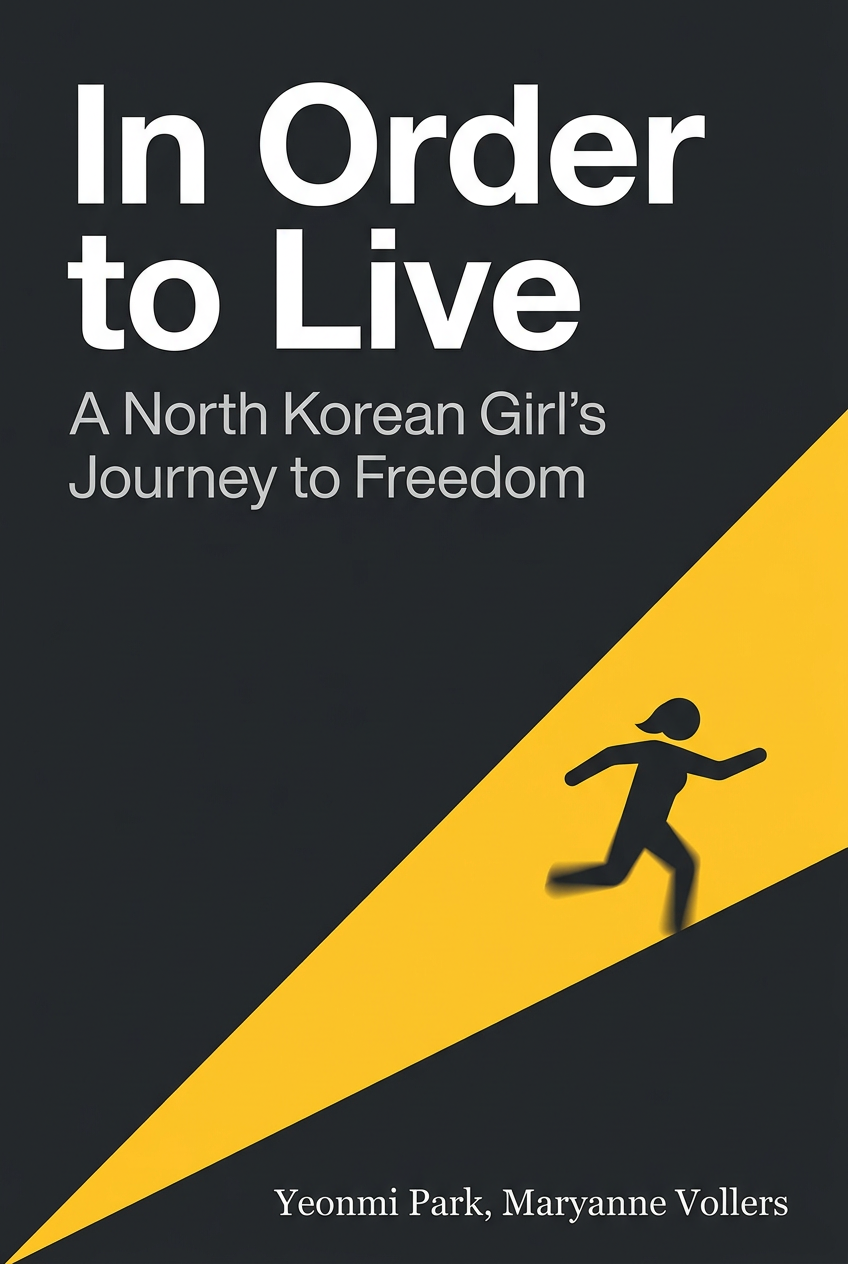
In Order to Live
A North Korean Girl's Journey to Freedom
What's it about
What would you risk for a taste of freedom? Imagine being born into a world where your every thought is controlled and starvation is a daily reality. This gripping true story reveals the harrowing journey of one young woman who dared to escape North Korea's brutal regime. Discover the unimaginable resilience it takes to survive brainwashing, human traffickers, and a perilous trek across the Gobi desert. You'll learn about the hidden realities of life under dictatorship and witness the unbreakable power of the human spirit in its fight for a life worth living.
Meet the author
Yeonmi Park is a human rights activist and North Korean defector whose harrowing escape at age thirteen has made her a leading voice for her people. After a perilous journey through China and the Gobi Desert, she found freedom and dedicated her life to exposing the brutal realities of the North Korean regime. Park's powerful testimony, delivered on global stages and in her bestselling memoir, illuminates the resilience of the human spirit and the high price of freedom.
Opens the App Store to download Voxbrief

The Script
Think of the difference between a houseplant and a wild weed. The houseplant lives in a predictable world. It receives measured water, consistent light, and soil from a bag. Its entire existence is curated, its needs met within a system designed for its survival. But what happens if the water stops? If the sun is blocked? It wilts. Its reality, built on a foundation of dependable rules, offers no training for a world where those rules suddenly vanish. Now, think of the weed pushing through a crack in the pavement. It knows nothing of schedules or curated soil. Its life is a constant, desperate negotiation with scarcity and chaos. It learns to twist toward a sliver of light, to draw moisture from a morning fog, to anchor itself against the crushing weight of concrete. It learns to live in a world actively hostile to its existence.
This is the lived difference between two realities on the same peninsula, separated by an invisible line. For most of us, our understanding of the world is like that of the houseplant—built on the assumption that certain things are true: food will be available, lights will turn on, and words have stable meanings. We have no context for a reality where hunger is the air you breathe, where darkness is absolute, and where a single wrong word can erase your family. The person who bridges this gap for us did so as a journey of survival. Yeonmi Park was born into the world of the pavement weed. She wrote In Order to Live because she had to unlearn every lesson of that brutal, starved reality to survive in ours, and in doing so, she realized the story of her escape was the only way to explain the world she had left behind—a world most of us can barely comprehend.
Module 1: The Architecture of Control
Our journey begins inside North Korea, a world built on a foundation of absolute control. The regime's power is psychological. It seeps into every home, every conversation, every private thought. The first thing we learn is that survival depends on mastering self-censorship from birth. Yeonmi's mother gives her a constant, chilling warning: "Take care of your mouth." She adds, "even when you think you’re alone, the birds and mice can hear you whisper." This wasn't a metaphor. After the mother repeated a simple rumor, she was interrogated by the secret police. The agent’s final words instilled a lifelong fear. This fear is the air they breathe.
Building on that idea, the regime reinforces this fear with public displays of brutality. The state demonstrates its power by making human life disposable. Yeonmi’s mother witnesses a young man publicly executed by a firing squad. His crime? He killed and ate a cow. The cow was state property. The man was not. Her horrified conclusion was simple and stark. A human’s life had less value than an animal’s. This was a deliberate lesson for everyone watching. This is what happens when you defy the state.
And it doesn't stop there. The punishment extends beyond the individual. The regime destroys families through a system of collective punishment. North Korea operates on a caste system called songbun. It ranks every citizen based on their perceived loyalty. If one person commits a crime, their entire family's songbun is ruined. When Yeonmi's father is arrested for smuggling goods on the black market, her family is branded. They become "a family of criminals." Her father is tortured in a labor camp, a place where you are "no longer considered a human being." The children are mocked at school. Their future is erased. This system ensures that every citizen becomes a guard for their own family, policing each other out of fear.
So here's what that means in practice. The state creates a perfect prison. It uses fear to enforce silence. It uses public violence to deter defiance. And it uses collective punishment to turn families into their own jailers. This is the environment Yeonmi Park was born into. It’s a world designed to crush the individual spirit completely.
Module 2: The Breakdown of a Nation
Now, let's turn to what happens when this perfectly controlled system begins to fail. In the 1990s, North Korea's state-run economy collapsed. The government could no longer feed its people. The result was a devastating famine that tore the country apart. The first, most brutal lesson was that in the absence of the state, survival becomes a savage, individual fight. The social fabric disintegrated. Yeonmi describes seeing dead bodies in the streets. She saw them floating in the river. Spring, a season of life elsewhere, became "the season of death." Food stores ran out before new crops were ready. Children ate insects and wild plants to survive. Yeonmi and her sister developed pellagra, a disease of severe malnutrition. Their childhood dream was to "eat a mountain of bread."
Consequently, a new economy rose from the ashes of the old one. The failure of the state created an entire generation fueled by black markets. The official food distribution system was gone. To live, everyone had to turn to illegal private markets, the jangmadang. Yeonmi’s father became a trader. Later, Yeonmi herself sold persimmons to earn money. These markets created what's known as the "Jangmadang Generation." These are North Koreans who grew up relying on their own hustle, not on government handouts. They were less indoctrinated. They were more skeptical. They saw the regime's failure with their own eyes every single day.
But flip the coin. This new, illegal economy ran on a single fuel: corruption. To navigate a broken system, bribery becomes a necessary way of life. Nothing worked without a bribe. Yeonmi's father had to bribe doctors for sick notes. He bribed police for travel permits. He bribed border guards to look the other way. Even as a child, Yeonmi had to bribe a guard with rice vodka just to get into an orchard to find something to sell. This constant, grinding corruption teaches a cynical lesson. The rules don't matter. Only what you can pay for matters.
So what happens next? The famine and the rise of the black market did something the regime never intended. They accidentally created cracks in the wall of control. People were forced to think for themselves. They were forced to become entrepreneurs. And through smuggled goods, they got their first taste of a world beyond their borders. This brings us to a crucial turning point.