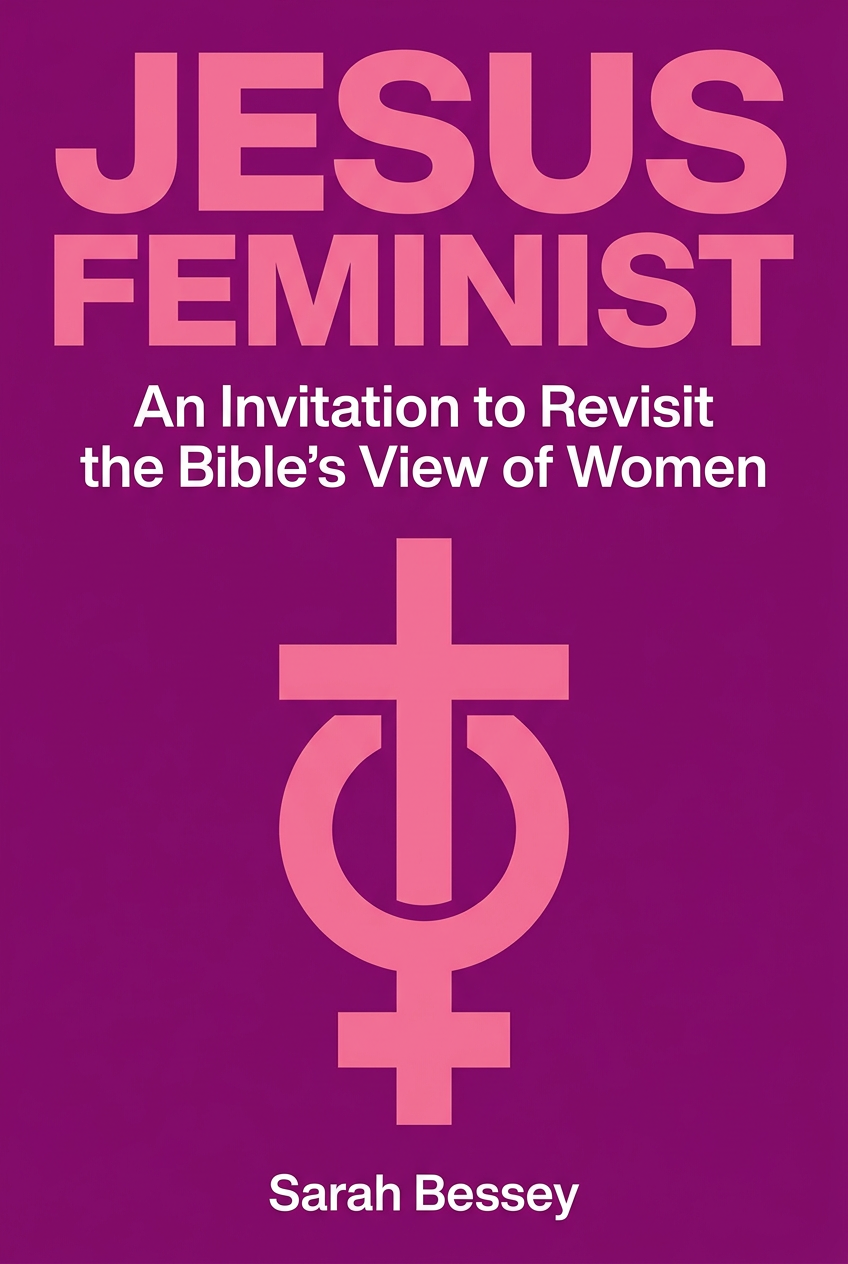
Jesus Feminist
An Invitation to Revisit the Bible's View of Women
What's it about
Ever felt a tension between your faith and your belief in equality for women? Discover how embracing feminism can actually deepen your relationship with Jesus. This summary unpacks the powerful idea that your passion for justice is a gift from God, not a departure from scripture. You'll explore the Bible through a new lens, reclaiming the stories of women and challenging patriarchal interpretations that have held you back. Learn to confidently articulate a faith that champions the full equality and gifting of women in the church and the world, all while drawing closer to the heart of Jesus.
Meet the author
Sarah Bessey is the celebrated, bestselling author of Jesus Feminist, an award-winning book that has become a touchstone for Christians seeking a more egalitarian view of faith. Raised within the charismatic evangelical tradition and later finding a home in the Anglican Church, Bessey’s writing emerged from her own deeply personal journey of reconciling her faith with her feminism. Her work gives voice to the countless women who have long felt a disconnect between their lived experiences and traditional church teachings.
Opens the App Store to download Voxbrief

The Script
Think of two childhood homes. They stand side-by-side, built from the same floor plan, with identical rooms and windows. In the first house, the rooms are assigned strict, unchangeable purposes. The dining room is for formal meals only, its chairs unused, its table a polished, empty surface. The living room is for receiving guests, a place of performance and posture. Every object has its place, every action its proper time, and the doors are kept locked against the wildness of the outside world. Life here is a matter of following the rules laid down by the original architect, a life of preservation.
In the second house, life has spilled over every boundary. The dining room table is covered in flour from baking, scattered with board game pieces, and scarred with the marks of homework sessions and late-night conversations. The living room is a tangle of blankets, books, and sleeping pets. The doors are wide open, and the scent of rain on hot pavement drifts in. It’s the same structure, the same blueprint, but it has been transformed by the messy, unpredictable, joyous reality of being lived in. It has become a home by allowing itself to be filled with life. This is the difference between a faith that feels like a pristine, preserved museum and one that feels like a sprawling, chaotic, and welcoming home. The question for many becomes: can my faith, which I was taught to preserve, actually be a place to fully live?
This very question echoed in the life of Sarah Bessey. Raised in the Canadian prairies within a loving, charismatic church, she was taught a specific floor plan for a woman’s life within the faith. Yet, as she grew, she felt the walls of that blueprint closing in, unable to contain the full, messy, vibrant reality of her own personhood and her experience of God. She saw the goodness in the structure but felt a deep longing for the freedom of a home. Bessey, a popular author and speaker known for her vulnerable and narrative-driven approach to theology, wrote "Jesus Feminist" as a series of personal essays, a sprawling and heartfelt invitation to throw open the doors and windows, to show how the beautiful, ancient structure of her faith was a home expansive enough for all of her life, and all of ours.
Module 1: Redefining the Starting Point
Many conversations about women in the church begin with a handful of controversial Bible verses. Bessey suggests this is the wrong place to start. The real foundation is a person: Jesus. His interactions with women were revolutionary for his time. He consistently broke cultural and religious taboos, treating women as full human beings with spiritual capacity and intellectual worth.
This leads to the first major insight: Jesus’s treatment of women is the primary model for Christian relationships. Think about it. He never patronized women. He took their questions seriously. His longest recorded one-on-one conversation in the Gospels was with a Samaritan woman, a social and ethnic outcast. He revealed his identity as the Messiah to her first. And what did she do? She became an evangelist to her entire town. After his resurrection, Jesus appeared first to Mary Magdalene. He commissioned her to be the first preacher of the good news, even though a woman's testimony was legally worthless at the time. He called a crippled woman a "daughter of Abraham," a shocking title that formally welcomed her into the covenant family, granting her a spiritual status previously reserved for men. This pattern is consistent and intentional.
From this foundation, Bessey reclaims the word "feminist." She argues that for a Christian, it's not a secular or political label to be feared. Instead, feminism is the radical notion that women are people, too. It's about championing the dignity, rights, and full humanity of women as equal to men. She points out that the early feminist movements for abolition and suffrage were deeply rooted in the Christian faith of their leaders. For Bessey, being a "Jesus feminist" is about recognizing that God is already at work in any movement that brings more justice and human flourishing into the world. Patriarchy, she states, is not God's dream for humanity.
This perspective offers a way to step outside the endless, polarized debates. The church has spent decades locked in arguments between two main camps. The first is "complementarian," the belief that God created men and women with complementary but hierarchical roles, with male leadership as the biblical standard. The second is "egalitarian," the belief that leadership should be based on spiritual gifts, not gender. Bessey critiques how both sides can weaponize Scripture, reducing complex issues to proof-texts.
So here's what that means for us. We can move beyond theological labels to focus on Jesus's example. The goal is to follow Jesus. This requires humility. It means acknowledging that both sides are probably right in some ways and wrong in others. It means admitting we all see things imperfectly. By shifting our focus from being "right" to being faithful, we can find common ground in a shared love for Jesus and a desire to build the inclusive community he modeled.
Module 2: Rereading the Bible with New Eyes
Once we re-center our focus on Jesus, we can approach the Bible differently. We can see it as a complex, unfolding story of God's relationship with humanity. This requires us to read thoughtfully, not just literally. The popular mantra, "The Bible says it, I believe it, that settles it," is too simplistic. Everyone interprets Scripture. The question is how we interpret it.
A key principle emerges here: Difficult Bible passages must be understood in their historical and cultural context. Take the verses often used to command women's silence in church, like those in 1 Corinthians and 1 Timothy. Bessey argues these were letters written by the Apostle Paul to address specific problems in specific cities. In Corinth, for instance, some women, newly liberated in Christ, may have been disrupting the worship gatherings. Paul’s instruction was likely a call for orderly learning, not a permanent ban on all women speaking for all time. In fact, in that same letter, he encourages women to prophesy. The Greek word often translated as "silence" can also mean a quiet, peaceful stillness—the posture of a focused student, not a gag order.
Building on that idea, it becomes clear that the Bible's broader witness affirms women's active leadership. When you look at the whole of Scripture, you see a consistent pattern of women participating fully in God's mission. In the Old Testament, Deborah was a judge and military leader. In the New Testament, women were vital to the early church. Paul worked alongside women he called apostles, deacons, and teachers, like Junia, Phoebe, and Priscilla. Luke’s Gospel notes that a group of women, including Mary Magdalene and Joanna, financially supported Jesus's ministry out of their own resources. They weren't just followers; they were patrons and partners. This wider narrative of inclusion is more powerful than a few isolated, context-specific verses.
This brings us to a "redemptive movement" way of reading the Bible. The idea is that God works within flawed human cultures to progressively guide people toward his ultimate design of justice and wholeness. God’s redemptive work in history moves toward greater freedom and equality. Consider slavery. The Old Testament contains rules for managing slaves, which sounds awful to us now. But in its ancient context, it was a step toward greater humanity. Later, the Apostle Paul urged a slave owner, Philemon, to receive his runaway slave back as a brother in Christ. Ultimately, Christians led the abolitionist movement, recognizing that slavery fundamentally contradicted God's intention for human dignity. Bessey argues that gender equality follows the same redemptive path. We are called to join God in moving beyond the patriarchal structures of the past toward the full equality revealed in Jesus.