All Books
Self-Growth
Business & Career
Health & Wellness
Society & Culture
Money & Finance
Relationships
Science & Tech
Fiction
Topics
Blog
Download on the App Store

Lagoon

14 minNnedi Okorafor

What's it about

What would you do if aliens landed, not in New York or London, but in the chaotic heart of Lagos, Nigeria? This isn't your typical first contact story. It's a vibrant, explosive look at how humanity reacts when the impossible becomes reality, right in front of them. Prepare to meet a marine biologist, a famous rapper, and a troubled soldier, three strangers whose lives are irrevocably changed by the arrival. You'll discover how ancient Nigerian mythology and futuristic science collide as they become humanity's unlikely ambassadors, navigating a city on the brink of transformation and chaos.

Meet the author

Nnedi Okorafor is a multiple award-winning, international bestselling author of Africanfuturism and Africanjujuism, holding a PhD in English from the University of Illinois at Chicago. A first-generation Nigerian-American, she draws on her dual heritage to weave Igbo cosmology, Nigerian folklore, and sharp social commentary into her science fiction. This unique perspective allows her to vividly reimagine a bustling Lagos, Nigeria, confronting a first contact alien event in her groundbreaking novel, Lagoon.
Listen Now

Opens the App Store to download Voxbrief

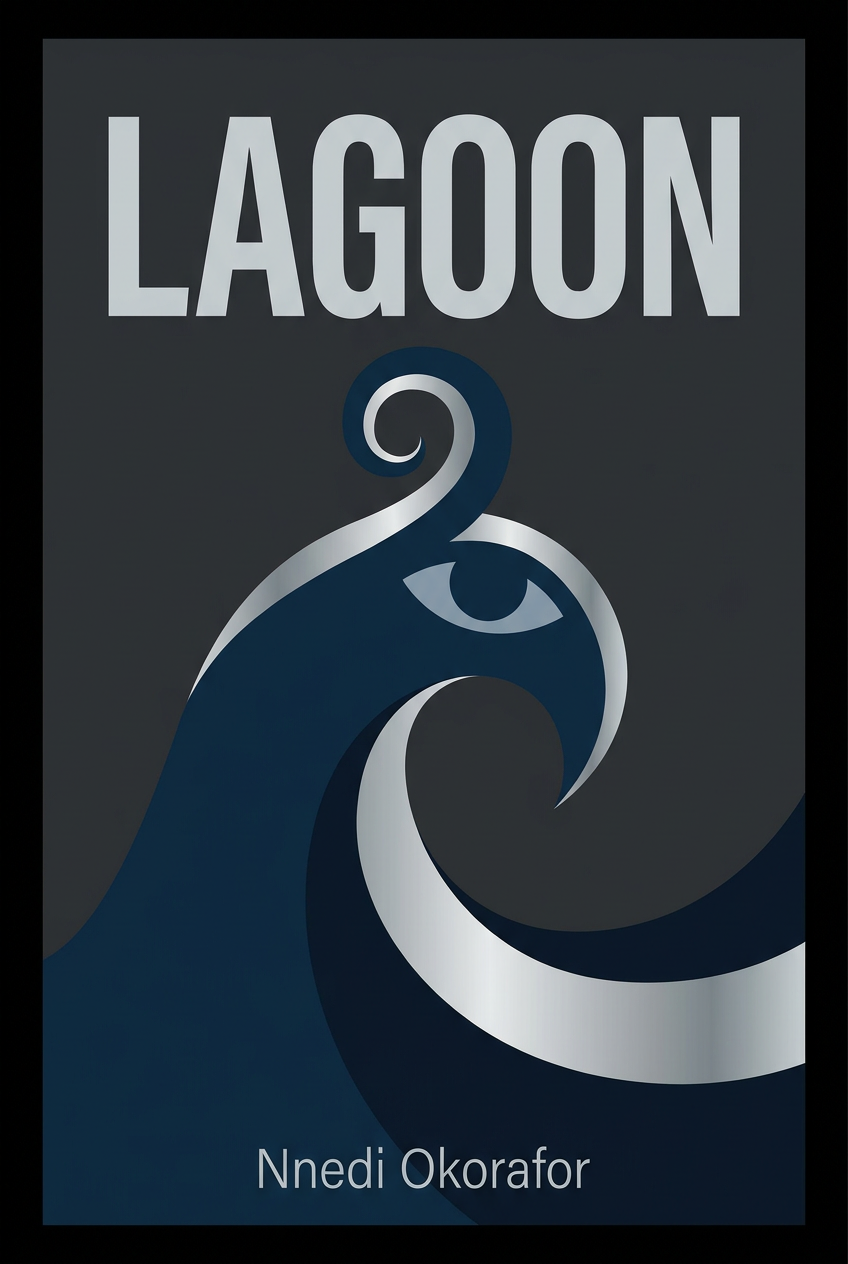
Lagoon book cover

The Script

Think of two languages spoken in the same city. One is the official language, the one used on street signs and in government buildings—the language of commerce and formal introductions. It’s structured, predictable, and understood by all. Then there is the second language, a creole of slang, gestures, and shared history spoken on the crowded Danfo buses and in the bustling markets. This is the language of life itself—chaotic, fluid, and deeply alive. It’s the difference between asking for directions and knowing the shortcut through a neighbor’s yard. It’s the difference between a city on a map and a city in the blood.

Now, what happens when something utterly alien—something from beyond the stars—tries to communicate with that city? Which language does it learn? Does it address the formal, predictable structure, or does it plug directly into the chaotic, vibrant, living network? What if the first word it speaks isn't a formal greeting, but a piece of local slang, a fragment of myth, a taste of the city’s very soul? This is the explosive collision that occurs when the old gods and new aliens meet in the churning, vibrant heart of Lagos, Nigeria.

Nnedi Okorafor, a Nigerian-American author celebrated for her unique blend of Africanfuturism, felt a deep frustration with the way first contact stories were always told. They were almost exclusively set in Western cities like New York or London, following a predictable, sterile script. She wanted to write an alien invasion story that felt authentic to her heritage, one where the aliens plunged into the chaos and energy of Lagos. Okorafor envisioned a story where the city itself—with its traffic, its gods, its resilience, and its relentless pulse—was a main character, an organism that would react to, and be transformed by, the arrival of the unknown.

Module 1: The City as a Living Character

The first thing to understand about "Lagoon" is that the city of Lagos is a living, breathing character. Okorafor portrays it as a complex organism with its own spirit, history, and will. The city itself is a core actor in the story.

This perspective challenges us to think differently about systems and environments. Your environment is an active participant in your story. The book opens with an epigraph in Nigerian Pidgin English. It translates to: "Lagos is no man’s land. Nobody owns Lagos, we all own Lagos. Lagos will never be destroyed!" This establishes a sense of collective ownership and unbreakable resilience. It’s a city that belongs to everyone and no one. Its chaotic energy is its strength.

Here’s where it gets interesting. The alien arrival is a direct response to human actions. The first protagonist we meet is a swordfish, enraged by the oil pollution poisoning her home. She attacks an offshore oil hose, causing a massive spill. In that exact moment, the aliens arrive. They purify the water. They heal the ecosystem. This reframes the entire concept of an "invasion." Disruption can be a corrective force, arriving at moments of critical imbalance. The aliens choose Lagos precisely because of its chaotic vitality and its deep-seated problems. As one character notes, it's a place of "belle-sweet, gidi gidi, kata kata." Pleasure, hustle, and chaos. This is what the aliens find attractive. It’s a fertile ground for change.

The narrative also forces us to see the city through a different lens. One character, Chris, observes that Lagos is like a big zoo. Everyone is contained by walls and gates. There is containment, but no real security. This paradox is central to the city's identity. It's a place of intense social stratification and physical barriers, yet it possesses a relentless, unstable energy. This creates an environment that is both restrictive and dynamically alive. It’s a powerful metaphor for any complex system, be it a company or a market. True dynamism often thrives within apparent constraints.

Module 2: The Catalyst of Personal Crisis

Now, let's turn to the human characters. The people who first encounter the aliens are ordinary individuals at their breaking points. A marine biologist named Adaora, fleeing a violent fight with her husband. A soldier named Agu, beaten by his own comrades. A famous musician named Anthony, hiding his identity. They are drawn to Bar Beach by their personal trauma.

This is a crucial insight. Profound change finds us at our most vulnerable. Their individual crises make them receptive to the extraordinary. They are already broken open. Their guards are down. This allows the alien encounter to happen. Adaora's pain from her husband's slap, Agu's desperate need to call his family, Anthony's desire for anonymity—these raw human needs put them in the right place at the right time.

And here’s the thing. The alien arrival amplifies their personal problems. Adaora's marital strife with her husband, Chris, intensifies. He accuses her of being a "marine witch" and using black magic. His religious fundamentalism clashes violently with her scientific mind. Agu's crisis of loyalty deepens. He must choose between returning to a corrupt military that threatened his family or becoming a fugitive. These personal conflicts become intertwined with the global crisis. Extraordinary events put human drama under a microscope.

This leads to a powerful bond between the three strangers. Their shared, traumatic experience of being abducted by a giant wave and taken underwater forges an immediate alliance. They are from completely different worlds. A scientist, a soldier, a celebrity. But their shared ordeal supersedes all social roles. It creates a new "we." They choose to stay together, bound by a secret no one else could possibly understand. This reminds us that the strongest teams are often forged in the fires of a shared, difficult experience. Their bond is based on having survived the impossible together.

Read More