Life of Pi
What's it about
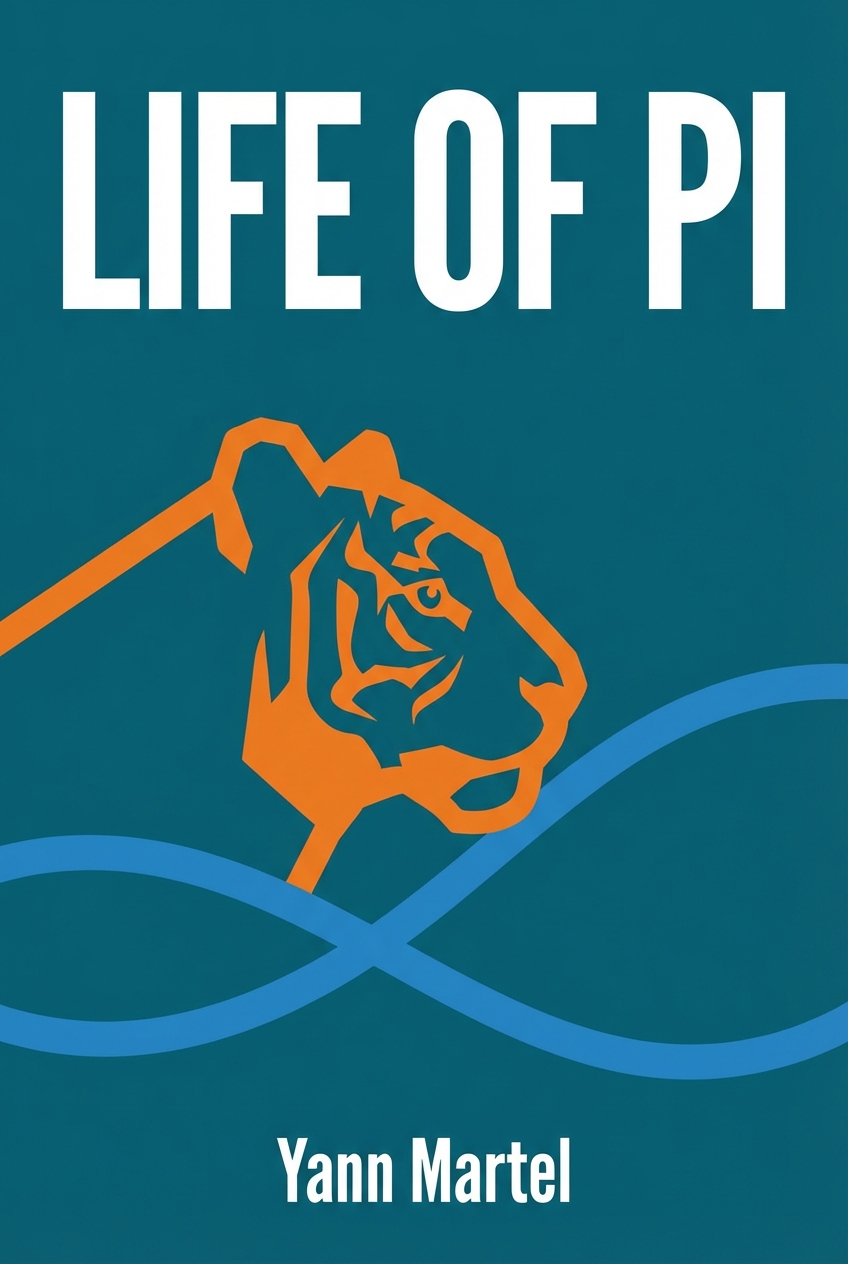
Could your faith survive being lost at sea with only a Bengal tiger for company? This incredible story of survival pushes the boundaries of belief, forcing you to question what’s real, what’s possible, and what it truly means to have hope when all is lost. Explore the breathtaking and terrifying journey of Pi Patel, an Indian boy stranded on a lifeboat in the Pacific Ocean. You’ll discover how he uses his zookeeping knowledge, wit, and spiritual resilience to coexist with a deadly predator, challenging your own perceptions of storytelling, truth, and the will to live.
Meet the author
Yann Martel is the Man Booker Prize-winning author whose novel Life of Pi became a global literary phenomenon, selling over twelve million copies worldwide. A philosopher by training and a world traveler by nature, Martel spent years researching religion, zoology, and survival stories in India. This immersive journey provided the rich, authentic foundation for his uniquely imaginative tale of faith, storytelling, and the resilience of the human spirit when faced with the impossible.
The Script
In a zoo, a sign on an enclosure reads, 'DO NOT FEED THE ANIMALS.' It’s a simple command, a clear line between the human world and the wild one. But what happens when that line dissolves? Imagine a zookeeper who, through years of patient observation, comes to understand the subtle language of his charges. He doesn’t just see a tiger; he sees an individual with its own moods, fears, and even a strange, quiet dignity. He learns the precise tilt of an ear that signals anxiety, the low rumble that is a form of contentment. To others, the animal is a beautiful but dangerous spectacle. To him, it is a known being. This deep, personal understanding doesn't erase the animal's wildness—it respects it. It’s a relationship built on a shared, silent acknowledgment of life.
This fragile bridge between the human and the animal, and the stories we tell to make sense of it, is the territory that fascinated Canadian author Yann Martel. He was a writer adrift, struggling with two unsuccessful novels and a profound sense of creative failure. On a trip to India, feeling his ambition collapse, he stumbled upon an idea that ignited his imagination: a story about a boy sharing a lifeboat with a Bengal tiger. The premise became the vessel for his deepest questions about faith, suffering, and the nature of truth itself. Martel spent years meticulously researching zoology, religion, and castaway survival stories to build a tale that was both fantastically unbelievable and viscerally real. He needed to write a story that would, as one of his characters promises, give you a reason to believe in God.
Module 1: The Zoo and the Nature of Reality
The story begins not at sea, but in a zoo. The narrator, Piscine Molitor Patel, or Pi, grows up in the Pondicherry Zoo, which his father owns and operates. This setting is crucial. It’s here that Martel lays the groundwork for the book’s central themes. The zoo becomes a laboratory for understanding reality, freedom, and the hidden dangers of misinterpretation.
One of the first ideas Martel challenges is our romantic notion of the wild. An animal's life in the wild is one of constant, brutal necessity. Pi explains that wild animals live under an "unforgiving social hierarchy." Their lives are governed by fear, a low food supply, and the constant need to defend their territory. Freedom, as we imagine it, is a human projection. In reality, animals are conservative creatures. They crave stability and familiarity, not endless roaming.
This leads to a counterintuitive insight. A well-designed zoo enclosure can be a haven. Pi's father teaches him that a "biologically sound" enclosure provides security. It compresses an animal's essential needs—food, water, safety, rest—into a manageable territory. An animal in such a space isn't a prisoner. It's a landholder. It takes possession of its territory and feels secure. Martel uses this to suggest that freedom isn't about the absence of boundaries. It’s about having a secure space where your needs are met.
But here’s the twist. The zoo also teaches Pi about the most dangerous animal of all. It's not the tiger or the lion. The most dangerous animal in a zoo is Man. Pi’s father provides a horrifying list of visitor cruelty. People feed razors to bears and nails to elephants. They attack animals with hammers and swords. This isn't just about malice. It's also about ignorance. Visitors project human traits onto animals, a habit Pi’s father calls Animalus anthropomorphicus—the animal as seen through human eyes. They see either a cute, cuddly toy or a vicious monster. Both are dangerous illusions. They fail to see the animal for what it is: a wild creature that must be respected. To drive this lesson home, Pi’s father forces his sons to watch a starved tiger, Mahisha, violently kill a goat. The lesson is brutal and unforgettable: never underestimate the true nature of a wild animal.