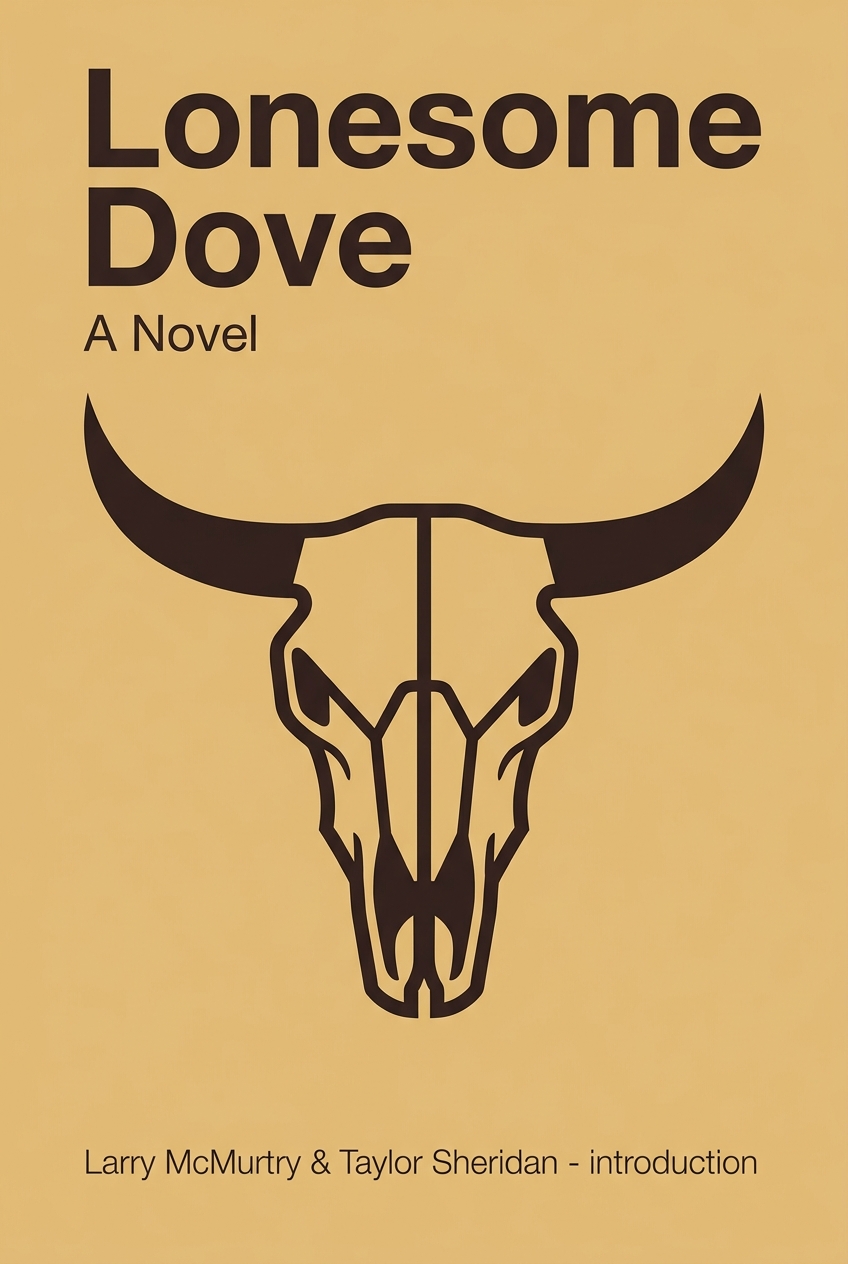
Lonesome Dove
A Novel
What's it about
Ever wondered what it takes to leave everything behind for one last, epic adventure? Journey back to the Old West and discover the true meaning of friendship, loyalty, and courage in the face of impossible odds. This is your chance to ride alongside legends. You'll join retired Texas Rangers Gus McCrae and Woodrow Call as they embark on a treacherous cattle drive from the dusty Texas border to the untamed plains of Montana. Uncover the raw, human stories of love, loss, and the relentless spirit that defined an era.
Meet the author
Larry McMurtry, a Pulitzer Prize-winning novelist and screenwriter, is celebrated as the definitive chronicler of the American West and its enduring myths. Born into a Texas ranching family, McMurtry drew from his own heritage and deep understanding of the region's landscape and people to create his stories. His work deconstructs the romanticized cowboy archetype, revealing the complex, often harsh realities of life on the frontier. This authentic perspective, born from personal experience, is the heart of his acclaimed masterpiece, Lonesome Dove.
The Script
Two old men sit on a porch in a forgotten Texas border town, watching the river drift by. One is talkative, the other is quiet. For years, this has been their life—a slow, predictable rhythm of small chores, idle conversation, and the ghosts of past glories. They are retired Texas Rangers, legends in their own minds, but now they just run a shabby little outfit called the Hat Creek Cattle Company, a company that owns no cattle. The dust settles, the heat shimmers, and the days bleed into one another. Then, an old friend rides into town, spinning a tale of an untouched paradise a thousand miles north in Montana. A land of green grass and clear rivers, a place to build a new life. It’s a foolish, impossible dream, a journey across a continent still wild and unforgiving.
For one of the old men, the quiet one, the dream is a nuisance, a disruption to his comfortable decay. But for the other, the restless one, it’s a spark in the tinder of his soul—one last chance for a grand adventure, a final ride into the heart of the myth he’s spent his life chasing. The decision to go is less a choice and more an inevitability, the pulling of a thread that unravels their settled lives and sets in motion a sprawling, brutal, and magnificent cattle drive, an exodus that will test every friendship, unearth every regret, and redefine the meaning of home and heroism.
This epic journey was born from a much smaller, abandoned project. Author Larry McMurtry, a novelist who spent his life chronicling the fading American West, had originally written a film script in the early 1970s with director Peter Bogdanovich. Titled 'The Streets of Laredo,' it was meant to star John Wayne, James Stewart, and Henry Fonda. But when Wayne unexpectedly turned it down, the project collapsed, and the script sat in a drawer for over a decade. McMurtry, unable to shake the characters he’d created—the restless Gus and the stoic Call—decided to reclaim them. He expanded the story into a novel to dissect the myth of the cowboy, to explore the harsh, lonely reality behind the legend he grew up with in his own family of Texas ranchers.
Module 1: The Frontier Forges Character Through Unforgiving Realities
The world of Lonesome Dove is governed by a single, brutal principle: the environment is indifferent to human ambition. Survival is earned through a pragmatic, often ruthless, adaptation to reality. This is the forge where true character is revealed.
One of the first things we learn is that authority on the frontier is informal and often ineffective. Formal rank means little. Major Randall Chevallie, a self-appointed officer who fled West Point, struggles to control his troop of Texas Rangers. They are mostly drunk on captured mescal, a potent spirit. Order is maintained by the force of personality of men like the scout Bigfoot Wallace. He operates on his own timeline, guided by instinct and experience. When Bigfoot predicts a "blue norther"—a sudden, violent cold front—the camp scrambles to prepare. They listen to him, not the Major. This shows us that in a high-stakes environment, proven competence will always command more respect than a title. The person who can actually solve the problem is the true leader, regardless of their position on an org chart.
This environment forces a radical self-reliance. Individuals are defined by eccentricity and pragmatic survival instincts. In the isolation of the plains, people develop pronounced, unique codes of conduct. We see this in Matilda Roberts, a prostitute traveling with the Rangers. She isn't a passive victim. She’s fiercely independent, catching and butchering a snapping turtle for her own breakfast because, as she says, "turtle beats bacon." She operates by her own rules, using her skills to provide for herself. Similarly, Shadrach, the oldest Ranger, is a man of few words but decisive action. He baffles everyone by pocketing the turtle's decapitated head. It's a bizarre act, but it speaks to a private logic forged by a lifetime of survival. In a world without external structure, you build your own internal one.
Finally, the narrative shows that survival demands practical skills and endurance, not glory. The life of a Texas Ranger is grueling, mundane work. The youngest rangers, Gus McCrae and Woodrow Call, are tasked with chopping wood, shoeing horses, and saddle-soaping the Major’s gear. They endure constant discomfort, wearing thin shirts on frosty mornings and sleeping on the wet ground. Their equipment is poor. Their pistols are in bad repair. Their vigilance is what keeps them alive, not bravado. This is a stark reminder that innovation and big-picture strategy are useless without the discipline to handle the thankless, everyday tasks that keep the enterprise running. True excellence is about enduring the grind.