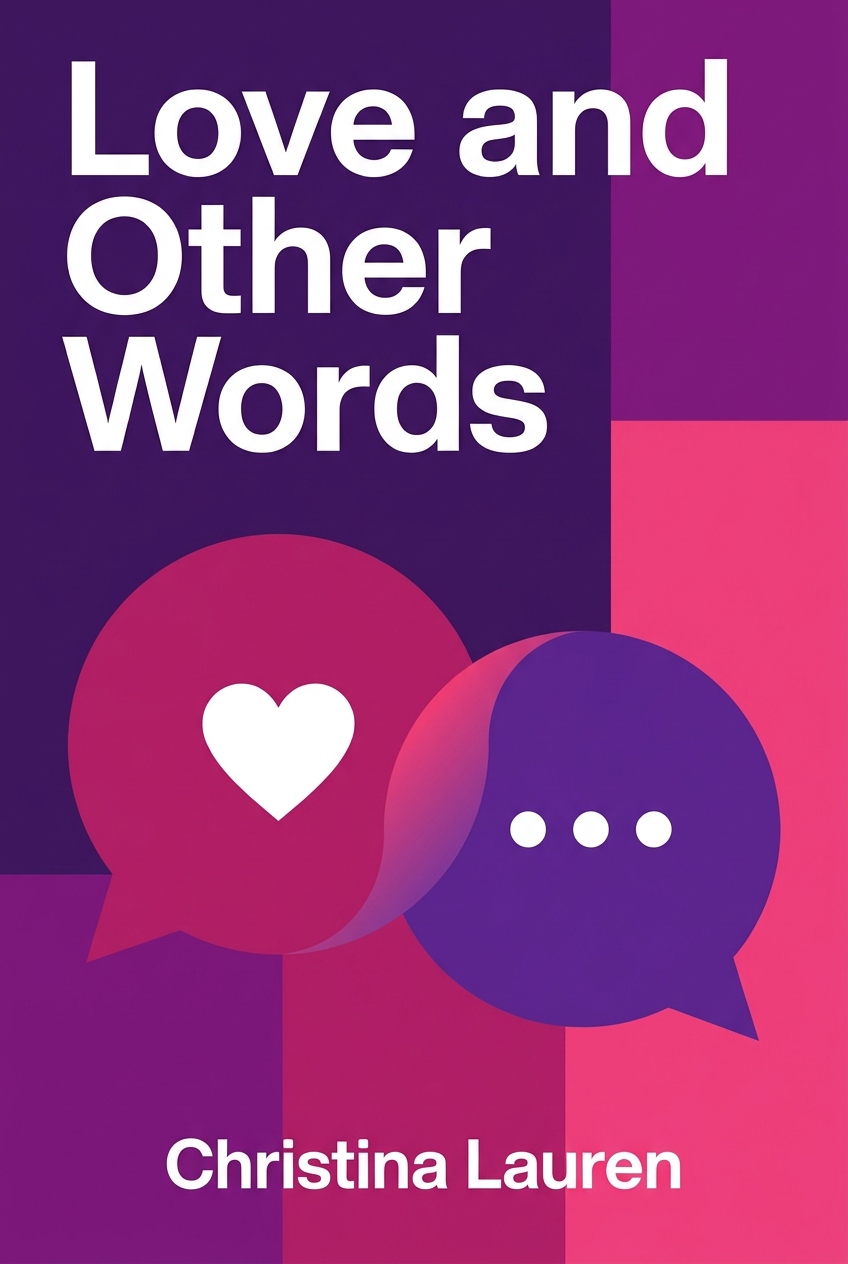
Love and Other Words
What's it about
Have you ever wondered if you can truly reconnect with your first love after years of heartbreak and silence? Discover a story that proves second chances are real, but only if you're brave enough to confront the one secret that tore you apart. This moving tale follows Macy and Elliot, childhood best friends turned sweethearts, whose perfect love story shattered overnight. You'll journey through their past and present, uncovering the beautiful moments that bound them and the devastating event that separated them, revealing what it takes to heal and find your way back to each other.
Meet the author
Christina Lauren is the combined pen name of longtime writing partners and best friends Christina Hobbs and Lauren Billings, the New York Times and USA Today bestselling authors of more than thirty novels. Their shared passion for romance and storytelling allows them to explore the complexities of love, friendship, and second chances with a unique, dual-voiced perspective. This collaborative magic is the heart behind the emotional depth and unforgettable characters found in their beloved books.
Opens the App Store to download Voxbrief

The Script
In the attic of every childhood friendship, there are two boxes. One is neatly labeled: birthdays, inside jokes, the first day of school. It’s filled with polished memories, the official story you tell at reunions. The other box is tucked away, unlabeled and dusty. Inside, it’s a mess of seemingly random artifacts: a forgotten bookmark, a ticket stub from a movie you both hated, a single, mismatched sock. These are the pieces of the real story, the one built from silences, unspoken promises, and the quiet, seismic shift of a single afternoon that changed everything. It’s the second box that holds the true weight of a relationship—the one that, if opened years later, can either explain a lifetime of distance or offer a fragile path back to one another.
This gap between the story we tell and the one we live is the emotional territory Christina Lauren set out to explore in “Love and Other Words.” The name itself is a pseudonym for the writing duo Christina Hobbs and Lauren Billings, best friends who have built a career translating the complex, often unspoken, language of relationships onto the page. They were fascinated by the idea of a love so foundational it becomes part of your personal vocabulary, and what happens when a single, devastating event forces you to forget how to speak it. Drawing on their own deep friendship, they crafted a story about two people rediscovering a language only they ever knew how to speak.
Module 1: The Architecture of Unresolved Love
The novel opens with a powerful premise: some connections are not meant to be forgotten. Macy Sorensen is a pediatric resident, engaged to a financially secure, emotionally safe man named Sean. Her life is a predictable loop of work, sleep, repeat. This carefully constructed stability shatters when she runs into Elliot Petropoulos, her first love, after eleven years of absolute silence. The reunion is a shock to the system. Macy feels the air get sucked out of the room. This immediate, visceral reaction reveals a core insight: Past relationships, especially those that end without closure, remain emotionally active systems. They don't just fade away. They lie dormant, waiting for a trigger.
For Macy, Elliot isn’t just a memory. He is a living archive of a version of herself she thought was gone forever. Their shared history was built in the sanctuary of a closet-turned-library in her father's weekend cabin. It was a world founded on a mutual love for books and words. Their connection was a friendship so deep that Macy describes Elliot as her "Everyfriend"—a best girlfriend and first boyfriend rolled into one. The authors use this foundation to make a sharp point about connection. Deep bonds are often forged in shared sanctuaries, whether physical or intellectual. For Macy and Elliot, the closet was both. It was a physical space away from the world, and an intellectual space where they could be their truest selves, sharing favorite words and dissecting novels.
This brings us to the central conflict. When Elliot re-enters her life, Macy’s carefully managed present begins to fray. She feels a sense of betrayal lying next to her fiancé, even though she has done nothing wrong. Her engagement to Sean, which she accepted after only a few months, suddenly feels hollow. It becomes clear that her current relationship was built on a different foundation: convenience and emotional safety. The authors suggest that we often build new lives on the foundations of past trauma as a form of self-protection. Macy’s relationship with Sean is a fortress against the kind of all-consuming, potentially devastating love she once knew with Elliot. It requires nothing from her heart. It’s a partnership of least resistance. The reappearance of Elliot forces her to confront the reality that she has been merely surviving.
Module 2: The Language of Grief and Connection
Grief is the soil from which the entire story grows. Macy loses her mother at a young age, and this loss shapes every aspect of her life. Her father, also grieving, navigates parenting by following a list of instructions her mother left behind. This list becomes a "bible of sorts," a tangible legacy that guides their lives. This leads to a powerful observation about coping with loss. Structured legacies can provide an essential framework for navigating life after a tragedy. Her father’s decision to buy the weekend cabin is a literal interpretation of one of her mother’s rules, creating a physical retreat that becomes the setting for Macy’s healing and her friendship with Elliot.
From this foundation, the novel explores how communication, or the lack thereof, defines our ability to heal. Macy finds solace in Elliot because he is the one person who doesn’t treat her grief as a taboo. He asks direct questions about her mother. He creates a space where she can be sad without feeling weird. And here’s the thing: Authentic connection thrives on the courage to discuss difficult truths openly. Their bond is cemented through words—the books they read, the favorite words they share, and the honest conversations they have about loss. Elliot gives Macy a copy of Bridge to Terabithia, a book about childhood friendship and loss. This gesture shows he understands her grief on a profound level, offering a shared language for her pain.
But flip the coin. Just as words can build connection, their absence can destroy it. The central mystery of the novel is why Macy and Elliot stopped speaking for eleven years. It stems from a catastrophic communication breakdown. After a traumatic event, Macy shuts down completely. She changes her number. She vanishes. She never tells Elliot that her father died in a car accident just one day after their painful separation. This reveals another hard truth. Emotional shutdown, while a natural defense mechanism, is often more destructive than the initial conflict. Macy’s silence creates a wound far deeper than the original betrayal she perceived. For over a decade, both are left in a state of unresolved pain, haunted by what was left unsaid. The story makes it clear that reconciliation is impossible without the willingness to finally have the conversation you’ve been avoiding.