All Books
Self-Growth
Business & Career
Health & Wellness
Society & Culture
Money & Finance
Relationships
Science & Tech
Fiction
Topics
Blog
Download on the App Store

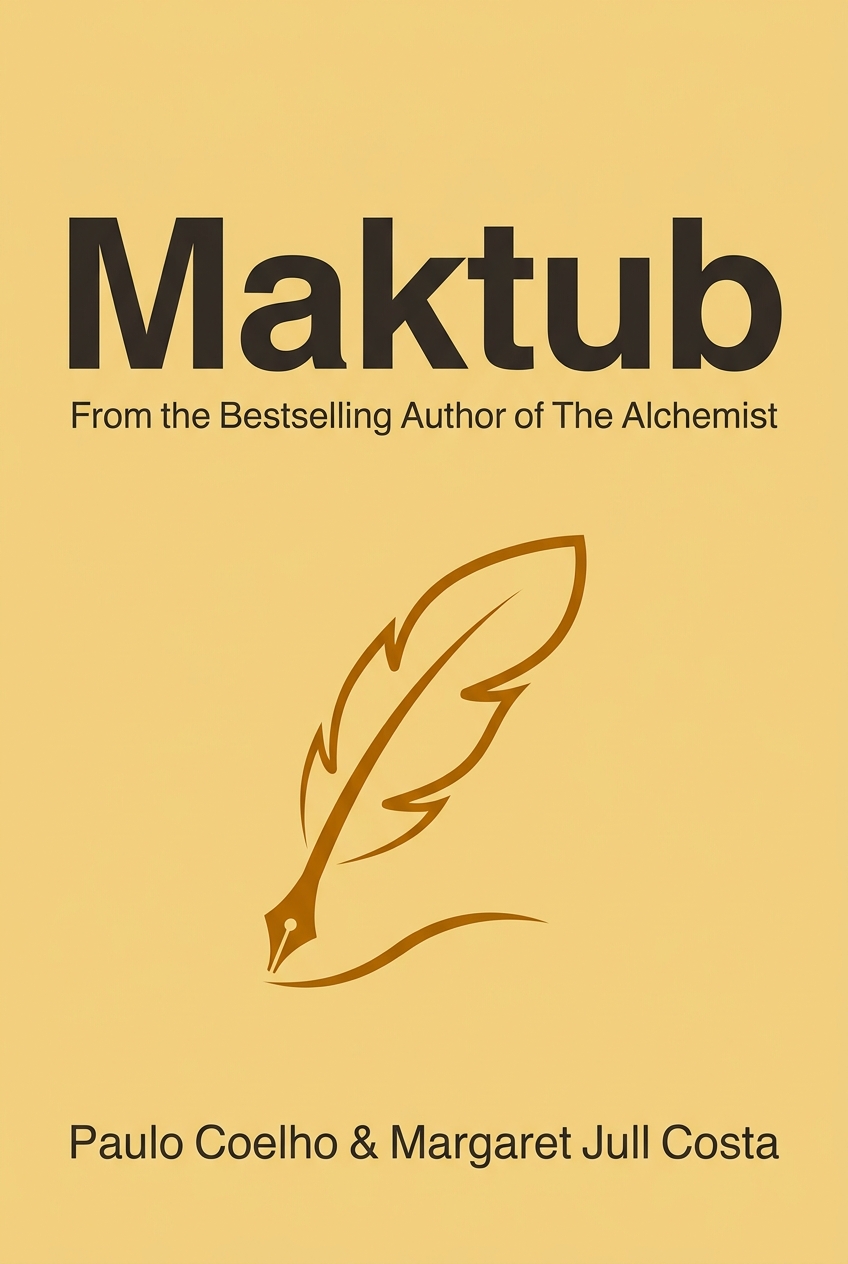
Maktub

From the Bestselling Author of The Alchemist

14 minPaulo Coelho, Margaret Jull Costa

What's it about

Are you searching for a sign to change your life? Discover how to find meaning, embrace change, and trust your destiny. This collection of parables and wisdom from the bestselling author of The Alchemist offers a guiding light for your personal journey. Based on Coelho's popular daily column, "Maktub"—meaning "it is written"—is your companion for self-reflection. You'll learn to see the miraculous in the everyday, find courage in moments of doubt, and understand that your path is already unfolding in the most beautiful way.

Meet the author

Paulo Coelho is one of the most influential authors of our time, with his masterwork, The Alchemist, having sold over 150 million copies worldwide. Originally written as a daily column for a Brazilian newspaper, Maktub collects his philosophical reflections on life, destiny, and spirituality. This treasured compilation is brought to English readers through the celebrated translation of Margaret Jull Costa, a multi-award-winning translator renowned for her work with Portuguese and Spanish literature, ensuring the soul of Coelho’s wisdom is perfectly preserved.
Listen Now
Maktub book cover

The Script

A seasoned martial arts master stands before two of his most promising students. He hands each of them an identical, unsharpened sword. "Make this blade sing your name," he instructs. The first student, driven by a desire for perfection, spends weeks in the library, studying metallurgy and ancient forging techniques. He builds a custom forge, meticulously controlling the temperature, hammering with a precise, scientific rhythm learned from texts. His final blade is flawless, a mirror-polished testament to technical mastery. The second student takes his sword and walks into the world. He uses it to chop wood for an elderly woman, to clear a path after a storm, and to defend a traveler from bandits. He sharpens it on river stones, nicks it on rocks, and tempers it in countless campfires. His blade becomes scarred, imperfect, and uniquely his own. When they return, the master asks them to strike a hanging silk scarf. The first student's perfect blade slices cleanly through. The second student's blade, imbued with the stories of its use, seems to pass through the silk without a sound, leaving it undisturbed yet utterly severed. The first blade performed a function; the second one fulfilled a destiny.

These small moments of choice, action, and consequence—the moments that shape a life’s unique song—fascinated a young Brazilian journalist named Paulo Coelho. Between June 1993 and June 1994, while working for the newspaper Folha de S.Paulo, he began a daily practice of capturing these fleeting insights. He was collecting the small stories, parables, and lessons he encountered in his own journey, much like the second student collecting nicks and memories on his blade. These brief, potent reflections, drawn from a wide tapestry of traditions and his own observations, were never intended to be a formal guide. Instead, they were compiled into a collection he called “Maktub”—an Arabic word that translates roughly to “it is written.” For Coelho, this meant our personal legends are written, moment by moment, through the choices we make and the wisdom we gather along the way.

Module 1: The Architecture of the Soul

We often think of growth as a straight line. A clear path from A to B. But Maktub presents a different model. It suggests our lives are more like a construction project. We use discarded pieces, broken tiles, and unexpected materials to build something whole.

A central story illustrates this beautifully. An old man named Gabriel spends 93 years building a house. He uses broken plates, shattered tiles, and old pots. His neighbors think he's mad. Then, for a moment, they call him a genius. But Gabriel just keeps building. He was inspired by an angel in a dream. He trusted the vision. This is the first key idea: Life is a mosaic of experiences that shape our spiritual architecture. You have to trust the emerging pattern. You have to have faith that the fragments will eventually form a coherent whole.

This process requires a specific mindset. It demands that we look at our past with balance. When we face a big change, our minds instinctively play two movies. The first is a highlight reel of our failures. It's a cringe-worthy collection of every mistake and misstep. The second movie is our success reel. It shows every victory and moment of brilliance. The author's master advises watching both. If you only watch the failure reel, you become paralyzed by fear. If you only watch the success reel, you become arrogant and overconfident. This leads to the next insight: You must balance reflection on past failures and successes to avoid paralysis or arrogance.

This is about building resilience. It’s about understanding that even the darkest moments contribute to the final design. A powerful parable in the book describes a caterpillar. It feels ugly. It feels doomed. Nature forces it into a cocoon. The caterpillar fears this is its tomb. But after a period of struggle, it emerges as a butterfly. It realizes the terrifying transformation was actually a beautiful, surprising design. The struggle was essential.

So how do we navigate this process day-to-day? Especially when our minds are full of negative thoughts and temptations? The book offers a practical technique. An abbot in a monastery compares stopping sinful thoughts to trying to grab the wind. It's impossible. Instead, he advises a different approach. Temptations and negative thoughts are harmless if not acted upon. Just say no.

The master in the book uses a striking image. He compares negative thoughts to the leaves of a belladonna plant. Belladonna is a deadly poison if eaten. But it's harmless if you just look at it. Thoughts are the same. They can't hurt you unless you are seduced by them. Unless you choose to ingest the poison. The key is observation without attachment. See the thought, acknowledge it, and let it pass without engaging. This discipline is a core part of building your spiritual house. It keeps the foundation clean.

Read More