All Books
Self-Growth
Business & Career
Health & Wellness
Society & Culture
Money & Finance
Relationships
Science & Tech
Fiction
Topics
Blog
Download on the App Store

Material World

The Six Raw Materials That Shape Modern Civilization

12 minEd Conway

What's it about

Ever wonder what really powers our modern world? It's not just code or capital. Discover the six essential raw materials that form the invisible backbone of everything you use, from your smartphone to the buildings you live in, and see how they secretly dictate our future. This summary of Material World takes you on a global journey to the mines, refineries, and factories that transform these fundamental elements. You'll learn how sand, salt, iron, copper, oil, and lithium are extracted and why their supply chains are more fragile than you think, holding the key to global economic power and environmental stability.

Meet the author

Ed Conway is the award-winning Economics and Data Editor for Sky News, with his journalism recognized by the British Journalism Awards and the Society of Professional Journalists. His extensive career reporting from the front lines of the global economy, from deep-level mines to advanced factories, provides the unique, first-hand perspective that underpins Material World. This direct access to the hidden infrastructure of our planet gives him unparalleled insight into the raw materials that truly shape our civilization.
Listen Now

Opens the App Store to download Voxbrief

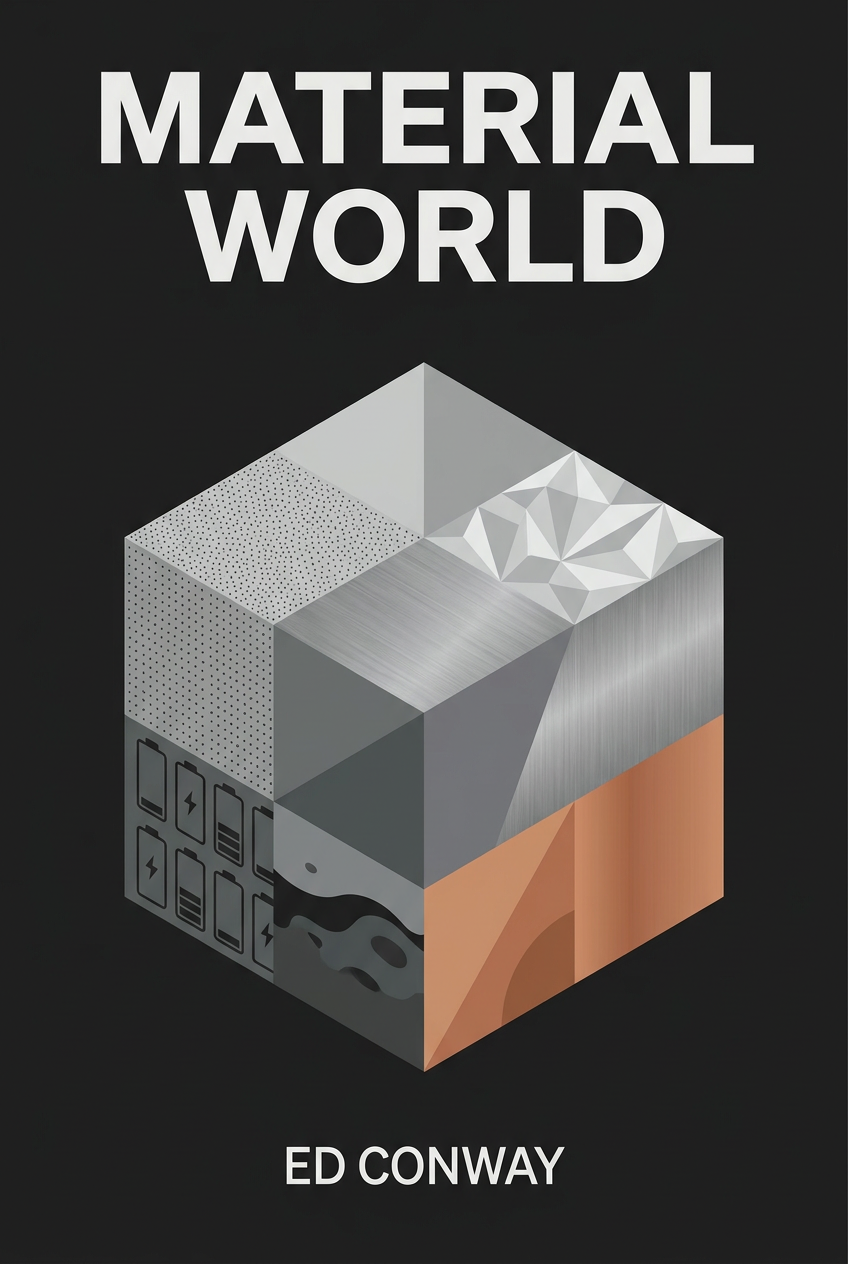
Material World book cover

The Script

Consider the weight of the digital world. A single hour of streaming high-definition video consumes around 3 gigabytes of data. In 2023, global internet traffic reached an estimated 4.8 zettabytes for the year—that's 4.8 trillion gigabytes. It's a number so vast it feels abstract, weightless, existing only in the cloud. Yet, every byte of that data travels through a physical system. Data centers, which house the servers processing this information, now consume up to 3% of the world's total electricity. That electricity is generated and transmitted through a grid built from nearly 80 million metric tons of copper and aluminum, with its foundations poured from millions of tons of concrete.

The servers themselves are constructed from silicon wafers derived from hyper-pure quartz sand, housed in steel racks forged at 1,500 degrees Celsius, and powered by circuits containing microscopic copper pathways. The undersea fiber-optic cables that carry 99% of all international data are wrapped in petroleum-based plastics and steel wire. The lithium-ion batteries in our devices, which make this digital access portable, depend on mining a few thousand tons of a single, scarce alkali metal each year. The supposedly immaterial realm of data has a staggering physical mass and an immense material cost, one that is growing exponentially alongside our data consumption. This hidden reality, the colossal physical footprint of our seemingly virtual lives, is precisely what journalist Ed Conway set out to expose.

As the Economics and Data Editor for Sky News, Ed Conway has spent his career translating complex global systems into understandable stories. He found himself increasingly frustrated by a world that discussed economics in purely abstract terms—interest rates, GDP, and digital services—while ignoring the foundational materials that make it all possible. He realized that to truly understand the modern economy, its vulnerabilities, and its future, he had to go to the source. This curiosity drove him on a global journey to the mines, refineries, and factories that extract and transform the planet's essential raw materials. "Material World" is the result of that quest: an exploration of the six substances that form the bedrock of our civilization, revealing the hidden physical machinery that powers our daily existence.

Module 1: The Six Materials That Rule the World

So much of our modern world feels virtual. We talk about cloud computing, digital assets, and remote work. But Conway argues this is a dangerous illusion. He reveals that our civilization is built upon a surprisingly small number of non-negotiable physical materials.

First up is sand. Not just any sand, but specific types of high-purity quartz sand. This isn't the stuff you find on the beach. This sand is the secret ingredient in the concrete that builds our cities. It's also refined into the silicon wafers that power every single computer chip. Our digital world is literally built on a specific type of rock. Think about that. The entire edifice of Silicon Valley, from data centers to iPhones, starts with digging up a special kind of sand. This creates a huge problem. We are running out of usable sand in accessible locations, leading to black markets and environmental devastation.

Next, there's salt. We think of it as a simple seasoning. But salt is a chemical powerhouse. It’s essential for creating plastics, pharmaceuticals, and industrial chemicals. Conway traces the journey of salt from vast underground mines to the chemical plants that are the bedrock of modern manufacturing. The most basic materials often have the most complex and critical supply chains. A disruption in salt production wouldn't just make our food bland; it would cripple industries we don't even associate with it. Your phone's plastic case, the medicine in your cabinet, the cleaning supplies under your sink—all depend on a steady flow of this humble mineral.

Then, we have the "Iron Age" materials: iron, copper, and lithium. Iron ore is forged into steel, the skeleton of our infrastructure. Skyscrapers, bridges, cars, and ships all rely on it. Copper is the nervous system of our electrical world. It's in every wire, motor, and generator, conducting the power that keeps the lights on and the data flowing. And then there's lithium. This is the new king. The green energy transition represents a substitution of one set of materials for another. We're trading a dependency on fossil fuels for a dependency on minerals like lithium, cobalt, and nickel. Conway takes us to the salt flats of Chile, where lithium is extracted, showing the immense environmental and social trade-offs of our electric future. These aren't clean, digital solutions. They are messy, physical, and resource-intensive.

Finally, there's oil. It's not just for fuel. Crude oil is the feedstock for the petrochemical industry. It's transformed into plastics, fertilizers, textiles, and countless other products. It's the blood of the material world. The book makes it clear that even as we move toward electric vehicles, our reliance on oil for everything else is not going away anytime soon. This material underpins our entire way of life, from the clothes we wear to the food we eat.

Module 2: The Hidden Costs and Geopolitical Chessboard

We’ve looked at the "what." Now for the "so what." Conway's journey reveals the staggering hidden costs behind these essential materials. Extracting them is a brutal, energy-intensive process. It reshapes landscapes, pollutes water, and displaces communities.

The first major point is that material extraction is fundamentally a battle against entropy. We take concentrated, low-entropy ores and minerals from the earth. We then expend enormous energy to process them into useful forms, like steel and silicon. This process generates massive waste and disorder elsewhere. For every ton of copper, we might move hundreds of tons of rock. For every smartphone, a mountain of earth is disturbed. The clean, orderly world of our cities and devices is directly subsidized by creating chaos and pollution in other, less visible parts of the world. This is a physical law we can't code our way around.

Building on that idea, Conway shows how this material dependency creates a new geopolitical chessboard. A handful of countries control the majority of these critical resources. China, for example, has a near-monopoly on the processing of rare earth elements, which are vital for electronics and green tech. Russia is a major supplier of nickel and natural gas. Control over key materials is becoming a primary vector of global power. This is about who controls the chokepoints in the global supply chain. A nation that can restrict the export of lithium or silicon can hold the world's economy hostage. We saw a preview of this with semiconductor shortages during the pandemic. Conway argues this is just the beginning.

Furthermore, the supply chains themselves are incredibly fragile. They are long, complex, and optimized for just-in-time efficiency, not resilience. A single point of failure—a mine shutdown, a shipping lane blockage, a political dispute—can send shockwaves through the entire global system. We have built a world of extreme material interdependence with almost no redundancy. For a professional in tech, this means your product roadmap is not just dependent on your engineers. It's dependent on geopolitical stability in the Congo, shipping logistics in the South China Sea, and water rights in the Atacama Desert. You are part of this physical chain whether you realize it or not.

Read More