All Books
Self-Growth
Business & Career
Health & Wellness
Society & Culture
Money & Finance
Relationships
Science & Tech
Fiction
Topics
Blog
Download on the App Store

Memories Time Can't Heal

A Vietnam War Novel

14 minJames Quinnett

What's it about

What if the deepest wounds of war aren't left on the battlefield, but carried home in your mind? This gripping novel plunges you into the heart of the Vietnam War, exploring the devastating and lasting impact of PTSD on a young soldier long after the fighting stops. Follow one man’s harrowing journey from the chaos of combat to the silent, internal battles he faces back home. You'll uncover the raw realities of survival, the bonds of brotherhood forged in fire, and the haunting truth that some memories are too powerful for time to heal.

Meet the author

James Quinnett is a decorated U.S. Army veteran who served as a combat medic with the 1st Cavalry Division in Vietnam from 1968 to 1969. His firsthand experiences treating the wounded on the front lines provided the unflinching foundation for his powerful debut novel. After his service, Quinnett dedicated his life to veteran advocacy and began writing to process his own memories and honor the stories of those who served alongside him, offering a perspective only a witness can provide.
Listen Now

Opens the App Store to download Voxbrief

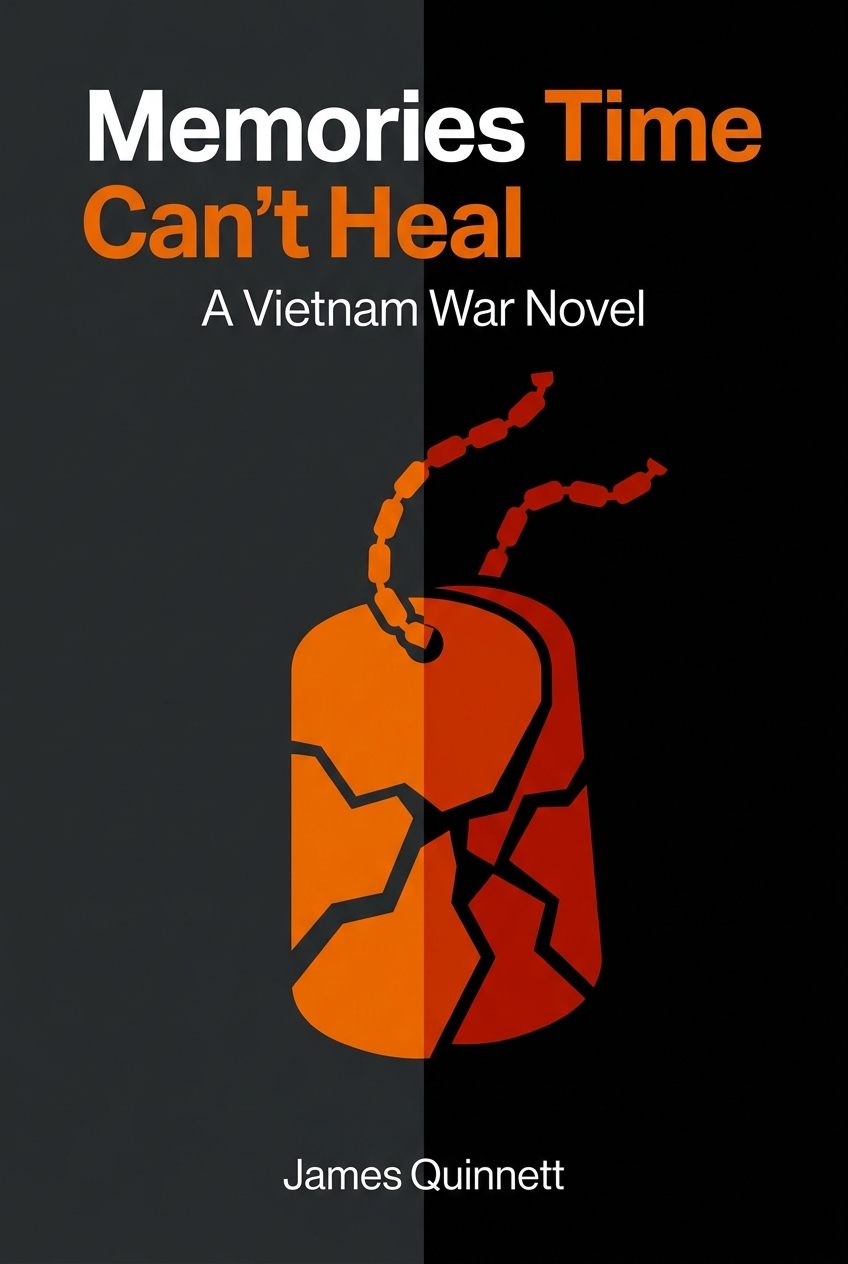
Memories Time Can't Heal book cover

The Script

In the archives of the city’s oldest newspaper, there are two identical boxes. Each contains the complete set of negatives from a single photographer, a man who documented the city’s reconstruction after the Great Flood of ‘58. The first box, cataloged as ‘The Official Record,’ holds the images that were published: stoic men clearing debris, families smiling in front of newly raised frames, the mayor cutting a ribbon. The images are clean, orderly, and tell a story of resilience and triumph.

The second box is unlabeled. Its negatives were never developed, never seen. They contain the moments between the official shots: a father staring blankly at a foundation where his house once stood, a woman weeping into a salvaged blanket, a child’s toy half-buried in the mud. These are images of loss. Together, the two boxes tell the real story—the public myth of recovery and the private, unprocessed grief that fueled it. This division between a community’s heroic narrative and its silent, individual pain is a phenomenon that fascinated James Quinnett, as a paramedic.

For fifteen years, Quinnett worked the night shift, responding to emergencies where the official incident report never captured the full human story. He saw the aftermath of events that would be sanitized for the morning news, witnessing the raw, unedited memories being seared into the minds of survivors. He wrote "Memories Time Can't Heal" after noticing a pattern: the moments that caused the most lasting damage were the ones that had no place in the official story of 'moving on.' The book became his attempt to develop the negatives from that second, unlabeled box and give voice to the quiet traumas that time, and public narratives, often refuse to acknowledge.

Module 1: The Psychological Disconnect and The Unspoken Bond

The book opens with a powerful scene. The narrator, fresh from Vietnam, sits in a Hilton bar in San Francisco. He watches civilians in their comfortable clothes, sipping drinks and talking about investments. He feels a surge of hatred. These people, he realizes, have no concept of the carnage he just left behind. This moment crystallizes the core theme of the book: the profound alienation of the returning soldier. The rhythms of civilian life—the fast cars, the urgent business—feel foreign and meaningless.

This leads to a crucial insight. Returning soldiers feel a profound alienation from a civilian world they find trivial and incomprehensible. The narrator looks at passing cars and wonders why everyone is in such a hurry. What could possibly be so important? This reveals a fundamental disconnect in values. The world he fought in demanded constant vigilance and a focus on pure survival. The world he returned to seems absorbed in concerns that feel utterly insignificant by comparison.

But flip the coin. While disconnected from civilians, these soldiers form an immediate, unspoken bond with each other. In that same bar, the narrator spots another young man, Jerome, who is about to ship out to Vietnam. He instantly recognizes him as a "kindred spirit." Their conversation is brief, grounded in a shared reality that no one else in the room can access. It’s here we see another key principle. A deep, unspoken camaraderie forms between soldiers, built on shared trauma that civilians cannot comprehend. The narrator looks into Jerome’s eyes and knows that a year from now, those eyes will have seen things only he and others like him could ever understand. It's a fellowship forged in the anticipation of shared horror.

So what does this mean? It suggests that deep, transformative experiences create their own tribes. In the high-stakes world of tech, founders who have navigated near-bankruptcy or engineers who have pulled off impossible product launches often share a similar bond. They've been through a fire others haven't. They speak a shorthand language of shared struggle. The book argues that this bond is a psychological necessity for survival.

Module 2: The Brutalizing Environment and The Arbitrary Nature of Fate

As the narrator arrives in Vietnam, the book pivots from the quiet alienation of return to the raw, visceral shock of the war zone itself. He describes veteran soldiers as "shadowy figures dancing," their behavior almost animalistic as they recount stories of violence to intimidate the newcomers. This is a chaotic, dehumanizing environment where civility is stripped away with terrifying speed.

This is where the author makes a chilling point. War rapidly strips away civilian morality, fostering a culture of brutality and emotional detachment. The narrator hears a rumor that soldiers from his own unit killed members of an allied artillery unit over a drunken argument. True or not, the story's existence highlights an atmosphere where irrational violence is a constant possibility. The "shackles of civilization," as he puts it, peel away not in months, but in days. He speculates on what the fresh-faced soldier Jerome might become: a stoner, a drunk, a killer. The environment demands this transformation.

And here’s the thing. In this brutal world, survival has little to do with skill or merit. It's almost entirely about luck. The book relentlessly demonstrates that in war, safety is an illusion and fate is arbitrary. The narrator’s relatively safe training period ends with a sudden nighttime deployment that shatters any sense of predictability. His landing zone, or LZ, is quiet, but he reflects that if it had been a "hot LZ"—one under enemy fire—they would have been slaughtered. It was pure chance.

This point is driven home by the shocking death of Captain Kahele. One moment, the captain is reassuring the narrator that everything will be alright. The next, he's killed by a single, random bullet. His promise, and the narrator's fleeting hope, are rendered meaningless by chaos. This is a story of human beings caught in a machine of random violence, where a life can be extinguished by a stray piece of metal, regardless of one's bravery, rank, or character. This forces a re-evaluation of our own ideas of control and predictability in high-stakes environments. We build systems and processes to manage risk, but Quinnett's narrative is a stark reminder that chaos is always lurking at the edges.

Read More