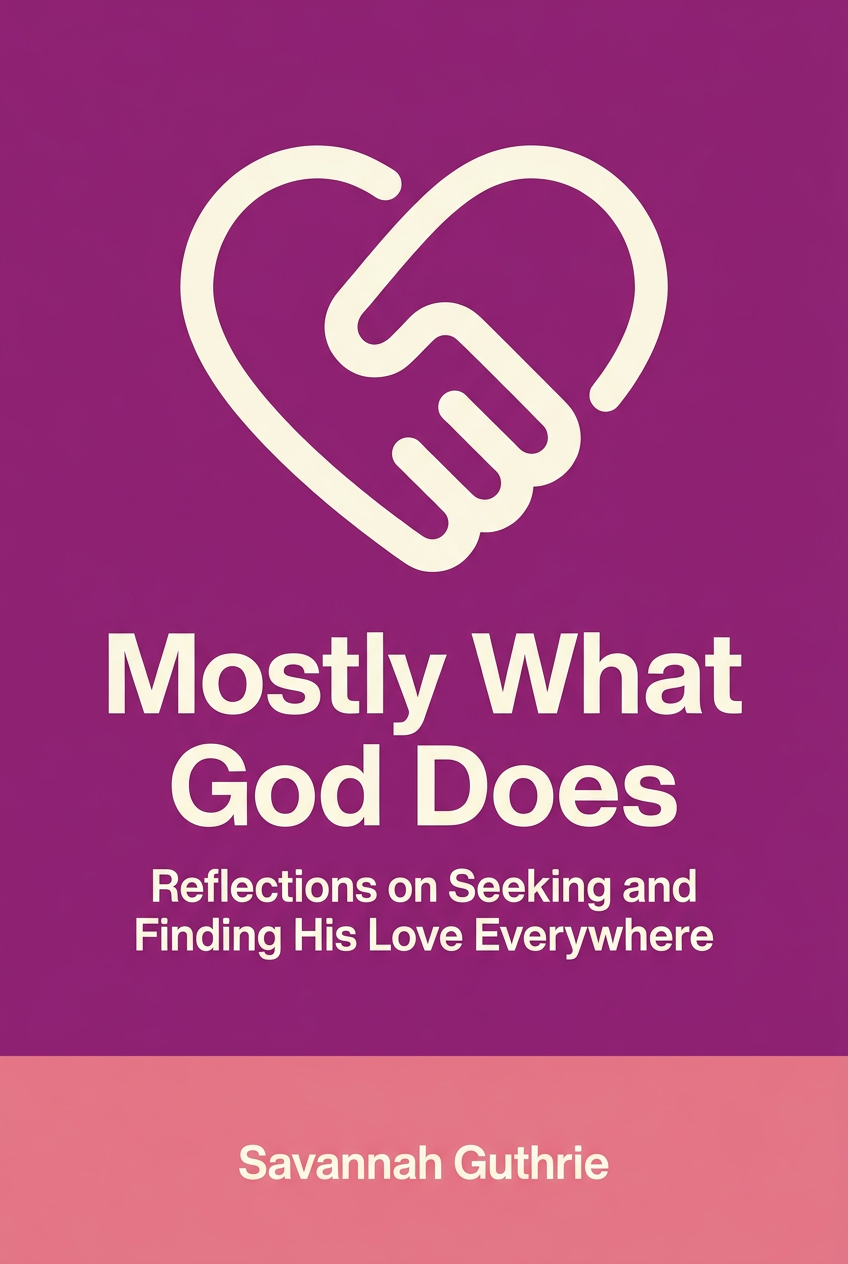
Mostly What God Does
Reflections on Seeking and Finding His Love Everywhere
What's it about
Tired of searching for faith in a world that feels chaotic and demanding? Discover how to find God's constant, loving presence not just in the big moments, but woven into the simple, everyday fabric of your life, from your morning coffee to your evening routine. You'll learn Savannah Guthrie's personal methods for seeing divine love everywhere, even amidst doubt and heartache. Through her candid stories and powerful reflections, you can shift your perspective from seeking a distant God to recognizing His hand in all that you do.
Meet the author
Savannah Guthrie is the Emmy-winning coanchor of NBC’s TODAY and chief legal correspondent for NBC News, known for her incisive interviews with top leaders and newsmakers. A lifelong student of faith, she has spent years wrestling with big questions and searching for God's presence in the everyday. This book is a collection of personal essays born from that journey, offering a vulnerable and relatable exploration of finding divine love in the midst of a busy, imperfect life as a wife, mother, and professional.
Opens the App Store to download Voxbrief

The Script
Think about the last time you followed a recipe. You gather the ingredients, measuring with precision: a cup of flour, a teaspoon of salt, two tablespoons of sugar. The instructions are a clear, logical sequence. Follow them, and you get a cake. Now, think about the last time you tried to comfort a crying child. There is no recipe. There is no precise measurement of hugs or soft words. You don’t follow a sequence; you feel your way forward. You sense what is needed—a story, a song, a quiet presence—and you offer it. One act is about control and predictable outcomes. The other is about presence and unpredictable grace. We spend so much of our lives trying to master the recipe, believing that if we just follow the right steps for our career, our family, our happiness, we will get the intended result. But so much of life, especially the parts that matter most, is the messy, intuitive, hands-on work of comfort and connection, where the most important ingredient is simply showing up.
This tension between the life we try to control and the one that actually unfolds is the very heart of Savannah Guthrie's spiritual journey. As a journalist and co-anchor of NBC's Today, her professional life is built on facts, timelines, and verifiable information—the world of recipes. Yet, in her personal life, particularly in the quiet, unscripted moments of motherhood and in the face of unexpected loss, she found that her deepest sense of faith wasn't discovered in a grand, orderly design. It was found in the small, the messy, the everyday. Mostly What God Does wasn't written as a theological treatise or a step-by-step guide. It grew from her personal journals, from a desire to capture those fleeting moments of grace that felt less like a divine plan being executed and more like a quiet, loving presence simply showing up, especially when no recipe could fix what was broken.
Module 1: The Core Revelation — God’s Primary Activity is Love
This entire book pivots on a single, transformative idea. It’s the starting point for everything else. The author suggests that before we can understand anything about faith, we must first grapple with the fundamental nature of God. And her core insight, drawn from a modern Bible paraphrase, is that God’s primary activity is to love you. This isn't a side-job or a secondary characteristic. It's His main thing. It's what He does.
This idea landed for Guthrie like a "thunderbolt." She contrasts the plain language of Eugene Peterson's The Message paraphrase with more traditional translations. Where others were formal, this was direct. It reframed God as an active, relational being whose chief occupation is love, rather than a distant, judgmental monarch.
So here's what that means in practice. It allows you to re-evaluate your own spiritual history. Guthrie talks about periods in her life when she felt distant from God. Years went by without prayer or Bible study. The traditional view would label this as failure, a source of guilt. But with this new lens, she asks a powerful question: "What if I believed that what he was really doing was loving me the whole time?" This simple shift transforms the narrative from one of human failure to one of divine faithfulness. It moves the emotional center from guilt to gratitude.
Building on that idea, the book argues that faith is a dynamic relationship, not a static achievement. It’s a lifelong connection with seasons of closeness and distance, not a state of constant, unwavering belief you either have or you don't. Guthrie is candid about her own journey. She describes a childhood where God was like a sixth family member. This was followed by years of intense devotion in her twenties. Then came a period of distraction and disappointment where she checked out. Yet, even in those distant years, the message that "God loves you" kept resurfacing. It was like a lifeline, a persistent, gentle call to reconnect. This illustrates a key belief in the book: God is an active participant in the relationship, patiently working to draw us back even when we wander.
Module 2: The Human Experience of Divine Love
Once we accept that God's primary action is love, the next question is: how do we experience it? Guthrie argues that this divine love is made tangible and understandable through our most profound human relationships.
Here's where it gets interesting. The author states that parenthood is the most powerful earthly metaphor for God's love. Guthrie, who became a mother later in life, describes the overwhelming, unconditional love she felt for her children as a revelation. It gave her a reference point for the divine. She shares a story about her son, Charley, going through a phase of being "mean to mommy." He would say hurtful things, yet her love for him never wavered. It was absolute. She uses this to illustrate God's love for us. It is a constant, foundational reality, not contingent on our good behavior or our feelings toward Him.
Furthermore, she connects this to the daily frustrations of parenting. When a parent denies a toddler ice cream for breakfast, it is an act of love based on a bigger picture the child can't see. She suggests we consider that God operates similarly. What we perceive as a "no" or a hardship might be an act of protection from a loving parent with a higher perspective.
This leads to a second crucial point. Because our feelings are unreliable, we must treat God’s love as a fact. Guthrie admits that most days, she doesn't feel like she's "soaking in God's love." Life is too busy. The demands are too great. The feeling fades. But the fact remains. She points to the Apostle John, who repeatedly called himself "the disciple whom Jesus loved." This was a statement of identity based on objective truth. For John, being loved by Jesus was the most important, objective fact about himself. Guthrie suggests we adopt this mindset. It’s a daily choice to interpret our circumstances through the lens of God's love, especially when it’s hard.
And it doesn't stop there. The book suggests we can use physical anchors to remind us of this spiritual reality. Personal symbols can make the abstract concept of divine love concrete and tangible. For Guthrie, this is her tattoo. It reads "All My Love," traced from her late father's handwriting in a letter to her mother. This tattoo serves as a permanent, physical link to her earthly father's love. By extension, it becomes a daily reminder of her heavenly Father's love. The phrase "All my love" is how she now imagines God speaking to the world. It’s a personal mantra that makes an enormous theological concept intimate and accessible. It’s a powerful example of how we can use tangible objects and memories to ground our abstract beliefs in our daily lives.