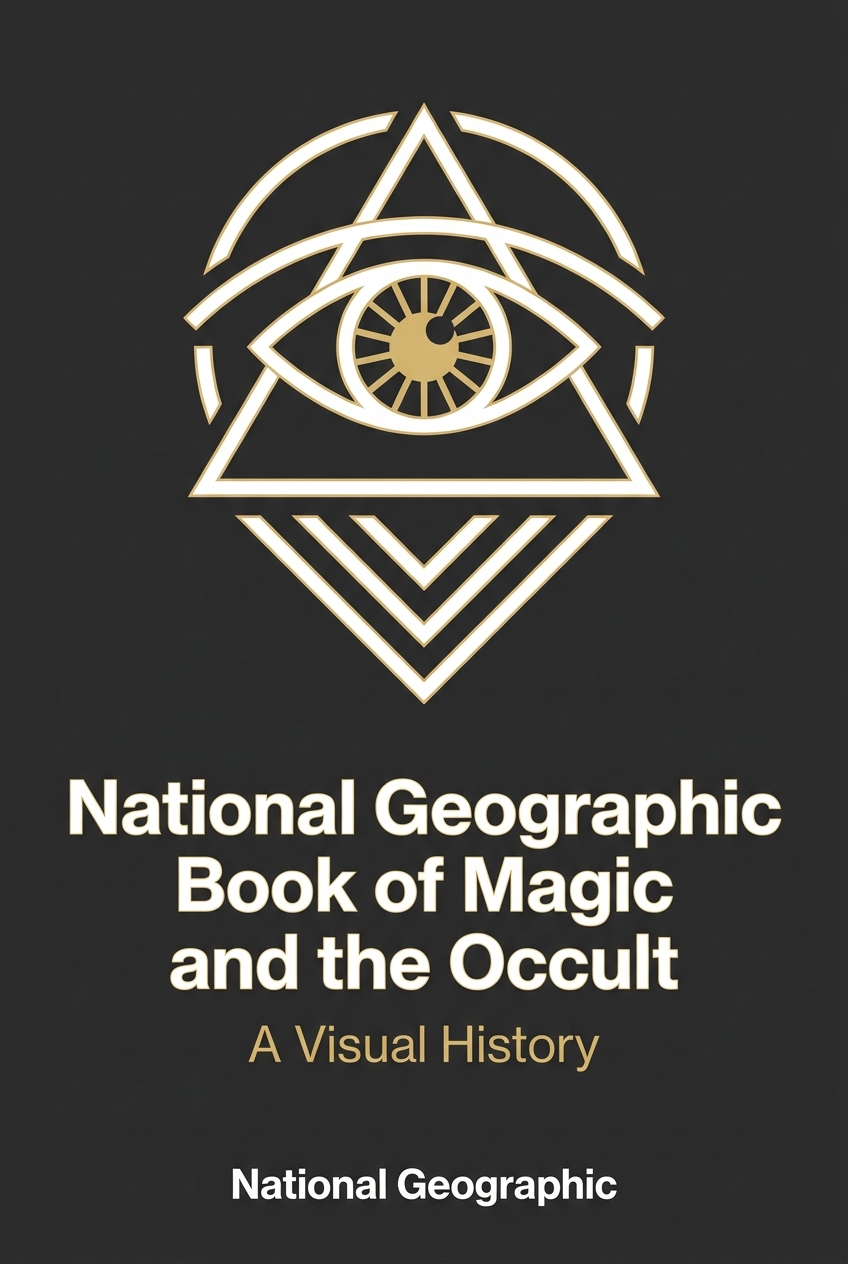
National Geographic Book of Magic and the Occult
A Visual History
What's it about
Ever wondered what separates magic from myth and religion? This visual history unearths the real stories behind humanity's most ancient and mysterious practices, from prehistoric rituals to modern-day witchcraft, revealing the powerful role belief has played in shaping our world. You'll journey across continents and centuries to explore the secrets of alchemy, divination, and spellcasting. Discover the tools of sorcerers, the symbols of secret societies, and the cultural impact of occult traditions, all brought to life through stunning imagery and expert historical insights.
Meet the author
For over 130 years, National Geographic has been the world's most trusted source for exploration, scientific discovery, and visual storytelling across cultures and throughout history. This unparalleled legacy of documenting human belief systems and ancient traditions provides the unique foundation for this definitive visual history. By drawing on its vast archives and network of experts, National Geographic illuminates the enduring power of magic and the occult, revealing the threads that connect these practices to our shared human story.
Opens the App Store to download Voxbrief

The Script
In a quiet German laboratory in 1954, a scientist slides a petri dish under his microscope. Inside, a colony of luminous bacteria glows with a soft, steady light, a tiny, self-contained constellation. For weeks, the light has been constant, a biological clockwork. But one morning, he walks in to find the dish dark. The bacteria are still there, still alive, but their collective light has vanished. He's baffled. Then, on a hunch, he takes a small sample from the darkened colony and places it into a fresh nutrient broth. For hours, nothing. But as the bacteria multiply, a critical threshold is reached, and suddenly, the entire new culture flashes into light, all at once, as if a command had been given. The bacteria weren't just glowing; they were communicating, waiting for a quorum before revealing their hidden power.
This phenomenon, now called quorum sensing, feels like something straight out of a grimoire—a secret language, a collective ritual, an invisible force made manifest. It highlights a persistent question that hums just beneath the surface of our modern, rational world: Where does the explainable end and the magical begin? For centuries, humanity has cataloged phenomena that defy easy explanation, from dowsing rods that twitch over unseen water to ancient rituals that seem to produce tangible results. These are the stories that live in the fascinating borderlands between science, faith, and folklore. It was this enduring human curiosity about the unseen that prompted National Geographic, an organization built on exploring and explaining the known world, to turn its cartographic eye inward, charting the vast, mysterious territories of human belief in magic and the occult.
Module 1: The Principle of Inherent Potential
A recurring theme across these stories is that magic is about revealing what is already there. The most powerful acts of magic or heroism come from understanding and unlocking the hidden potential within people, objects, and even the natural world itself.
This idea is first introduced with a young Viking boy named Odd. His father was a woodcarver with a specific philosophy. He believed the carving was already inside the wood. The artist's job was simply to remove everything that wasn't part of its true form. Odd internalizes this lesson. True power comes from recognizing and revealing the inherent nature of things. When he needs to reach the realm of the gods, Asgard, he doesn't conjure a portal. He sees a frozen waterfall and understands that a rainbow is "imprisoned" in the ice. By using a flint axe to carve the ice into a prism, he simply releases the rainbow that was always latently present. He facilitates, he doesn't force.
This principle extends beyond physical objects. In a later story, the protagonist Coraline faces a terrifying entity known as the "other mother." This creature has created a parallel world designed to be a more perfect version of Coraline's own life. But it's a flawed copy. The other mother can't truly create. Fabricated realities are inherently limited and will always betray their artificial nature through imperfection and incompletion. The other world has edges. Walk far enough, and the trees become "approximate, like the idea of trees." Go further, and the world dissolves into a blank, featureless mist. The other mother can only twist and distort things that already exist. She cannot make something new. Coraline's victory comes from understanding this limitation. She realizes the other mother's power is based on illusion, not true creation.
Finally, we see this concept applied to personal growth. A boy named Bod, raised in a graveyard, is told by his guardian, Silas, about the nature of life and death. Silas explains that being alive means having "infinite potential." You can do anything, dream anything. Death is the end of that potential. It is the final state. Bravery is acting in accordance with your potential despite being afraid. Coraline learns this lesson explicitly. Her father tells her about a time he was swarmed by wasps. He stood still so she could escape, but he insists that wasn't brave because he wasn't scared; it was just the logical thing to do. Going back for his glasses later, when he was truly terrified, that was bravery. Coraline internalizes this. She returns to the other mother's world not because she is fearless, but because she knows it's the right thing to do. She acts on her potential for courage.