All Books
Self-Growth
Business & Career
Health & Wellness
Society & Culture
Money & Finance
Relationships
Science & Tech
Fiction
Topics
Blog
Download on the App Store

Never Finished

Unshackle Your Mind and Win the War Within

15 minDavid Goggins

What's it about

What if you're only using a fraction of your true potential? David Goggins argues that your mind gives up long before your body does. Learn how to break through that mental barrier and access a new level of grit, resilience, and achievement you never thought possible. This summary unpacks Goggins's "one-second decision" framework and other powerful mental tools. You'll discover how to reframe your past, embrace discomfort as a path to growth, and build an unbreakable mindset. Stop being a victim of your own thoughts and start winning the war within.

Meet the author

David Goggins is a retired Navy SEAL and the only member of the U.S. Armed Forces to complete SEAL training, Army Ranger School, and Air Force Tactical Air Controller training. Overcoming a childhood of poverty, prejudice, and abuse, he transformed himself through sheer self-discipline and mental toughness. Goggins is also an elite ultramarathon runner and former world record holder for the most pull-ups done in 24 hours, embodying the principles of unshakable resolve he shares in his writing.
Listen Now

Opens the App Store to download Voxbrief

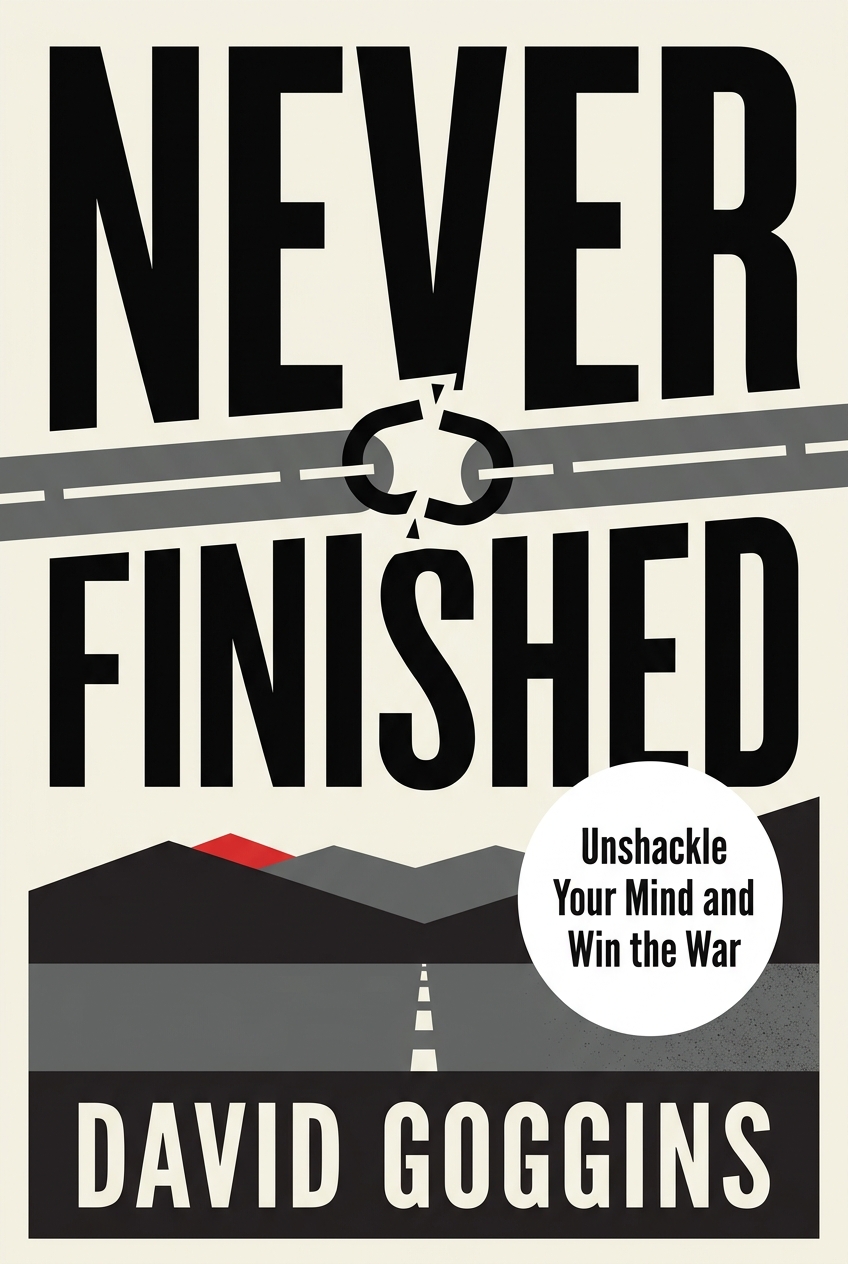
Never Finished book cover

The Script

The mind is like a master jeweler, meticulously crafting a display case to hold its most cherished accomplishments. Each success—a promotion, a finished project, a personal best—is polished and placed under perfect lighting. We return to this case often, admiring the collection, feeling the warmth of past victories. But over time, the velvet lining can become a comfort zone, the glass a barrier. The jeweler's true craft is in venturing back into the dark, chaotic mines of potential to find, cut, and polish new ones. The most valuable work happens far from the finished product, in the grit and pressure where raw, unformed capacity is forged into something brilliant. What happens when someone decides to smash the display case and live permanently in the mine?

This relentless pursuit of the next challenge, of living in a state of constant self-excavation, is the life's work of David Goggins. After sharing his story of radical transformation in his first book, he found that many people treated his journey as a finished product—a trophy to be admired. But for Goggins, a retired Navy SEAL and elite endurance athlete, the concept of being 'finished' is a dangerous illusion. He wrote Never Finished as a direct response to this, a raw, unfiltered look into his ongoing process of breaking down his own mental and physical barriers, long after the world deemed him a success. It’s an exploration of the idea that our potential is an infinite mountain range we must continually learn to climb.

Module 1: The One-Second Decision

We all have dreams. Big, audacious goals we set in moments of comfort. Maybe it’s launching a startup, running a marathon, or becoming a Navy SEAL. But Goggins points out a brutal truth. Most dreams die in the middle of suffering. When the pressure is immense and your mind is screaming to quit, you are just one second away from abandoning everything. Goggins argues that the single most important battle you will ever fight happens in that one second.

He illustrates this with a story from his own SEAL training. During the infamous Hell Week, he was slammed by a frigid six-foot wave. The shock and his deep-seated fear of water triggered a moment of terrifying clarity. A voice in his head said, "I don’t really want to be a Navy SEAL." He was a half-step away from quitting. But in that critical moment, he made a choice. He didn't react. He thought. This leads to his first major insight.

In moments of extreme pressure, you must win the one-second battle in your mind. Instead of giving in to the emotional impulse to quit, you have to force a pause. Goggins took a deep breath. He projected his future if he quit. He saw himself back in a dead-end job, haunted by regret. That vision was more painful than the cold ocean. So he made the one-second decision to stay. He locked arms with his teammates and faced the next wave. This tiny choice, repeated thousands of times, is what separates those who persevere from those who quit.

This brings us to the next point. You have to train for these moments before they happen. You must consciously quit on your own terms. Goggins is clear. Quitting isn't always wrong. But how you quit matters. Quitting on impulse, at the peak of pain and insecurity, leaves a permanent scar of regret. A conscious decision to change course, made from a place of clarity, is different. The rule is simple. Never quit when it’s hard. If you must retreat, do it when it’s easy. Get through the storm first. Then decide your next move with a clear head.

But how do you survive the storm? Here's the thing. You must reframe suffering as a finite event. During Hell Week, Goggins didn't focus on the 130 hours remaining. That number is overwhelming. Instead, he broke it down. He told himself, "This sucks, but it will be over." He focused on winning the next second, the next minute, the next evolution. By viewing suffering as a temporary state, you strip it of its power. You make it manageable. This mental tool allows you to endure what seems unendurable. It’s about managing your mind when fear is at its loudest.

Module 2: The Mental Lab and the Savage Alter Ego

Goggins realized early on that his primary obstacle was his own mind. He was trapped by a "born loser" mentality. He survived, but he never aimed to excel. To break this cycle, he had to go to war with himself. This required a new kind of training ground.

This is where he introduces the idea of the Mental Lab. It's a dedicated space in your mind for brutal self-honesty. A place where you dissect your fears, failures, and insecurities. You don't hide from them. You put them under a microscope. Goggins used his workouts, his study sessions, and every moment of self-doubt as an experiment. He was testing the limits of his own mind. From this foundation, he offers a powerful strategy. You must build a "Mental Lab" to deconstruct and rebuild yourself. This is about confronting the ugly truth. You must own exactly who you have become, flaws and all. Goggins looked in the mirror and admitted he was a quitter with thin skin. Only by accepting this reality could he begin to change it.

So what happens next? Once you see the raw material, you need a tool to shape it. For Goggins, this tool was an alter ego. He psychologically separated himself from "David," the scared, abused kid. He created "Goggins," a savage who refused to be denied. This was a new identity powered by the dark side of his soul. It was a persona that fed on pain and rejection.

This leads to a crucial insight. Create a relentless alter ego to access untapped mental reserves. This alter ego doesn't make excuses. It doesn't seek comfort. It thrives on adversity. When Goggins faced a challenge that felt too big for "David," he would call on "Goggins." This mental shift allowed him to access a level of grit and determination he didn't know he had. It's a way to weaponize your own psychology. You can tap into the unused strength and passion that Goggins calls the "dark matter" of your mind.

But even a savage can get soft. After the success of his first book, Goggins found himself living a comfortable life. He was training for maintenance, not for growth. He had become a "part-time savage." He realized that complacency is the enemy of a savage mindset. Praise and comfort are dangerous. They soothe the inner savage and dull your edge. To stay sharp, you have to constantly seek out discomfort. You must deliberately put yourself in situations that test your limits. This is why Goggins signed up for the Leadville 100-mile race on short notice. He needed to re-enter the crucible. He needed to prove to himself that "Goggins" was still there, ready for a fight.

Read More