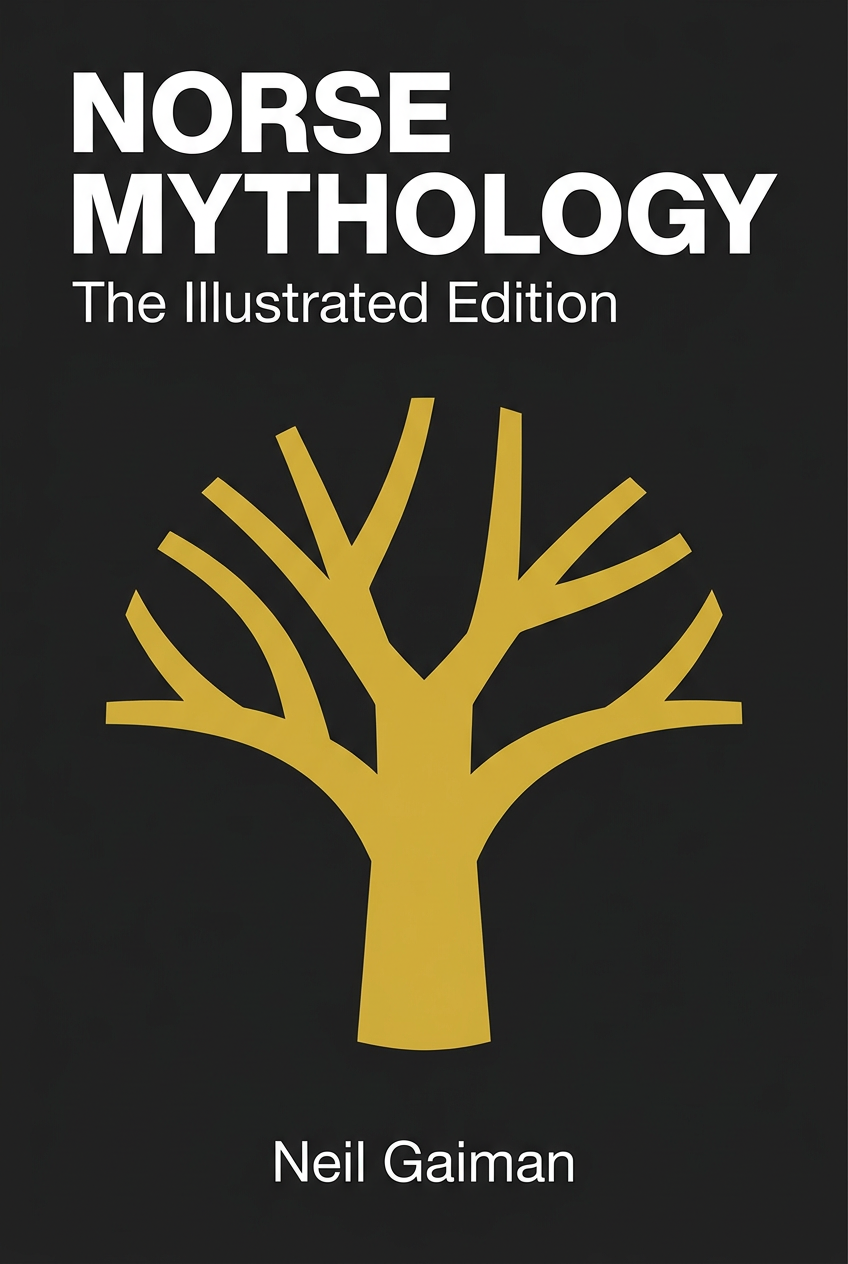
Norse Mythology
The Illustrated Edition
What's it about
Ever wonder about the epic tales that inspired Thor and Loki? Dive into the world of Norse mythology and discover the original, breathtaking stories of gods, giants, and the end of all things. This is your chance to finally understand the myths that shape modern fantasy. You’ll journey alongside Odin, the all-father who sacrificed an eye for wisdom, and witness Thor’s mighty hammer in action against colossal frost giants. Learn the secrets of Asgard, the nine realms, and the intricate web of deceit spun by the trickster Loki, all leading to the final, cataclysmic battle of Ragnarök.
Meet the author
Neil Gaiman is the celebrated, award-winning author of The Sandman and American Gods, whose lifelong passion for ancient myths has made him a master of modern fantasy. From his childhood devouring the tales of Asgard's gods in the pages of comics, Gaiman developed a unique talent for revitalizing these stories for a new generation. He channels this deep-rooted fascination into his work, expertly weaving the power, drama, and humor of the Norse sagas into a compelling and accessible narrative for today's readers.
Opens the App Store to download Voxbrief

The Script
Think of the great, foundational stories. The ones that feel like they were carved from mountains and polished by glaciers. The ones where the world is new and still wet clay, where gods walk in muddy boots, bleed golden ichor, and are just as foolish, greedy, and brilliant as we are. These are stories that don't just explain lightning; they give lightning a personality, a temper, and a very large hammer. They are tales told around a fire to make sense of the frost creeping up the walls and the howl of the wind that sounds a bit too much like a wolf. They are the original shared universe, a web of tales so interconnected that a casual lie told in one story can unravel a world in another.
These are the stories that captured Neil Gaiman as a child. Long before he was a celebrated author of novels like American Gods and the comic series The Sandman, he was a boy in England devouring tales of Thor, Loki, and Odin. He found them raw, funny, and deeply human, but he also found them scattered, retold in fragments, or simplified for children. He felt the original, powerful stories—the adult versions full of trickery, sex, and cosmic despair—were becoming lost, like distant echoes. He wrote Norse Mythology to retell them with the clarity and narrative drive of a master storyteller, to gather those scattered echoes and let them ring out once more, clear and powerful for a new generation.
Module 1: The Power of Perceived Weakness
We often view adversity as a disadvantage. A setback. A bug in the system. But what if it’s actually a filter? A mechanism that strips away the non-essential and forces a different kind of strength to emerge. This is the story of Odd, a boy whose name means "tip of a blade" and is considered lucky. Yet, his life is anything but. His Viking father dies from exposure during a raid. A falling tree then shatters Odd’s leg, leaving him crippled. His village, a place of shared, loud emotion, can't understand his quiet, smiling resilience. They see his lack of outward grief as an infuriating flaw.
This brings us to a critical insight. Your greatest innovations often come from your greatest constraints. Odd's physical limitations and social isolation don't break him. They sharpen him. Unable to keep up with the other boys, he retreats to the woods. He learns the rhythm of the seasons. He becomes an observer. His crippled leg forces him to think, not just react. When an endless winter descends, he doesn't despair. He takes his father's axe, limps to a remote cabin, and survives. His "weakness" becomes the very thing that positions him for an extraordinary journey. For the professional facing a budget cut, a smaller team, or a technical limitation, this is a powerful reframe. The constraint is the directive. It forces you to find a more elegant, more creative solution that brute force could never uncover.
Then, the story reveals a deeper layer. Adaptability is a function of resourcefulness. In the deep woods, Odd finds a fox, an eagle, and a bear. The bear is trapped by a fallen tree. A normal person might run. A Viking might see a threat. Odd, however, sees a problem to be solved. He uses his axe as a tool to free the animal. He has ingenuity. This single act of kindness sets the entire plot in motion. The animals, he soon learns, are the gods Odin, Loki, and Thor, trapped in animal form by a Frost Giant.
This leads to a final, crucial point about perception. True character is revealed when your external identity is stripped away. The villagers see Odd as unlucky and broken. His stepfather ignores him. But when he is alone, defined only by his actions, his true nature emerges. He is a provider, a problem-solver, and a leader. He builds a fire. He finds food. He takes charge of three very powerful, very grumpy, and currently very helpless gods. He simply does what needs to be done. It's a stark reminder that our value isn't tied to our title or social standing. It's defined by our capacity to act effectively, especially when no one is watching.
Module 2: Deconstructing the Divine
Now, let's explore the gods themselves. We often think of gods as omnipotent beings. Perfect, all-knowing, and untouchable. Gaiman’s portrayal shatters this illusion. The Norse gods are powerful, yes. But they are also petty, vain, and remarkably fallible. Their conflicts are driven by familiar human failings. Lust, jealousy, and ego.
This gives us our first major insight into their world. Even gods can be outmaneuvered by exploiting their predictable flaws. How do the gods of Asgard end up exiled as animals in Midgard, the human world? It starts with Loki. A Frost Giant, disguised as a beautiful maiden, seduces Loki with flattery. The giant says she desires Thor's hammer, Mjollnir, as a token of affection. Loki, driven by vanity and a desire to impress, steals the hammer. The moment he hands it over, the trap is sprung. The "maiden" reveals his true form, uses the hammer’s power against the gods, and exiles them. The entire catastrophe hinges on Loki’s well-known weakness for clever schemes and attractive propositions. It’s a timeless lesson in strategy. Understanding an opponent’s psychology is more powerful than matching their strength.
From this foundation, we see how divine actions have real-world consequences. The conflict isn't contained to the heavens. Mythological struggles are the operating logic of the natural world. The endless winter that cripples Odd's village is a direct result of the Frost Giants' victory. The book explains that past wars between gods and giants caused ice ages. When the gods win, the ice retreats. When the giants win, it advances. This connects the grand, cosmic drama directly to the human struggle for survival. It suggests that the large-scale forces shaping our industries and markets aren't abstract. They are the result of specific actors making specific decisions, often driven by their own internal conflicts.
But here's where it gets really interesting. The story subverts the power dynamic entirely. Mortals can be pivotal actors in divine conflicts. Odd, the crippled boy, is the one who finds the transformed gods. He feeds them. He listens to their bickering. And most importantly, he decides to help them. He takes on the mission of restoring them to power because he sees that their problem is his problem. The endless winter will kill his people. His agency is born of necessity. This is a crucial takeaway for anyone in a large organization. You may not feel like you have the power of a "god" in the C-suite. But proximity to the problem gives you a unique perspective and the ability to act. Your initiative can be the catalyst that solves a problem even the most powerful leaders are stuck on.