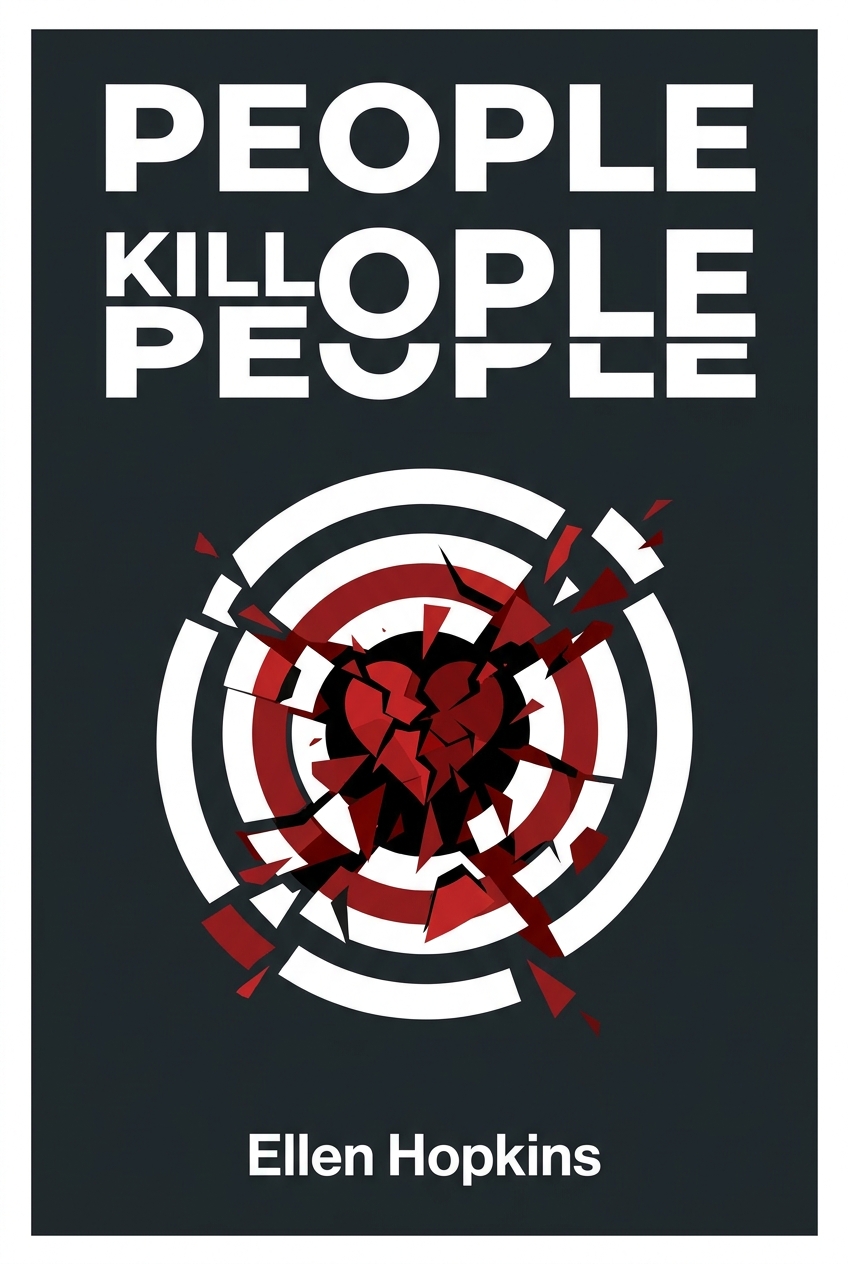
People Kill People
What's it about
Ever wonder what pushes ordinary people to do the unthinkable? This gripping novel plunges you into the lives of six teenagers whose worlds collide in a single, tragic moment, forcing you to confront the complex realities behind gun violence and question what you truly believe. You'll get a raw, unfiltered look into each character's story—their family struggles, hidden secrets, and personal demons. Discover how love, fear, and desperation can drive people to their breaking point, revealing that the reasons people kill are never as simple as they seem.
Meet the author
Ellen Hopkins is a 1 New York Times bestselling author of fifteen acclaimed novels, renowned for her unflinching and poetic explorations of difficult teen issues. A former journalist and poet, Hopkins draws from both real-world headlines and her own experiences as an adoptive mother to craft powerful, authentic stories. Her unique verse style gives voice to the complex emotions surrounding topics like gun violence, offering readers a deeply personal and resonant perspective on challenging social realities.
Opens the App Store to download Voxbrief

The Script
Two men enter the same sporting goods store. The first, a father, walks with his son toward the fishing aisle. He points out lures, teaches the boy how to test the flex of a rod, and buys a small tackle box—a container for future memories of quiet mornings on a lake. The second man walks past them, his eyes fixed on the glass counter at the back of the store. He doesn’t see the father and son. He doesn’t see the colorful displays of kayaks or the neatly stacked sleeping bags. He sees only his destination: the firearms section. He’s there to buy a tool. For him, it’s a simple transaction, a means to an end he has already decided upon. The father and son leave with a promise of connection. The second man leaves with an instrument of disconnection, its potential waiting to be unlocked.
Both men purchased an object. Both objects are inert, holding no inherent morality. Yet one is designed to create a story, and the other is designed to end one. This stark contrast—the same world holding both the peaceful ritual and the violent transaction—is the central tension that author Ellen Hopkins felt compelled to explore. A foster mother who has worked with countless troubled teens, Hopkins has witnessed firsthand how seemingly disconnected lives can violently intersect. She wrote "People Kill People" to step inside the minds of the people involved—the bullied, the grieving, the mentally ill, the responsible, and the radicalized. She wanted to untangle the complex web of human motivations that leads one person to pick up a fishing rod and another to pick up a rifle.
Module 1: The Human Triggers of Violence
This book argues that violence is about the person holding the weapon. Hopkins personifies "Violence" as a seductive whisper, a latent potential that exists in everyone. It’s a seed of savagery that can sprout when watered by the right combination of fear, trauma, and misinformation.
The first key insight is that fear, when amplified by media and prejudice, can create a deadly feedback loop. We see this with Zane, a retiree consumed by grief over his son's death in war. He sits at home, watching cable news that paints his neighborhood as a hotbed of "jihadists" and "punks." His fear is irrational. It's unfounded. But it feels real to him. This fear, stoked by a constant stream of alarmist media, drives him to buy a gun. He isn't a monster. He's a scared man who makes a fatal decision based on a distorted reality. The tragedy that follows—the accidental shooting of his wife, Renee—is a direct result of this manufactured paranoia.
Building on that idea, the book shows how personal trauma becomes a powerful catalyst for adopting extremist ideologies. Take Silas. His entire white nationalist worldview is rooted in a single childhood wound: his father left his family for a Mexican woman. This personal betrayal metastasizes into a sweeping racial hatred. Silas feels powerless and abandoned. So he seeks out a new family, a new identity. He finds it in the Traditionalist Youth Network, an online hate group that gives his anger a name and a target. The group provides what his family couldn't: a sense of belonging, a clear purpose, and a community that validates his feelings of victimhood. Extremist groups weaponize personal grievance to recruit the alienated. They offer simple answers to complex pain. For Silas, "white sovereignty" is a way to reclaim the control he lost as a child.
Finally, the book reveals a chilling truth: the desire for revenge can be a driving life force, rationalizing violence as justice. We see this in Rand, a young man haunted by childhood sexual abuse. His abuser, a trusted scoutmaster, stole a piece of his soul. Now, Rand’s entire life is oriented around settling that score. He wants to become a cop to "take out bad guys." His desire for revenge is so powerful it shapes his career choices. The narrative even describes revenge as a sensuous experience—something you can feel, taste, and see. This shows how a thirst for vengeance can become an all-consuming obsession, making a violent act feel not just justified, but necessary for becoming whole again.