All Books
Self-Growth
Business & Career
Health & Wellness
Society & Culture
Money & Finance
Relationships
Science & Tech
Fiction
Topics
Blog
Download on the App Store

Porsche 911

50 Years

18 minRandy Leffingwell

What's it about

Ever wonder what makes the Porsche 911 more than just a car, but a cultural icon that has dominated racetracks and captured hearts for over half a century? Get ready to uncover the engineering genius, design evolution, and riveting stories that cemented its legendary status. You'll go behind the scenes to explore the 911's journey from a controversial successor to the beloved 356 to a global performance benchmark. Discover the secrets of its distinctive rear-engine layout, the personalities who shaped its destiny, and the pivotal moments that defined each generation of this automotive masterpiece.

Meet the author

Randy Leffingwell is one of the world’s leading Porsche historians, having authored more than fifty books on transportation, including the award-winning Porsche 911: 50 Years. His career began as a newspaper photojournalist, which evolved into a lifelong passion for documenting the stories behind legendary marques. Leffingwell combines his investigative reporting skills with unparalleled access to Porsche's historical archives, offering readers a truly definitive and insider perspective on the iconic 911.
Listen Now

Opens the App Store to download Voxbrief

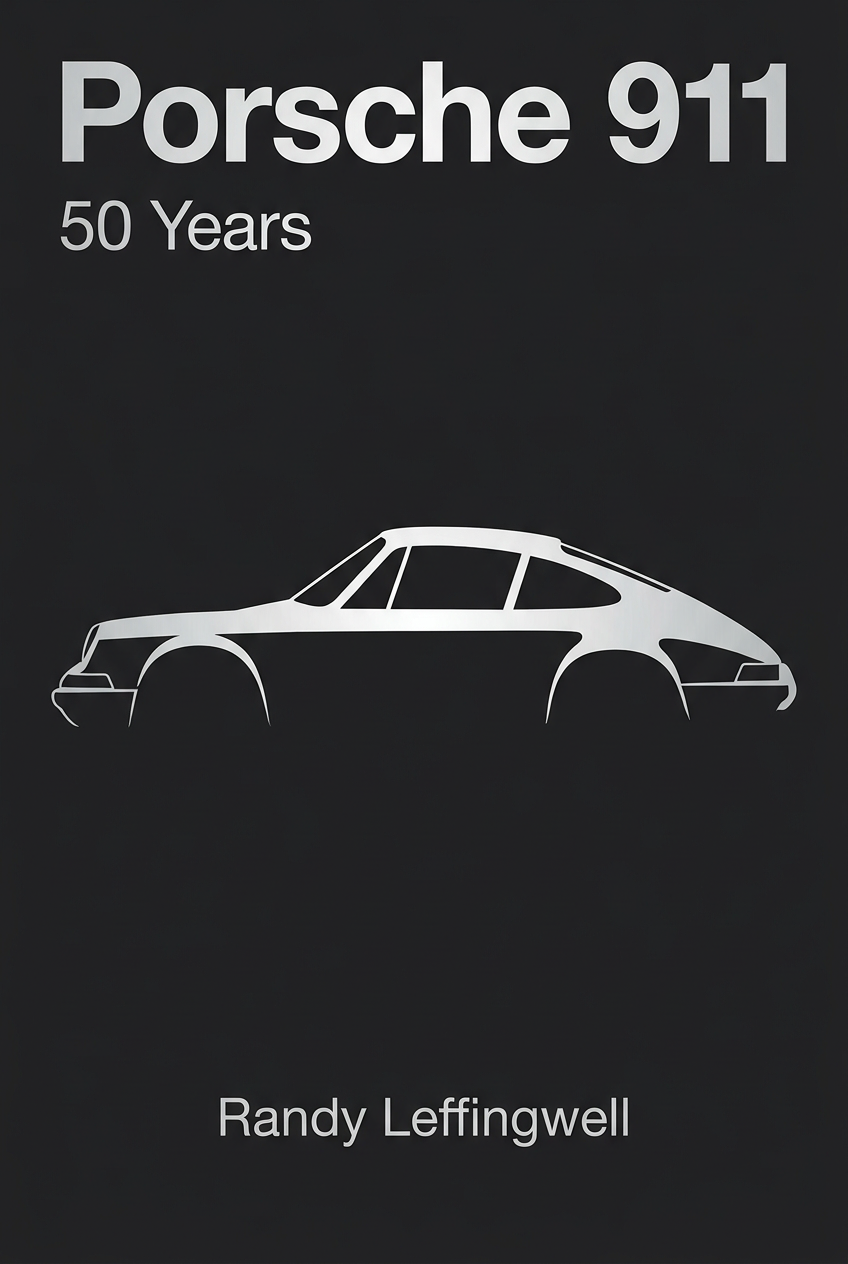
Porsche 911 book cover

The Script

In a world of finite objects, some things manage to achieve a kind of immortality. A Stradivarius violin, passed from virtuoso to virtuoso, doesn't just survive; its voice deepens with every generation. Its wooden body, shaped by a master centuries ago, absorbs the triumphs and anxieties of each player, its varnish bearing the faint, ghostly map of their touch. It is a living ledger of human expression, a physical vessel carrying an unbroken chain of sound and story. The violin changes the player as much as the player changes the violin, creating a legacy that transcends the simple sum of its spruce and maple parts.

This same rare alchemy—where an object becomes a legend—is what captivated photographer and historian Randy Leffingwell. He saw it not in a concert hall, but on the racetrack and the open road, embodied in the unmistakable silhouette of the Porsche 911. For years, Leffingwell had documented the world of high-performance machinery, but the 911 presented a different kind of puzzle. The story was about how a single, stubborn design philosophy could persist for decades, constantly refined but never abandoned, becoming a cultural touchstone. Leffingwell set out with his camera to capture the story of an icon that, like the master's violin, had become a repository of history, passion, and relentless ambition.

Module 1: The Birth of an Icon

The story of the 911 begins with a simple problem. Ferry Porsche couldn't find a car he wanted to buy. So, he decided to build one himself. This led to the Porsche 356, the 911's direct ancestor. The 356 was born in a former sawmill in Austria. It was a humble start. But it established a core principle for the company.

First, Porsche's evolution was driven by listening to its most demanding users. Early on, customers and distributors provided direct feedback. They wanted more power. They demanded more comfort and space. American distributors like Max Hoffman were especially influential. Hoffman saw a market for a stripped-down, sportier car. His feedback led directly to the creation of the iconic 356 Speedster. This model became a sensation on the American West Coast. It proved that listening to the edge cases in your market can unlock massive opportunities. Porsche learned to build for its most passionate advocates.

This brings us to the next generation. The transition from the 356 to its successor was not smooth. It involved a clash of philosophies. On one side was Erwin Komenda, a traditionalist. He believed new models must resemble their predecessors. His initial design was a "swollen 356." On the other side was Ferry's son, F. A. Porsche. He was trained to reduce designs to their purest geometric form. He felt little obligation to the past.

And here's the thing: Breakthroughs often require a battle between continuity and progress. Ferry Porsche ultimately rejected the traditionalist view. He tasked his son with creating something new. The result was the prototype for the car we now know as the 911. Its clean lines and modern silhouette were a direct result of this generational shift in thinking. It was a risk, but it defined the car's identity for decades to come.

So what happens next? The new car was initially called the 901. It was unveiled at the Frankfurt Motor Show. But there was a problem. French carmaker Peugeot had trademarked three-digit model numbers with a zero in the middle. This legal pressure forced a quick pivot. Thus, external constraints can force creative solutions that become iconic. Porsche simply replaced the "0" with a "1." The 901 became the 911. A simple change, born from a legal threat, created one of the most famous names in automotive history.

Finally, Porsche immediately began to diversify the platform. They understood that a single model couldn't serve everyone. They created the 912, an entry-level version with a smaller engine. This made the 911's desirable shape accessible to more buyers. They also introduced the 911S for high performance and the 911T for touring. But the most innovative move was the Targa. Creating a convertible was difficult. The car's structure couldn't support a fully retractable roof. So, engineer Helmuth Bott proposed a solution. He added a fixed stainless-steel roll bar for rigidity. This solved the engineering problem while also creating a unique and stylish new model. This shows that a diversified product line captures a wider market and allows for targeted innovation. By creating a family of models, Porsche could experiment with different price points, performance levels, and features, all on a single, successful platform.

Module 2: Crisis, Turbocharging, and Corporate Change

The 1970s brought a perfect storm of challenges. The OPEC oil embargo hit the sports car market hard. New U.S. safety and emissions regulations threatened the 911's very existence. The value of the German Deutsche Mark soared, making the cars expensive for American buyers. Porsche’s response to these pressures defined the 911's next chapter. It proved that external crises are powerful catalysts for engineering innovation.

For instance, to meet 5-mph impact standards, designers created new bumpers with accordion-like covers. This solution was elegant. It met the regulation without ruining the car's lines. To tackle emissions, engineers increased engine displacement. This promoted more complete combustion and torque. Porsche used regulations as a reason to make the car better.

Building on that idea, the company also turned to its racing program for answers. On the track, the 911 suffered from front-end lift at high speeds. Wind tunnel testing led to a simple front spoiler. This innovation quickly moved from race cars to production models. Then came the "ducktail." This distinctive rear spoiler was developed to improve high-speed stability. It became a signature feature of the legendary 1973 Carrera RS. This proves that motorsport is a high-speed R&D lab for production technology. Racing was where Porsche solved its hardest engineering problems.

The most significant technology to emerge from this era was turbocharging. Ernst Fuhrmann, the company's new leader, insisted that racing success must translate to road cars. Porsche had dominated the Can-Am racing series with its turbocharged 917. Fuhrmann directed his engineers to adapt that technology for the 911. The result was the 1975 911 Turbo, also known as the 930. It was a monster. Its performance was staggering. It created a new halo model for the brand.

But flip the coin. This period also saw immense internal turmoil. Tensions between the founding Porsche and Piëch families boiled over. The families agreed to step back from daily operations. They installed a professional management team. Fuhrmann, the new CEO, inherited a company that had secretly planned to kill the 911. He saw its continued sales success and reversed course. He focused on revitalizing the platform with models like the Carrera RS and the Turbo. Later, CEO Peter Schutz famously saved the 911 from cancellation. He saw the production plan on a chart in his office, extended the line for the 911 off the page, and declared, "We will not stop building the 911." This shows that corporate strategy and leadership vision are as critical as engineering. Without committed leaders, even the best products can be prematurely abandoned.

We've covered a lot. But the most important development was the 959. This project was a glimpse into the future. It was conceived as a technology showcase for the FIA's Group B racing category. It featured all-wheel drive, sequential twin-turbocharging, and active suspension. The 959 was a laboratory on wheels. It tested technologies that would appear in 911s years later. Development costs were enormous. The economic downturn of the late 1980s hit Porsche hard. The 959 project, combined with a collapsing U.S. market, contributed to the departure of both CEO Schutz and development chief Helmuth Bott. The 959 demonstrates that "moonshot" projects push the boundaries of what's possible, even if they strain resources. It was a massive financial risk, but it secured Porsche's technological leadership for a generation.

Read More