All Books
Self-Growth
Business & Career
Health & Wellness
Society & Culture
Money & Finance
Relationships
Science & Tech
Fiction
Topics
Blog
Download on the App Store

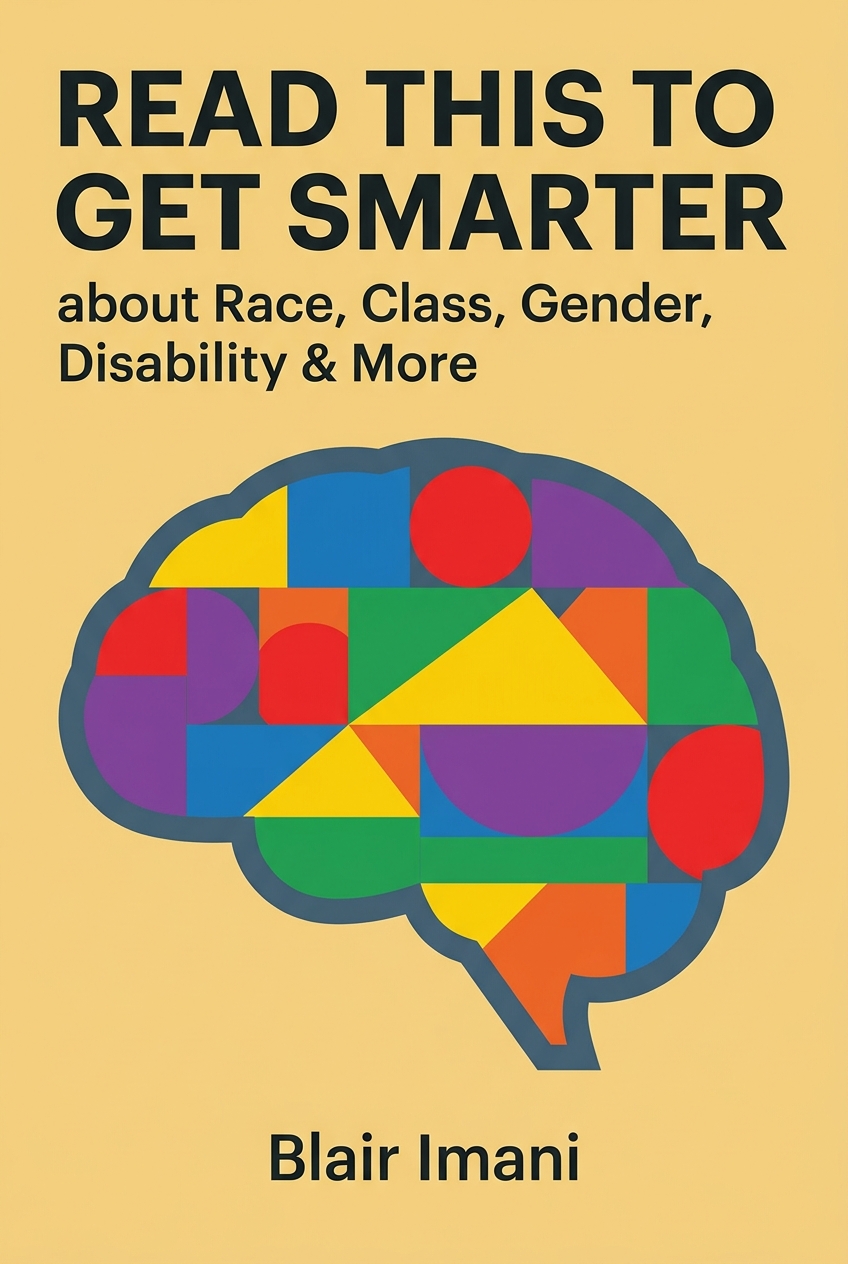
Read This to Get Smarter

about Race, Class, Gender, Disability & More

18 minBlair Imani

What's it about

Ever feel like you're walking on eggshells when discussing topics like race, gender, or disability? Learn how to navigate these crucial conversations with confidence and compassion. This guide provides the clear, accessible language you need to understand the world and the people in it. Go beyond the buzzwords and dive into the core concepts that shape our society. You'll uncover the history behind terms like intersectionality and cisgender, and gain practical tools to challenge your own biases, become a better ally, and foster more inclusive communities in your daily life.

Meet the author

Blair Imani is a critically-acclaimed historian, educator, and influencer whose viral "Smarter in Seconds" videos have taught millions of people about crucial social justice topics. A Black, bisexual, and Muslim woman, her work is informed by her own lived experiences navigating complex intersections of identity. Imani's unique ability to distill complicated subjects into accessible and engaging lessons empowers readers to create a more equitable world, one conversation at a time.
Listen Now
Read This to Get Smarter book cover

The Script

We treat knowledge like a complex machine with a steep learning curve. To understand a big topic—say, the economy or the justice system—we assume we need to apprentice ourselves to experts, poring over dense texts and mastering a specialized vocabulary just to gain entry-level access. This belief creates a silent barrier, convincing us that true understanding is reserved for a select few with the time and training to decipher it. This turns learning into an act of intimidation rather than an act of curiosity. We stand outside the walls of a topic, assuming the gate is locked, when in reality, the door was never closed. The complexity we perceive is often a failure of explanation, not a measure of the topic’s inherent difficulty.

The truth is, the most profound ideas are simply trapped in poor communication. This realization is what drove educator and historian Blair Imani to create a new kind of learning tool. Frustrated by seeing essential conversations about history, culture, and social structures stall because people felt they lacked the 'credentials' to participate, she set out to dismantle the myth that intelligence requires a formal, difficult apprenticeship. As a public historian who specializes in making the inaccessible accessible, Imani wrote Read This to Get Smarter as a series of clear, concise, and illustrated lessons. Her goal was to prove that anyone can grasp the world's most critical concepts when they are presented with clarity and respect for the learner, turning intimidation into invitation.

Module 1: The Architecture of Identity

Let's start with the foundation: you. We often think of identity as a simple label. But Imani argues it's far more complex. It's a dynamic interplay between how we see ourselves and how the world sees us.

First, your identity has two key components: personal and social. Personal identity is your internal sense of self. It's your beliefs, your values, your interests, and how you define your own gender or sexuality. Social identity is how others perceive you. These two don't always align. For example, Imani identifies as a bisexual woman. That's her personal identity. But because she is in a long-term relationship with a man, she is often perceived by others as straight. That's her social identity. This misalignment is the result of social biases, like the erasure of bisexuality. The key is to recognize that your personal identity is the authentic core.

Building on that, your name is a non-negotiable part of your identity that deserves respect. A name is a cornerstone of who you are. People change their names for many reasons. Imani changed her middle name from "Elizabeth" to "Imani" because it felt more aligned with her Black and Muslim identity. Her friend Milo changed his name to affirm his gender identity. Using someone's correct name and pronouns is a baseline act of respect. It signals that you see and acknowledge them for who they are. The author points out the very real bias tied to names. Her own father used a "whitened" name on resumes to get more callbacks. Studies confirm this is a widespread issue. Resumes with names perceived as white often get more responses than those with names perceived as Black or Asian. This shows that respecting a name is an act that pushes back against deep-seated biases.

So how do we put this into practice? Make a genuine effort to learn and pronounce names correctly. It's easy to dismiss an unfamiliar name as "difficult." But "difficult" is subjective. It just means you haven't learned it yet. The book offers simple, practical steps. Ask someone to repeat their name. Ask them to spell it. Use a mnemonic device. The effort itself is what communicates respect. Thank the person for their patience, practice the name, and move on. Don't make your struggle the center of the interaction.

Finally, your core values and beliefs require constant, critical examination. We all hold certain principles to be true. But we also have a powerful cognitive bias called confirmation bias. We seek out information that confirms what we already believe. Imani urges us to challenge this. Look at the gaps between stated values and actual reality. The United States values "liberty and justice for all," yet has the world's largest incarcerated population. Thomas Jefferson wrote "all men are created equal" while enslaving over 600 people. Critical thinking is about honestly examining our own assumptions and being willing to grow when presented with new evidence. This is the engine of getting smarter.

Read More