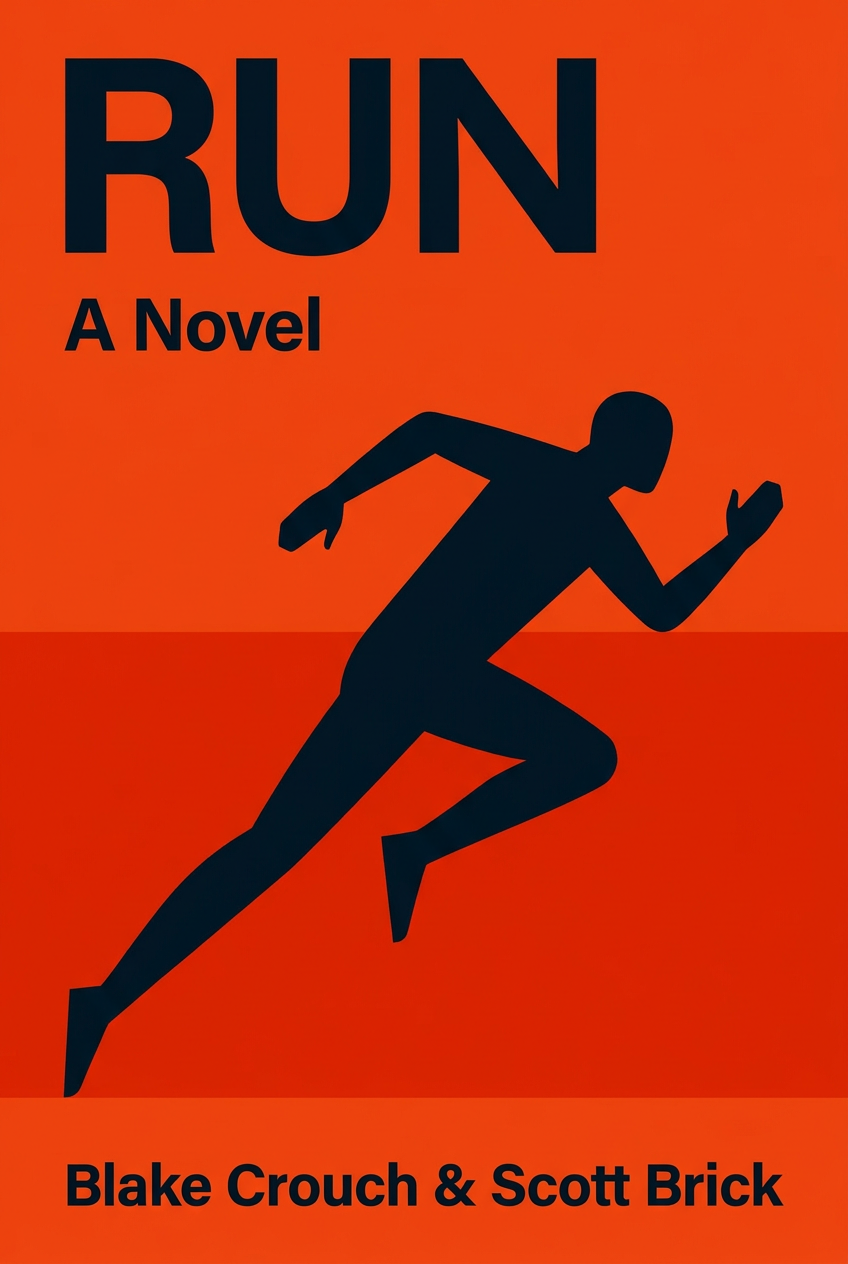
Run
A Novel
What's it about
What if the people you love most suddenly became your deadliest predators? In an instant, a horrifying epidemic sweeps the nation, turning ordinary citizens into savage, mindless killers. Your only choice is to run, but in a world gone mad, where can you possibly hide? This isn't just a story about survival; it's a terrifying glimpse into human nature under extreme pressure. You'll follow a family's desperate flight from a society that has completely collapsed, forcing them to make impossible choices. Discover what it takes to endure when the rules no longer apply and every stranger is a potential threat.
Meet the author
Blake Crouch is the international bestselling author of more than a dozen novels, including the sci-fi blockbusters Dark Matter and Recursion, which are being adapted for television. His expertise in crafting high-concept, breathless thrillers provides the perfect foundation for the apocalyptic chase at the heart of Run. Narrator Scott Brick, a multiple Audie Award winner and a member of the Audible Narrator Hall of Fame, brings Crouch's relentless vision to life with his masterful and gripping performance.
Opens the App Store to download Voxbrief

The Script
Think of the last time you saw a car pulled over on the highway, its hazard lights pulsing a silent, urgent rhythm. A police car is parked behind it, lights flashing but no siren. You drive past in a fraction of a second, your mind automatically filling in the story: a speeding ticket, a broken tail light, a routine stop. Your brain registers the scene, categorizes it based on a thousand similar experiences, and moves on before you even reach the next overpass. The incident is a known quantity, a predictable piece of the daily commute.
Now, imagine that same scene, but with one detail flipped. As you approach, you see the driver of the pulled-over car suddenly bolt, sprinting across multiple lanes of live traffic with a look of pure, animal terror. The officer doesn’t give chase. Instead, they get back in their car and speed away in the opposite direction, as if fleeing the same unseen threat. The familiar story shatters. The rules you thought you understood no longer apply. Your brain scrambles for a new explanation, but finds only a terrifying void. This becomes the first frame of a nightmare, and you just drove through it.
That feeling—the violent vertigo of a familiar world suddenly becoming unknowable and hostile—is the engine that drives Blake Crouch’s work. A bestselling author known for high-concept thrillers like Dark Matter and Recursion, Crouch excels at taking a simple, relatable premise and twisting it just enough to unravel the entire fabric of reality. For Run, he drew from a primal, parental fear: the instinct to protect your family when the fundamental rules of society collapse in an instant. The story was born from that simple, terrifying question: if the world goes mad, what do you do when the only goal is to keep your family alive for the next five minutes, over and over again?
Module 1: The Wilderness Mindset
The story opens with Samuel, a thirteen-year-old boy on the American frontier. For him, the deep forest isn't a park. It's an alien world, indifferent to human life. His father once said a man could walk west for a month and never see the sun. The canopy is that dense. But through years of experience, Samuel has learned to see the forest differently. This is where we find our first insight.
Survival depends on deep environmental literacy. Samuel doesn't just walk through the woods; he reads them. He notices a snapped twig and knows if it was a deer or a bear. He sees distant smoke and analyzes its color, its volume, and the wind direction. He deduces it's a settlement burning, not a campfire. This is a learned skill, a form of forensic observation that turns the environment into a live data feed. For us, this means developing a similar literacy in our own environments. Whether it's reading the room in a board meeting or noticing subtle shifts in market sentiment, the principle is the same. You must learn to see the signals everyone else misses.
This leads to a crucial distinction Crouch makes. Samuel's parents are educated. They love the woods, but they don't understand them. They represent "civilization"—a world of books, ideas, and cities they fled. This creates a stark divide. You must distinguish between theoretical knowledge and practical skill. Samuel’s parents have knowledge. Samuel has skill. He can track, hunt, and navigate. When disaster strikes, only one of these proves useful. His parents' education can't save them. Samuel's ability to read the forest is their only hope. In our careers, we accumulate vast amounts of theoretical knowledge. But the real test is application. Can you execute? Can you build the thing you designed? Can you navigate the crisis you studied?
And here’s the thing. This level of skill makes Samuel an outsider. His neighbors see his abilities as almost supernatural. They call him a "seer." But he knows it's just perception, honed by countless hours of practice. This brings us to a hard truth. Mastery often leads to a degree of isolation. When you operate at a level few can comprehend, you can become lonely. People may admire your results but misunderstand the process. They see the outcome, not the thousands of hours of deliberate practice. The lesson here is to find your purpose in the quiet confidence that comes from genuine competence. Samuel doesn't need praise. He just needs to survive.
Module 2: The Anatomy of Crisis
One morning, Samuel is hunting. He senses a change in the forest's rhythm. A profound quiet. He knows something is wrong. When he returns to his settlement, he finds only smoke, blood, and bodies. His world has been erased. The attackers killed most of his neighbors. But they took his parents alive. This is where the story truly begins. It's a relentless chase across the brutal landscape of a nation at war.
In the immediate aftermath, Samuel's first action is critical. In a crisis, you must shift from emotional reaction to methodical analysis. He finds his neighbors buried in shallow graves. He feels overwhelming grief, but he forces it down. He needs information. He starts "reading sign." He examines the footprints around the destroyed cabins. He identifies his mother's moccasins. His father's distinctive stride. The larger prints of their captors. He even notes the different shoe types—some moccasins, some leather-soled boots. He's reconstructing the event, turning chaos into a narrative. This is a powerful mental model for any crisis. The initial shock is inevitable. But your first move must be to gather data. What happened? Who was involved? What does the evidence tell me?
From this foundation, Samuel has to make a plan. He has to calculate his enemy's head start. He estimates their travel speed, factoring in prisoners. He figures they're about twenty miles ahead. It’s a desperate, almost impossible gap to close. But having a number, even a rough one, matters. So what happens next? You must ground your strategy in the pragmatic realities of time and resources. Samuel doesn't have a horse. He has a single-shot rifle, a knife, and the clothes on his back. His plan must be based on what he actually has. This discipline is essential. In business, we often build strategies around ideal scenarios. But true effectiveness comes from acknowledging constraints. What's our actual budget? How much time do we really have? What are the skills of the team I have right now?
Finally, the nature of the attack itself reveals a chilling logic. The attackers used tomahawks and clubs, not guns. Why? To maintain silence. They didn't want to alert hunters like Samuel who were out in the woods. They also took some people prisoner while killing others. This was calculated. To defeat an opponent, you must understand their motives and methods. Samuel realizes he is chasing intelligent adversaries with a purpose. He doesn't know their goal yet, but understanding that a goal exists is the first step toward thwarting it. This applies directly to any competitive landscape. Don't just react to your competitor's moves. Ask why they are making them. What is their underlying strategy? What resource are they trying to acquire or protect? Understanding their "why" is the key to predicting their "what."