All Books
Self-Growth
Business & Career
Health & Wellness
Society & Culture
Money & Finance
Relationships
Science & Tech
Fiction
Topics
Blog
Download on the App Store

Scorpions

A Newbery Honor Award Winner

13 minWalter Dean Myers

What's it about

What would you do if you were forced to lead a gang to protect your family? For twelve-year-old Jamal, this isn't a hypothetical. When his older brother is sent to prison, Jamal is pressured to take over the Scorpions, a choice that could cost him everything. This summary explores the impossible decisions young people face when trapped by their circumstances. You'll uncover how the weight of a gun and the promise of power can corrupt friendships, challenge family loyalty, and force a kid to grow up way too fast. Discover Jamal's struggle to find a way out when every path looks like a dead end.

Meet the author

Walter Dean Myers was a celebrated author and the third National Ambassador for Young People's Literature, dedicated to telling the authentic stories of urban youth. Growing up in Harlem, Myers drew from his own experiences with poverty, violence, and the struggle for identity to create powerful, realistic narratives like Scorpions. His work gives a voice to marginalized teens, exploring the complex moral choices they face with profound empathy and unflinching honesty, inspiring a generation of readers and writers.
Listen Now

Opens the App Store to download Voxbrief

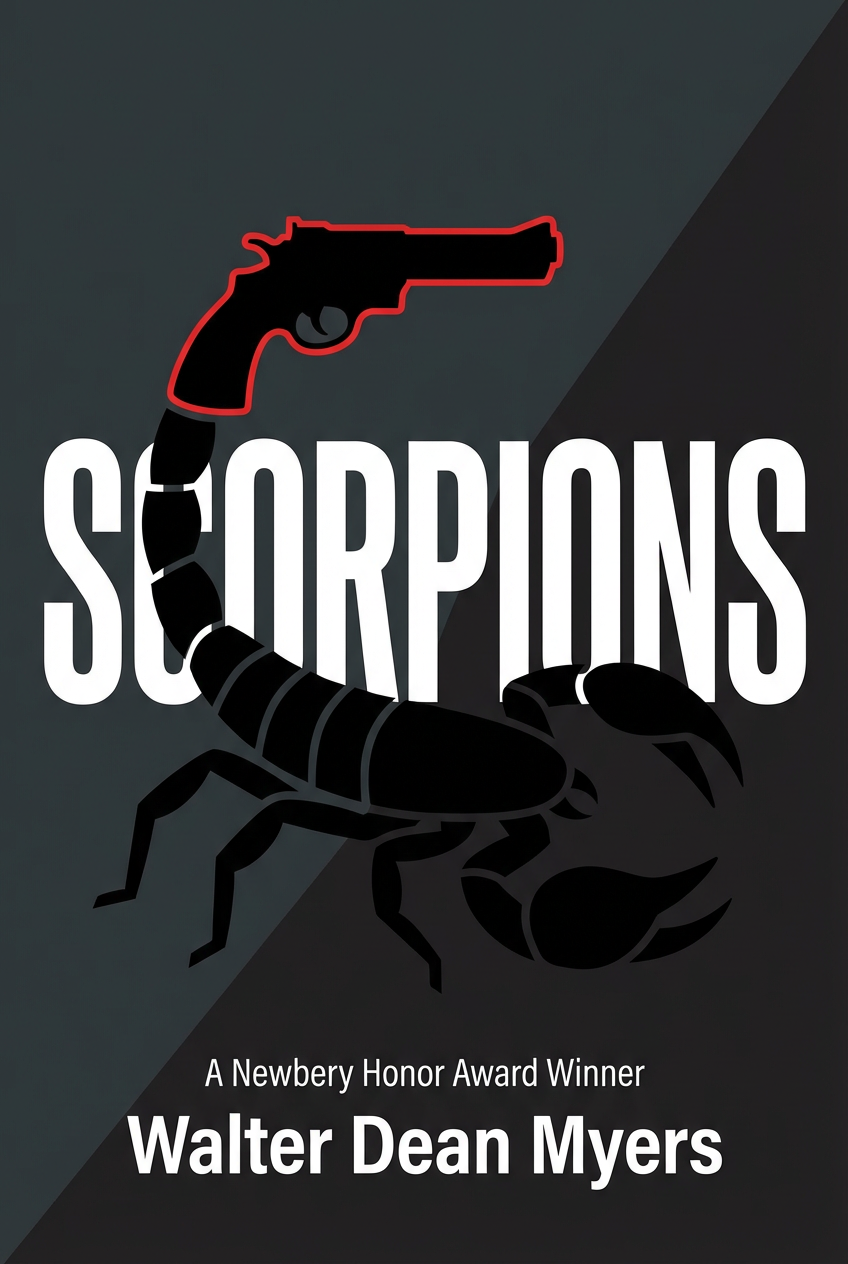
Scorpions book cover

The Script

A kid sits on a stoop, bouncing a worn-out tennis ball against the concrete steps. In his pocket is a permission slip for a field trip to the aquarium, signed and folded into a neat square. His biggest worry is whether he’ll have enough money for a souvenir shark tooth. An older brother’s friend walks up, leans against the railing, and doesn’t say a word. He just drops a heavy, cold object into the kid’s hand and walks away. Suddenly, the permission slip feels a thousand miles away. The weight in his palm is a future he never asked for, a language he doesn’t speak, and a loyalty he doesn’t owe. The choice is no longer between right and wrong. The choice is between the boy he was five minutes ago and the man he's suddenly expected to be.

That chilling moment of a stolen childhood is a reality Walter Dean Myers saw play out countless times on the streets of Harlem. As a young man, he navigated a world where boys were handed adult burdens without any guidance, forced to make life-altering decisions before they even understood the consequences. Myers, who grew up reading books that never reflected his own life or the lives of his friends, felt a deep responsibility to tell their stories. He wrote "Scorpions" as someone who understood the silent pressures and the impossible choices facing young men like Jamal. He wanted to give a voice to the quiet kid on the stoop, caught between the world he knows and the one being forced upon him.

Module 1: The Weight of Inherited Burdens

The story begins with Jamal Hicks, a twelve-year-old boy in Harlem. His life is already complicated. His older brother, Randy, is in prison for robbery and murder. His family is struggling. His mother works long hours, and the weight of responsibility often falls on him. This is where the central conflict ignites. From prison, Randy sends a message. He wants Jamal to take his place as the leader of his old gang, the Scorpions. This is a command.

This introduces a critical insight. External pressures often force children into adult roles they are unprepared to handle. Jamal doesn't want to be a gang leader. He wants to draw. He wants to hang out with his best friend, Tito. But the pressure is immense. It comes from his brother. It comes from his brother's intimidating friend, Mack. Mack delivers the message and frames it as a duty. A way to help the family. He tells Jamal that leading the Scorpions is the only way to earn money for Randy's appeal. The legitimate path, like working odd jobs, is impossibly slow. This situation creates a powerful dilemma. Jamal feels trapped between his own desires and a twisted sense of family loyalty.

So what does this look like in practice? Jamal is forced to meet with the Scorpions. He feels out of place. He's a kid trying to command respect from teenagers and young men who are older, tougher, and more experienced in street life. They challenge him immediately. They question his authority. They see him as nothing more than "Randy's little brother." To survive this environment, Jamal learns a hard lesson. In environments defined by threat, a performance of toughness becomes a survival mechanism. He has to project confidence he doesn't feel. He has to hide his fear. He can't even look at his friend Tito during a tense meeting, because seeing Tito's fear might reveal his own.

This leads to the most dangerous part of the inheritance. Mack gives Jamal a gun. A "piece." He claims it's for protection. He says it's necessary to be taken seriously as the leader. For Jamal, the gun is a physical and psychological burden. He's constantly aware of its weight in his waistband. He’s terrified it will fall. He's terrified it will go off by accident. The gun transforms every interaction. It escalates minor conflicts into life-or-death situations. When a bully named Dwayne threatens him at school, Jamal doesn't think about fighting. He thinks about the gun. The weapon offers a shortcut to respect, but it's a respect built on fear. And here’s the key takeaway from this module. Access to tools of violence creates an illusion of control while destroying actual agency. The gun multiplies Jamal's problems. It isolates him, fills him with anxiety, and pushes him down a path he never wanted to walk.

Module 2: The Failure of Institutions and the Power of Friendship

Now let's zoom out from the gang and look at the other forces shaping Jamal's world. His school is supposed to be a place of opportunity. Instead, it's a source of constant humiliation. His principal, Mr. Davidson, has already written him off. He tells Jamal a warning "won't do any good." He predicts Jamal will be expelled. His teachers are often sarcastic and dismissive. When Jamal claims his homework is missing, a teacher publicly suggests he'll just repeat the seventh grade. These interactions reinforce a devastating message: you are a problem. You are not worth the effort.

This reveals a systemic failure that Myers highlights throughout the book. Authority figures often reinforce negative self-perceptions through prejudice and low expectations. The adults in charge don't see a boy struggling with immense pressure at home. They see a troublemaker. They label him based on his brother's reputation and his own quiet defiance. This creates a vicious cycle. The more Jamal is treated like a failure, the more he disengages. Why try when the people in charge have already decided you will fail? He finds more respect, however twisted, from the Scorpions than he does from his principal.

But flip the coin. In the middle of all this failure, there is one source of unwavering support. His friendship with Tito. Tito is Jamal's anchor. He's loyal, compassionate, and serves as Jamal's moral compass. When Jamal is forced to lead the Scorpions, Tito joins him because he doesn't want Jamal to be alone. Their friendship is a sanctuary. They escape the city's grit by visiting the boat basin, dreaming of a future where they can sail away from their problems. They support each other through family troubles and Tito's chronic asthma.

And here’s the thing. This friendship is about shared vulnerability. True loyalty is tested in moments of shared fear and weakness. When Jamal is overwhelmed, Tito is there. When Jamal is given the gun, Tito is the one who voices concern. He senses the danger. He constantly urges Jamal to get rid of it. Tito understands that the gun is a curse. Their bond is the only relationship in Jamal's life not based on transactions or intimidation. It’s based on genuine care. This makes what happens next even more tragic. This pure friendship is ultimately what pulls them both into the heart of the violence.

Read More