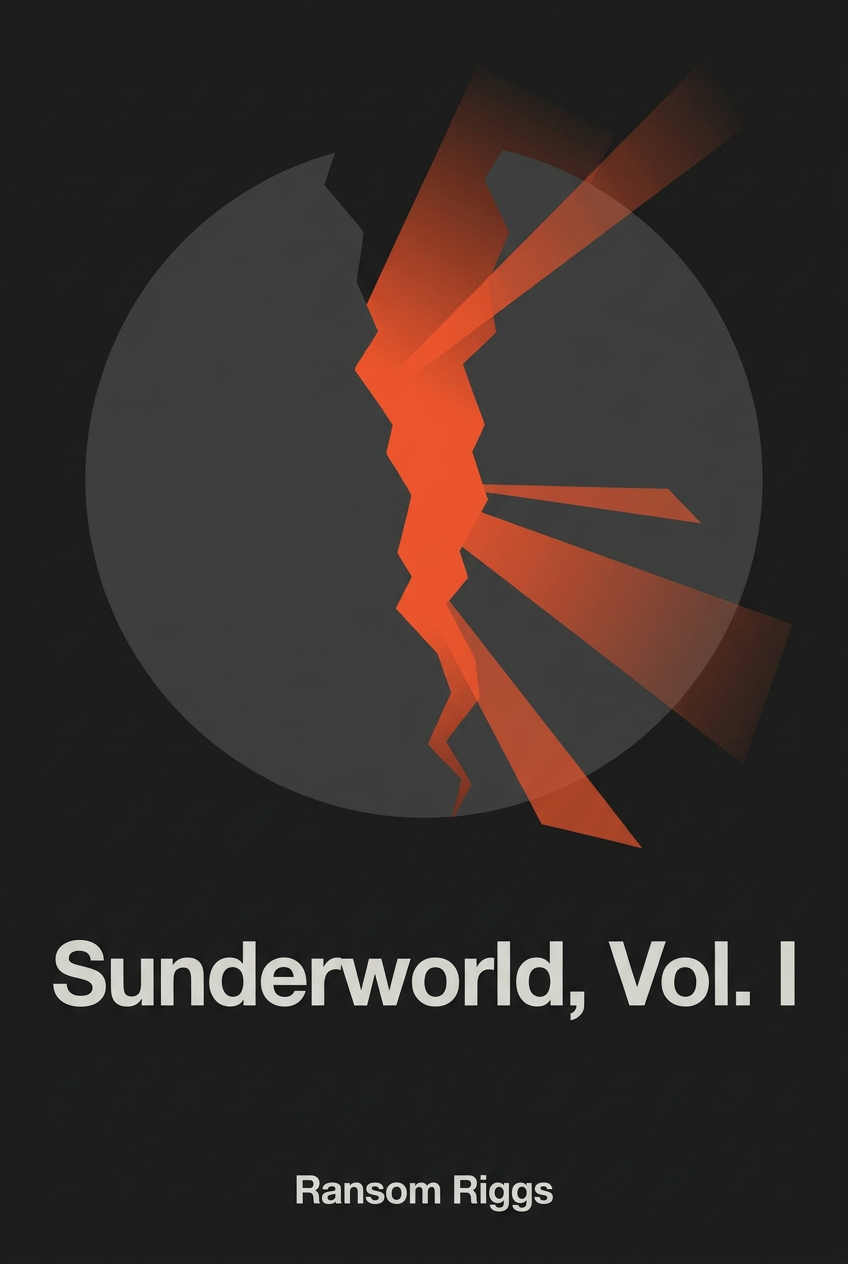
Sunderworld, Vol. I
The Extraordinary Disappointments of Leopold Berry
What's it about
Ever feel like your life is just one big, spectacular failure? What if you could turn your most embarrassing disappointments into your greatest superpower? This is the bizarre reality for Leopold Berry, a man whose epic fails are literally opening portals to another world—a dangerous, forgotten realm known as the Sunderworld. Dive into a world where your worst moments have world-altering consequences. You'll join Leopold and his sister as they navigate the Sunderworld, a place filled with monstrous "hollows" and cryptic prophecies. Discover how Leopold's lineage of failure is the key to saving this strange new dimension, and perhaps our own, from a looming, ancient threat. It’s a hilarious, thrilling adventure about embracing your extraordinary screw-ups.
Meet the author
Ransom Riggs is the 1 New York Times bestselling author of the Miss Peregrine’s Home for Peculiar Children series, which has sold millions of copies worldwide. A lifelong explorer of strange and forgotten history, Riggs draws inspiration from his vast collection of vintage found photographs. This unique passion for unearthing stories from overlooked images directly fueled the creation of Leopold Berry’s journey, blending the hauntingly real with the fantastically imagined in the world of Sunderworld.
Opens the App Store to download Voxbrief

The Script
Two identical ancient coins are discovered in a shipwreck. One is sent to a museum, placed under glass, its story frozen and cataloged: weight, composition, date of minting. It becomes a sterile fact, an artifact of a dead empire. The other coin falls into the hands of a street magician. It is palmed, flipped, vanished, and reappeared. It passes through a thousand hands, buys a loaf of bread, pays a ferryman, is gambled away in a back alley. It accumulates the grease, scratches, and stories of the living world. Though they started as twins, one coin is now merely a historical record, while the other has become a key—an object imbued with the energy of countless lives, a relic that feels alive.
This is the core of Sunderworld: the difference between a world that is cataloged and a world that is lived. It’s the gap between the known histories of the Peculiar world and the messy, dangerous, and often terrifying stories that were never written down. These are the forgotten coins, the tales that fell through the cracks of Jacob Portman’s grandfather’s stories. Ransom Riggs found himself captivated by this idea after completing his celebrated Miss Peregrine's Peculiar Children series. He realized that the established history of the Peculiars was just one side of the coin. He wanted to explore the uncatalogued world—the Sunderworld—a place where the rules were different, the dangers were primal, and the stories were raw and unverified. This book is his journey into that darker, wilder side of the map, uncovering the tales that were too strange, too secret, or too frightening to have been told before.
Module 1: The High Cost of Unmet Expectations
We first meet Leopold "Larry" Berry, a teenager drowning in the expectations of his father, Richter. Richter is a self-help guru, the author of Think Like a Winner, a man who sees the world in a strict binary of success and failure. Leopold, however, doesn't fit the mold. He's a tinkerer, a dreamer, a kid whose passions—working on his old car, making homemade movies—are dismissed by his father as worthless hobbies. This creates a powerful internal conflict. Your environment's definition of success can suppress your authentic strengths. Leopold is so conditioned to see his interests as failures that he can't even articulate them in a high-pressure college interview. He gives canned, inauthentic answers because he has learned that his true self isn't valuable.
This leads to a critical insight. When external pressure becomes overwhelming, the mind seeks an escape. For Leopold, this escape is something more than just daydreaming. He starts "Seeing into Sunder." These are vivid, disturbing visions that no one else can perceive. He sees a raccoon's tail catch fire, a man feed a tooth to a parking meter to open a hole in the ground, and a parking attendant with gray wings folded under her vest. These are not just quirks. Unresolved trauma and intense stress can manifest as reality-bending psychological episodes. These visions began after his mother's death, a grief he has never fully processed. They are a coping mechanism, a fantasy world called Sunderworld from an old TV show that he retreated into as a child. Now, under the immense pressure from his father, the walls of that fantasy are breaking down and leaking into his reality.
The pressure is emotional abuse. Richter doesn't just criticize; he controls. He uses Leopold's most cherished possession—his mother's old Volvo—as leverage, threatening to scrap it. And here's the thing. This kind of emotional manipulation forces a choice: conform and lose yourself, or resist and risk everything. Leopold clings to the car, a symbol of his autonomy and his last connection to his mother. Symbolic attachments become anchors of identity when your autonomy is threatened. His refusal to give up the car, even when it's illogical, is an act of defiance. It's his way of saying he still exists, separate from his father’s crushing expectations. This stubbornness is both his greatest weakness and, as we'll see, his greatest strength.
Module 2: The Blurring Line Between Coping and Crisis
We've established that Leopold's visions are tied to trauma. But what happens when those visions start to have physical consequences? This is where the story pivots from a psychological drama to something far more dangerous. While driving with his father, the stress of an argument triggers a severe episode. Leopold slams on the brakes to avoid a phantom streetcar, nearly causing a real-world collision. During the incident, his hands emit red sparks. The fantasy is no longer just in his head. Under extreme duress, psychological coping mechanisms can escalate into tangible, uncontrollable phenomena. The line has been crossed. What was once a passive viewing of "Sunder" has become an active, physical manifestation of its power.
This escalation forces Leopold to confront a terrifying possibility. Is he losing his mind, or is something else at play? He desperately tries to rationalize these events. The flaming raccoon, the winged attendant, the sparks—he labels them all as "episodes," symptoms of old trauma. He develops a mantra, repeating "Nope" to deny the reality of what he's seeing. Rationalization is a powerful defense mechanism against a reality you're not prepared to accept. This is a survival tactic. Believing he has magical powers is, in his mind, a step toward insanity. It's safer to believe he's broken than to believe the world is.
But the evidence keeps mounting. After one episode, a sudden, localized rainstorm begins, and he can't shake the question: "Did I do that?" He finds his best friend, Emmet, the only person he trusts. And it doesn't stop there. The friends discover a series of bizarre clues, starting with a doodle of "Kilroy was here" on a menu—a secret symbol between Leopold and his late mother. This symbol, a call to "pay attention," leads them on a strange scavenger hunt through a nostalgic, forest-themed restaurant. This is where we learn another key insight: Personal symbols and shared history can act as triggers, unlocking hidden meanings and forgotten paths. The Kilroy doodle is a key. It's his mother reaching out from the past, guiding him toward a truth he isn't ready for, a truth that culminates in a dangerous fire and a mysterious token for a defunct railway, Angels Flight.
Module 3: Crossing the Threshold into Sunder
The strange events at the restaurant leave Leopold and Emmet with a choice. Leopold holds a token for Angels Flight, the defunct funicular railway. In the Sunderworld TV show, this was an entrance. Emmet, ever the pragmatist, tries to dismiss it all as coincidence. But Leopold feels a pull, a desperate hope that all his suffering might actually mean something. After a heated argument, a moment of uncanny weirdness unites them: the entire Los Angeles skyline vanishes. They look at the dormant Angels Flight trolley. A light is on inside. Confronting the impossible requires a leap of faith, often validated only by a shared experience. Emmet can't deny what they both see. Logic has failed. Together, they decide to take the risk.
Their journey on the trolley is terrifying and jarring. They expect a magical kingdom; they find a grimy, dilapidated version of Los Angeles with a pink sky and floating buildings. The magical and the mundane are uncomfortably blended. This is the next crucial lesson. The reality of a fantasy is often messier and more mundane than its idealized version. Sunder has magical pawn shops and diners where coffee gives off silver sparks, but it also has bureaucracy and infrastructure problems. A magical transport device called a "tumbleport" malfunctions due to an "Aether drought," a shortage of the magical energy that powers their world.
This is where Leopold's journey of self-discovery truly begins. In this new world, he feels like an imposter. He lies about where he's from, instinctively hiding his identity. But then he gets his hands on a cheap, plastic "focuser," a device for channeling magic. When he uses it to cast a simple levitation spell, something clicks. The feeling is natural, like a forgotten muscle memory. For the first time, he feels a surge of pure happiness. Discovering an innate talent can be a profound source of identity and empowerment. This single act of magic provides him with a suit of emotional armor. Knowing he can do this, knowing this world is real, gives him a newfound resilience against the crushing weight of his father's judgment. He may not know his purpose yet, but for the first time, he feels like he might have one.