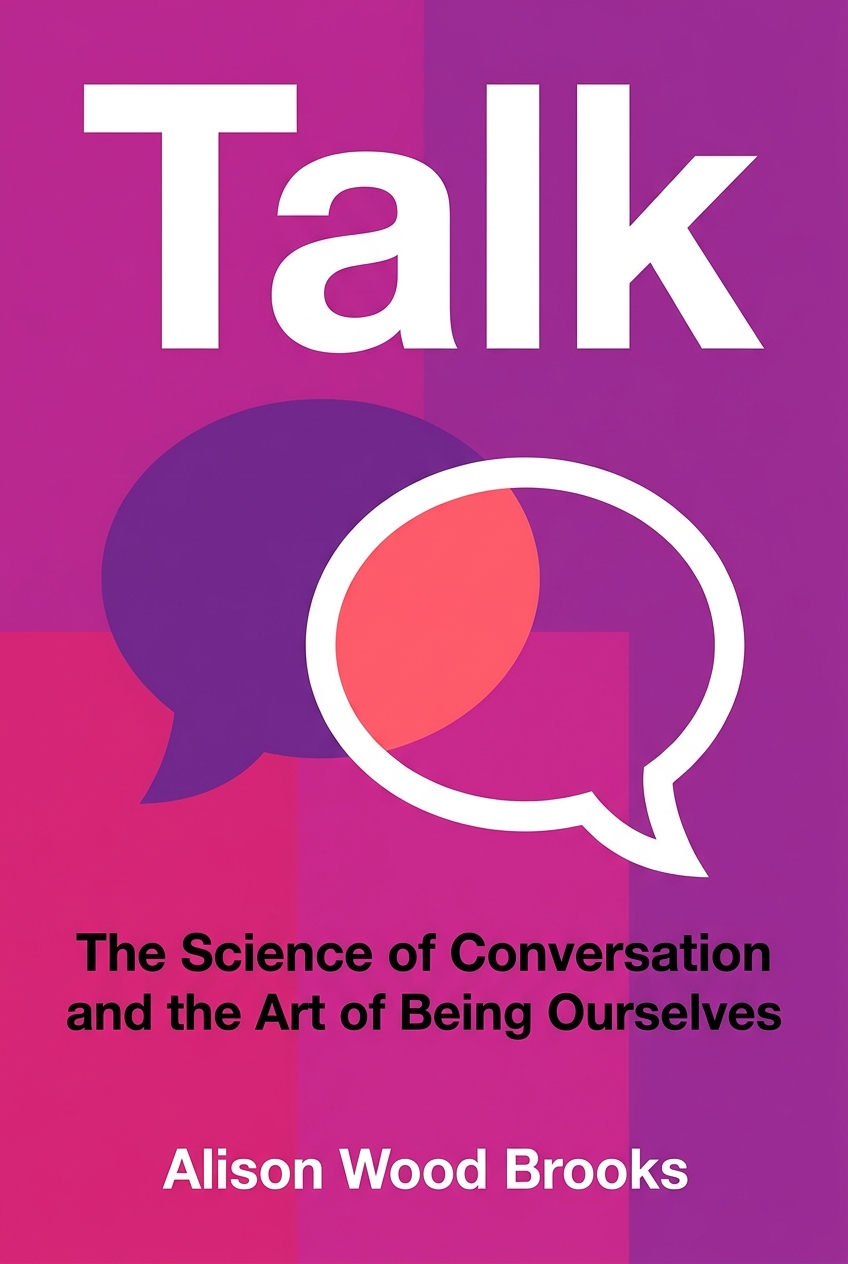
Talk
The Science of Conversation and the Art of Being Ourselves
What's it about
Ever feel like you’re saying all the right things, but still not truly connecting? Discover the science behind great conversation and learn how to make every interaction count, turning awkward small talk into meaningful exchanges that build trust and reveal your most authentic self. Based on years of research, this guide reveals the hidden patterns of successful dialogue. You'll learn specific techniques to navigate difficult topics, ask better questions, and listen more effectively. Stop just talking and start connecting in a way that feels natural and powerful.
Meet the author
Alison Wood Brooks is an award-winning professor at Harvard Business School and a leading behavioral scientist specializing in the psychology of conversation, influence, and emotion. Her lifelong fascination with what makes conversations work—or fail—led her to dedicate her career to researching the science behind our daily interactions. Through her work, she uncovers the simple, evidence-based techniques that can transform our professional and personal lives, one conversation at a time, helping us all become more authentically and effectively ourselves.
Opens the App Store to download Voxbrief

The Script
We treat conversation like a performance to be perfected, polishing our delivery and scripting our points. Yet, the most influential dialogues are the ones where we make the other person feel heard. The paradox is that the more we focus on our own brilliance—on sounding smart, witty, and persuasive—the more we build a wall between ourselves and the person we're talking to. Our desperate attempt to be impressive is precisely what makes us forgettable. We leave the interaction feeling like we've scored points, but we've lost the connection, which was the entire purpose of the exchange. We've mastered the art of speaking, but in the process, we've become profoundly deaf to the silent, underlying needs that truly drive every conversation.
This exact conversational breakdown became a professional obsession for Alison Wood Brooks. As a professor at Harvard Business School, she watched the brightest minds—future CEOs, founders, and leaders—repeatedly fail in the one area that mattered most: genuine human connection. They could analyze complex data and build sophisticated models, yet they struggled to ask a good question or truly listen to a dissenting opinion. Brooks realized that the most critical business skill wasn't being taught. She dedicated her career to deconstructing these interactions, running experiments that revealed the hidden mechanics of what makes conversations work. "Talk" is the culmination of that research, a guide born from observing thousands of conversational failures in the highest-stakes environments.
Module 1: The Anxiety Epidemic in Conversation
We've all been there. Your heart pounds before a big presentation. Your mind goes blank during a performance review. This is a biological reality. Brooks argues that conversation anxiety is one of the biggest silent killers of productivity and connection.
The first step is to understand what's happening. When we face a high-stakes conversation, our brain perceives it as a threat. This triggers a fight-or-flight response. Our prefrontal cortex, the part of our brain responsible for rational thought, starts to shut down. This makes it harder to listen, think clearly, and respond thoughtfully. It's why you can rehearse a perfect pitch in the mirror but stumble over your words when the pressure is on.
So what do we do? Brooks offers a surprisingly simple technique. Reframe your anxiety as excitement. Both anxiety and excitement are high-arousal emotions. They feel physiologically similar: a racing heart, a surge of cortisol. The only difference is the narrative we attach to them. Trying to "calm down" is often counterproductive because it's a low-arousal state. It's like trying to slam the brakes on a speeding car. Instead, by simply telling yourself "I am excited," you can re-channel that nervous energy into a more positive, performance-enhancing state. Studies show that people who reframe their anxiety as excitement perform better in public speaking, negotiations, and even karaoke.
Building on that idea, another key insight is to ask questions, especially to open a conversation. We often think we need to start with a brilliant statement to prove our worth. This puts immense pressure on us and often comes across as self-absorbed. Instead, asking a thoughtful question shifts the focus to the other person. It signals curiosity and respect. It also gives you a moment to breathe and gather your thoughts. Questions like "What's the biggest challenge you're working on right now?" or "What are you most excited about this quarter?" can instantly transform a tense interaction into a collaborative one. It lowers the stakes for everyone involved.