All Books
Self-Growth
Business & Career
Health & Wellness
Society & Culture
Money & Finance
Relationships
Science & Tech
Fiction
Topics
Blog
Download on the App Store

Terms of Endearment

14 minLarry McMurtry, Barbara Rosenblat

What's it about

Ever wondered how the most challenging relationships can also be the most rewarding? Discover the fierce, funny, and deeply human bond between a mother and daughter who infuriate and adore each other in equal measure, navigating life, love, and loss over three decades. You'll learn how their complex connection, filled with witty arguments and unwavering loyalty, reveals profound truths about family and forgiveness. Uncover the secrets to finding strength in imperfection and see how even the most difficult love can become an anchor in the storms of life.

Meet the author

Pulitzer Prize-winning novelist and screenwriter Larry McMurtry was a legendary chronicler of the American West and its complex, unforgettable characters. Drawing from his own Texas upbringing in a ranching family, he masterfully captured the poignant, often humorous, realities of life, love, and loss on the modern frontier. His keen observations of family dynamics and regional identity are the heart of his acclaimed work, including the beloved classic, Terms of Endearment.
Listen Now
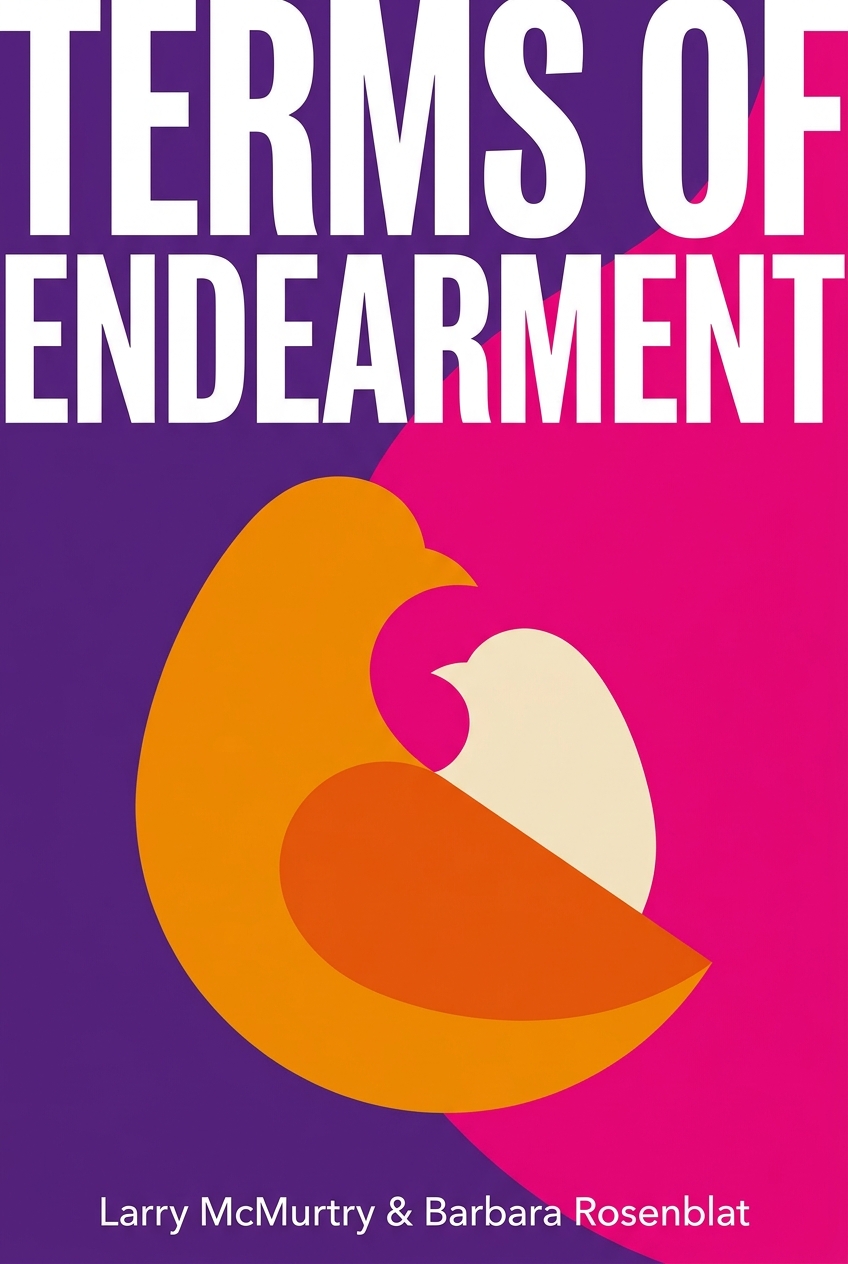
Terms of Endearment book cover

The Script

A mother is preparing two gift baskets, one for each of her adult daughters. The baskets are identical wicker, lined with the same pale yellow cloth. Into the first, for her eldest, she places a bottle of expensive French wine, a wedge of sharp, aged cheddar, and a hardback volume of classic poetry. She adjusts the items, making sure the label and the title are perfectly visible, a curated display of refined taste. Into the second basket, for her youngest, she places a six-pack of cheap domestic beer, a bag of greasy potato chips, and a dog-eared paperback romance novel with a lurid cover. She tucks a pack of cigarettes beside the beer. She looks at the two baskets, side-by-side on her kitchen counter. One is a portrait of the daughter she wishes she had. The other is a portrait of the daughter she has. Both are, in their own way, acts of love. But they are also weapons, loaded with a lifetime of expectation, disappointment, and a fierce, complicated affection that defies easy definition.

This intricate, often contradictory, nature of familial love is the territory Larry McMurtry spent his life exploring. Growing up in a family of Texas ranchers, he was surrounded by storytellers, but he was the one who listened, observing the vast, unspoken distances that could exist between people who shared the same blood and the same small town. He saw how love was a tangled knot of need, control, loyalty, and resentment, especially between mothers and daughters. A Pulitzer Prize-winning novelist and Oscar-winning screenwriter, McMurtry wrote Terms of Endearment to capture these relationships with unflinching honesty. He wanted to write about the kind of difficult, infuriating, and ultimately unbreakable bonds that felt more true to life than any sentimental greeting card, creating characters who live and breathe with all their glorious, maddening imperfections.

Module 1: The Architecture of Difficult Love

The novel’s core is the relationship between Aurora Greenway and her daughter, Emma. It’s a masterclass in how affection and conflict can become indistinguishable. Their daily 7:30 AM phone call is a ritualistic battle. Emma answers with irritation. Aurora responds with criticism disguised as concern. This dynamic reveals the book's first major insight. Love is often expressed through the friction of routine conflict. Their arguments are the relationship. It's their primary mode of connection, a daily affirmation of their unbreakable, if maddening, bond.

Building on that idea, McMurtry shows how this friction is fueled by a constant, unspoken power struggle. Aurora believes it is her maternal duty to enforce standards. She criticizes Emma’s laundry, her choice of husband, and her pregnancy announcement. She weaponizes guilt, seeing it as a tool to uphold her vision of how life should be lived. This leads to a second critical point. Control is often asserted through criticism and emotional manipulation. When Emma pushes back, Aurora’s go-to tactic is to hang up, only to call back later and chastise Emma for not letting her have the last word. It’s a performance of dominance. For Emma, the only way to disengage is to recite a toneless list of affirmations—"You’re wonderful, you’re sweet, you have gorgeous hair." She’s learned that her mother is seeking validation. This is what Emma calls milking the "compliment udder," a transactional exchange to end the emotional siege.

So what happens next? This dynamic forces both women to seek identity outside their prescribed roles. Aurora, a widow in Houston, surrounds herself with a rotating cast of inadequate suitors. Her struggle is choosing between men who can't meet her standards. She also escapes into a private world of movie magazines and celebrity crushes, a stark contrast to her controlled, respectable public life. And here’s the thing. When primary relationships are suffocating, we build parallel lives through fantasy and external validation. Emma does the same. Trapped in a dissatisfying marriage, she finds solace on her porch, reading the classifieds for jobs she’ll never take. She daydreams about an old friend, a successful writer, who represents a life of passion and intellect that feels out of reach. These private worlds are acts of self-preservation, spaces where they can explore who they are when they aren't performing as mother or daughter.

Read More