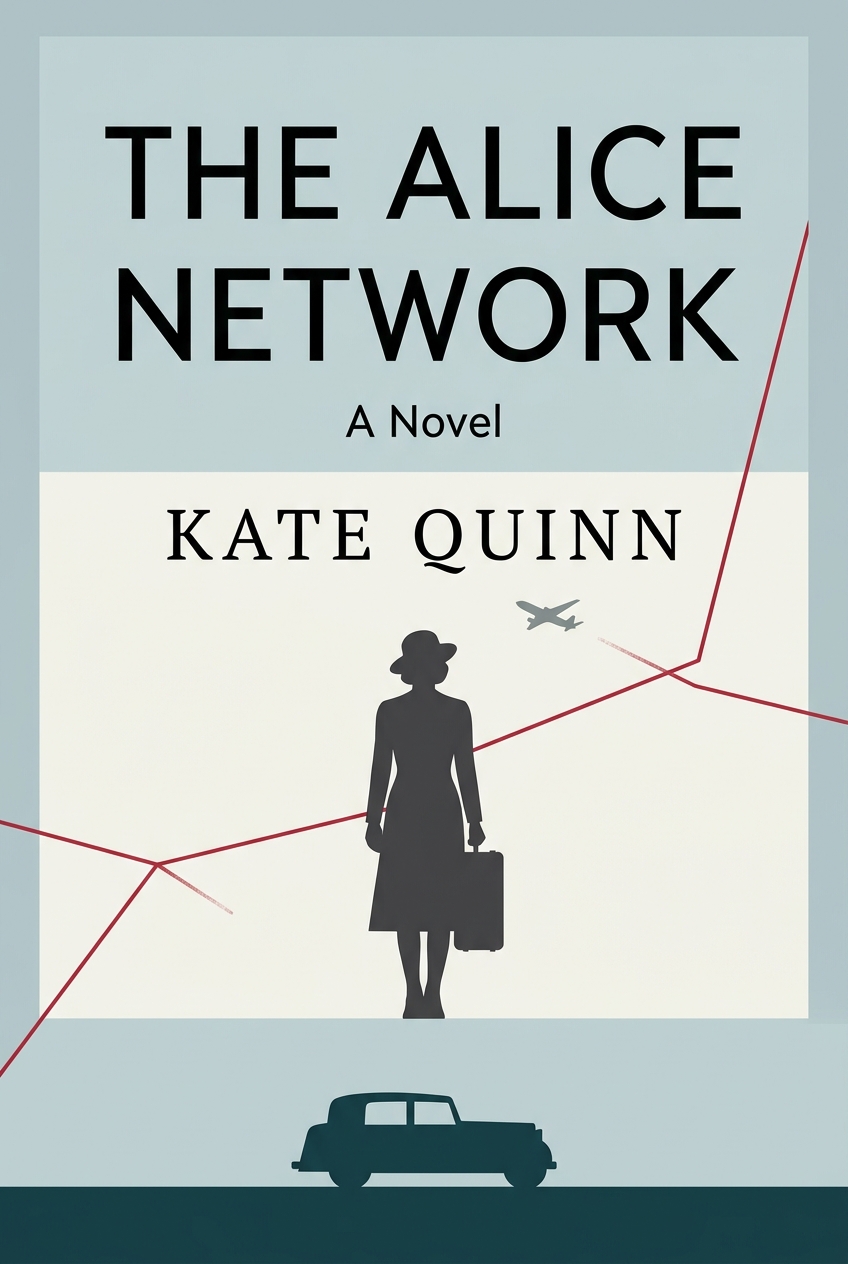
The Alice Network
A Novel
What's it about
Ever wondered what it takes to be a spy, risking everything for a cause greater than yourself? Dive into a gripping tale of two women—a female spy recruited to the real-life Alice Network in France during World War I and an unconventional American socialite searching for her cousin in 1947. Their lives collide in a dramatic story of courage, sacrifice, and redemption. You'll uncover the shadowy world of espionage, where an ordinary woman becomes a master of deception, and a young girl's quest for truth reveals a dark web of betrayal that connects two world wars.
Meet the author
Kate Quinn is a New York Times and USA Today bestselling author of historical fiction renowned for her meticulously researched novels about real-life heroines of the past. A lifelong history buff, she earned both her bachelor's and master's degrees in classical voice from Boston University before turning her passion for untold stories into a full-time writing career. Her dedication to uncovering the fascinating, often-overlooked contributions of women in history is the driving force behind her celebrated and immersive books.
The Script
In a forgotten corner of an old provincial archives building, a clerk files away a box of records from the Great War. It’s marked 'Miscellaneous Military Intelligence, Lille Sector.' Inside are faded reports written in a delicate hand, detailing troop movements and supply train schedules. They are signed with a code name: Lili. To the clerk, it’s just another piece of paper, another name in a sea of forgotten names. He slots the box onto a high shelf, next to hundreds of others, where it will likely remain untouched for another fifty years. The clerk doesn't know that these were lifelines, acts of breathtaking courage written by a woman who risked everything, only to be filed away as a footnote. Her story, and the stories of the women who fought alongside her, were effectively erased by the quiet, indifferent machinery of history itself.
How many other stories like Lili’s have been lost to those dusty shelves? How many acts of heroism have been buried under the label of 'miscellaneous'? This question of forgotten history, particularly the unwritten histories of women, is what drove author Kate Quinn. A lifelong student of the past with a master's degree in classical history, Quinn noticed a pattern: official records were filled with the deeds of men, while the contributions of women were often relegated to whispers, rumors, or complete silence. She stumbled upon the real-life Alice Network, a group of female spies who operated in German-occupied France during World War I, and was stunned that their incredible story of ingenuity and bravery was virtually unknown. "The Alice Network" was her answer to that silence, an effort to pull one of those forgotten boxes from the shelf and give a voice to the women filed away by history.
Module 1: The Invisible Army
In the world of espionage, being underestimated is your greatest weapon. World War I proved this in a powerful way. British intelligence quickly realized that in occupied France, a man was instantly suspicious. But a woman? She could be invisible.
This brings us to our first key insight. Women were strategically recruited as spies because they could blend in where men could not. Captain Cameron, a sharp British intelligence officer, puts it plainly. Women have the ability to pass unnoticed. He was making a strategic observation. He pointed to his best agent, a Frenchwoman managing a network of over a hundred sources. Her intelligence led to successful Allied bombings. She was, in his words, "the best we have, male or female."
Enter Evelyn "Eve" Gardiner. In 1915, she's a young woman working a dull office job in London, dismissed by her colleagues because of a persistent stammer. She's seen as "a bit simple." But Captain Cameron sees something else. He sees a woman who can slide from notice, whose face reveals nothing. He sees a potential spy.
From this foundation, we see a second critical principle emerge. The most valuable spies are defined by their ability to adapt. Eve's training is about "fiddly skills." She learns to pick locks, write in code, and conceal messages on tiny slips of rice paper. Her classmates are a motley crew: a burly Belgian, two different Frenchmen, an English boy. They look nothing like the identical soldiers on recruitment posters. Eve realizes a spy poster would show a line of completely different people who look nothing like spies. Her own perceived weakness, the stammer, is identified as a strength. Her handler, a legendary agent named Lili, advises her to "play it up like mad." People will talk freely around a girl they think is half-witted.
But here's the thing. This work is a cold, disciplined profession. Successful espionage demands a cold, disciplined mindset. Captain Cameron warns Eve that spies can't be "on fire for anything." The passionate fervor of a young soldier is a liability in this world. Spies face capture, torture, and execution. The work is distasteful. It involves listening at doors and opening mail. There is no public acclaim, only constant danger. Lili, the network's leader, is even more blunt. She calls the work boring, enlivened only by the constant threat of death.
As Eve is deployed to Lille, France, she must fully inhabit her new identity. Her mission is to work as a waitress in a high-end restaurant, Le Lethe, run by a charismatic but dangerous collaborator named René Bordelon. It's here that she must become "Marguerite Le François," a quiet, unassuming girl. She has to be a shadow. This is where the real test begins. She must gather intelligence on the German officers who dine there, all while surviving the intense scrutiny of her new boss. The game is on, and one wrong move means death.