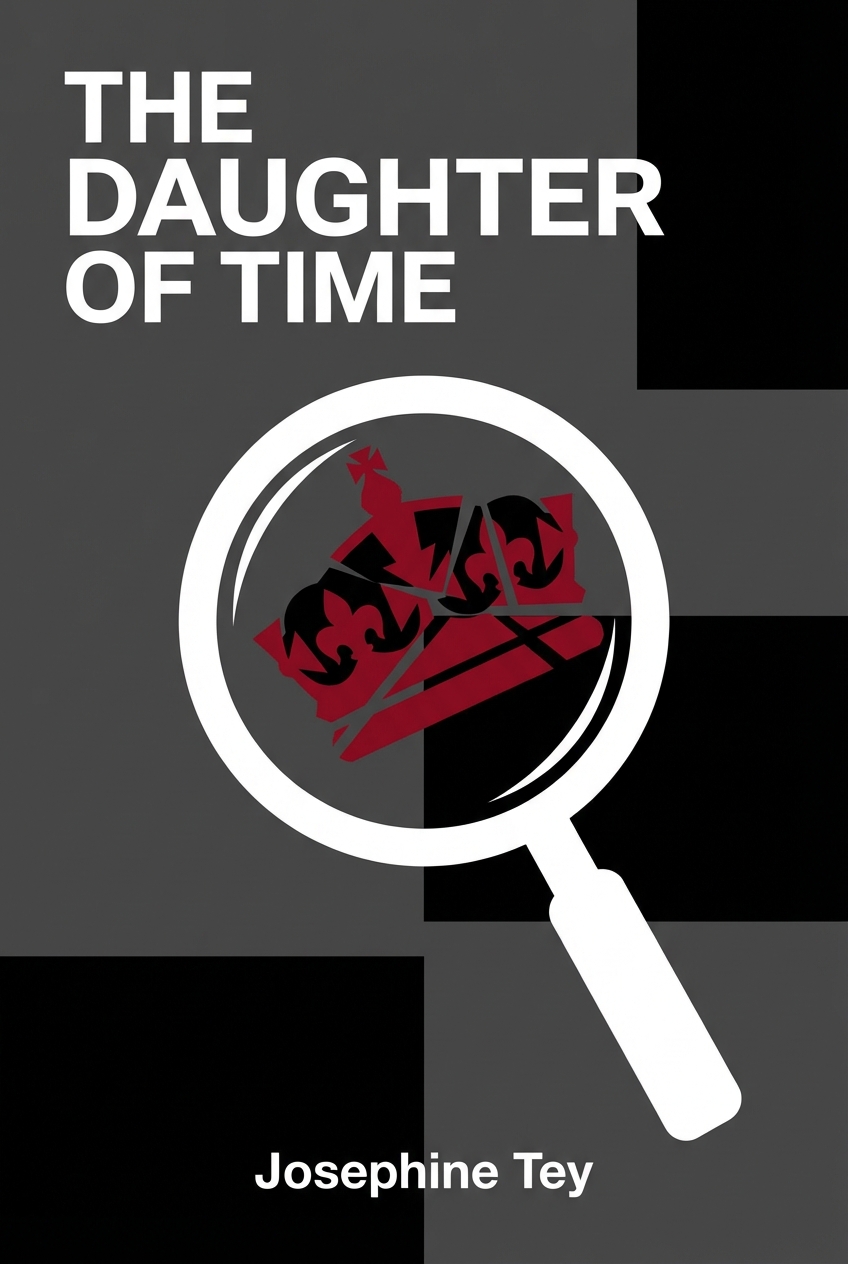
The Daughter of Time
What's it about
Ever wondered if history got it wrong? What if one of history's most notorious villains was actually innocent? Get ready to challenge everything you thought you knew about King Richard III and discover how a centuries-old lie became accepted as fact. Join a detective confined to a hospital bed as he uses modern investigative techniques to unravel a 500-year-old mystery. You'll learn how to separate truth from propaganda, analyze historical evidence like a pro, and see how easily reputations can be destroyed—or redeemed—by those who control the narrative.
Meet the author
Josephine Tey was the pen name of Elizabeth MacKintosh, a celebrated Scottish author whose crime fiction is hailed as some of the most intelligent in the genre. A trained physical education instructor and successful playwright under the name Gordon Daviot, she brought a unique, analytical perspective to her novels. This methodical approach is famously demonstrated in The Daughter of Time, where her detective hero meticulously re-examines historical evidence from a hospital bed, showcasing Tey's mastery of blending suspense with rigorous intellectual inquiry.
The Script
Think of the past as a crime scene. The evidence has been contaminated, the witnesses are long dead, and the official report—what we call history—has been written by the victors. We accept this report as fact, a settled narrative etched in stone. But what if that official story is the most sophisticated lie of all? What if the villains we’ve been taught to despise were framed, and the heroes we celebrate were the real perpetrators? We tend to believe that truth solidifies over time, that the further we get from an event, the clearer our perspective becomes. The uncomfortable reality is the opposite: the more time passes, the more the narrative hardens into an accepted myth, making the original truth nearly impossible to recover.
This is the puzzle that tormented Josephine Tey, a Scottish author best known for her classic mystery novels. While recovering from a physical ailment herself, much like her protagonist, she became obsessed with a historical cold case: the alleged crimes of King Richard III. She was struck by how the universally accepted portrait of a monstrous, child-murdering tyrant felt fundamentally wrong, like a poorly constructed alibi. Tey realized that the tools of a detective—scrutinizing evidence, questioning motives, and dissecting witness testimony—could be applied not just to contemporary crimes, but to the grand narratives of history itself. She wrote "The Daughter of Time" as a gripping investigation, using her fictional detective to dismantle a 400-year-old story and challenge the very idea that history is ever truly settled.
Module 1: The Tyranny of Common Knowledge
The story begins with Alan Grant, a sharp Scotland Yard inspector, laid up in a hospital bed. He's bored out of his mind. His friends bring him books, but he dismisses them as formulaic and predictable. He's a man who deals in facts, and he's surrounded by fluff. To give him a real puzzle, his friend Marta brings him a stack of portraits of historical figures. Grant, a student of faces, is drawn to one in particular. The man in the portrait looks like a judge. He seems burdened by responsibility, thoughtful, and even saintly.
When Grant learns the portrait is of King Richard III, the infamous hunchbacked monster who murdered his own nephews, he's stunned. The face doesn't match the story. This is the first critical insight. Accepted narratives are often built on weak foundations and rarely questioned. Grant's nurse, The Midget, embodies this. She sees the portrait and immediately declares him a "murdering brute." Why? Because her school history book said so. She can't name the original source. She doesn't need to. For her, the textbook is the source. This is what the book calls "Tonypandy," a term for a historical myth that becomes more real than the truth. It's an emotionally satisfying story that people prefer over messy, complicated facts.
This leads to the next key point. Our perception is powerfully shaped by the labels we're given. Before knowing the identity of the man in the portrait, Grant and his surgeon see a man of integrity. The moment the name "Richard III" is spoken, they can only see a villain. The surgeon remarks that villainy, like beauty, is "in the eye of the beholder." The label overwrites the direct evidence of their own eyes. This is a powerful lesson for any professional. How often do we judge a person, a company, or a technology based on its reputation before we've even looked at the data? Grant decides he won't be swayed. He will investigate this case like any other, starting from scratch. He’ll use only primary evidence, not the "history book" version of the truth.