All Books
Self-Growth
Business & Career
Health & Wellness
Society & Culture
Money & Finance
Relationships
Science & Tech
Fiction
Topics
Blog
Download on the App Store

The Dragon Reborn

Book Three of The Wheel of Time

13 minRobert Jordan

What's it about

Are you destined for greatness, or are you just going mad? This is the question that haunts Rand al'Thor. As the Dragon Reborn, he must wield immense power to save the world, but every use of it pushes him closer to insanity and the Dark One's grasp. Discover how Rand races to claim the legendary sword Callandor, a weapon that could be his salvation or his ultimate doom. You'll follow his perilous journey, torn between his duty and his fear, as his friends hunt the forces of Shadow across a fractured world, all leading to a cataclysmic confrontation in the heart of the Stone of Tear.

Meet the author

Robert Jordan is the pen name for James Oliver Rigney, Jr., an internationally bestselling author whose monumental Wheel of Time series has sold over 90 million copies worldwide. A graduate of The Citadel with a degree in physics, he served two tours in Vietnam, earning multiple decorations for his valor. This background in military history, physics, and mythology provided the rich, complex foundation for one of the most beloved and influential epic fantasy sagas ever written.
Listen Now

Opens the App Store to download Voxbrief

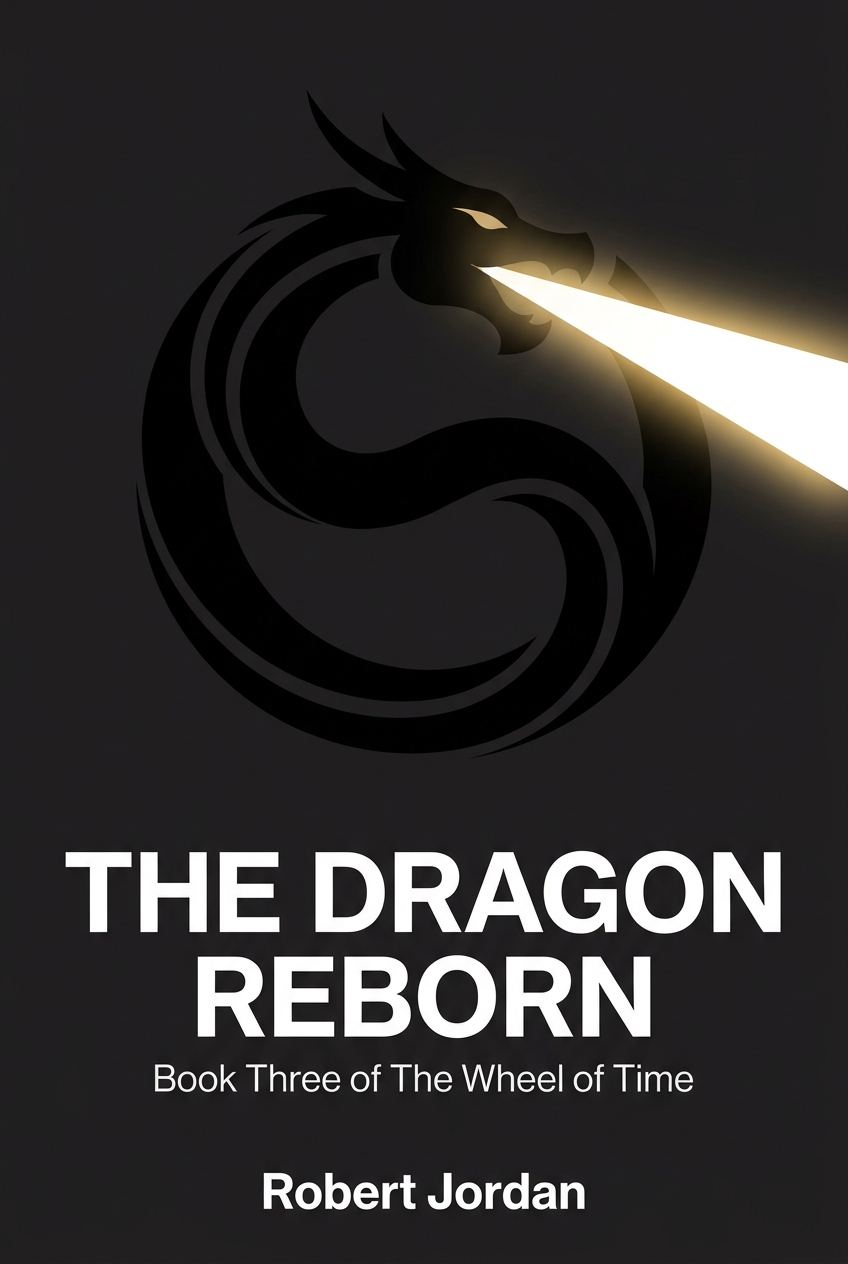
The Dragon Reborn book cover

The Script

In a high mountain pass, a young man huddles by a fire, alone. He is haunted by the memories of other men—a general who broke the world, a king who played the fool, a herder who loved a woman he could not have. These lives are not his own, yet they flicker behind his eyes, whispering advice, warnings, and temptations. He carries the weight of a prophecy that names him the world's savior and its destroyer, a title he desperately rejects. Each sunrise brings him closer to a confrontation he knows he is not ready for, a battle against an ancient, encroaching darkness. He is running from the terrifying power awakening inside himself, a power that feels both foreign and frighteningly familiar.

His friends, scattered by fate, search for him, each following a different path toward the same desperate hope. They are caught in the turning of an age, where legends walk the earth and the old patterns of reality are fraying. Their search is a race against time, as the forces of shadow consolidate their power, twisting the world to their will. The young man's allies know that if he is not found, if he is not guided toward his destiny, his refusal to accept his role could be as destructive as any act of malice. They must find the Dragon Reborn before he either surrenders to despair or is consumed by the very power meant to save them all.

This sprawling epic of a world on the brink of transformation was born from the mind of a man who understood the burdens of duty. Robert Jordan, a pen name for James Oliver Rigney Jr., was a West Point graduate and a decorated Vietnam veteran who had witnessed firsthand how ordinary people are swept up in the grand, terrible currents of history. He began crafting the intricate tapestry of The Wheel of Time series to explore the human cost of prophecy and power, questioning what it truly means when one person is chosen to bear the weight of the world's salvation. The Dragon Reborn is a pivotal chapter in that exploration, delving into the psychological torment of a hero who refuses the call.

Module 1: The Burden of an Unwanted Mandate

The story opens with a powerful subversion. The protagonist, Rand al'Thor, the prophesied Dragon Reborn, is almost entirely absent. Instead, we see the world reacting to him. This is a deliberate choice. It frames the central theme as the world’s struggle with a disruptive force it desperately needs and deeply fears.

Rand is a leader who doesn't want to lead. He flees his friends and allies, convinced he is a danger to them. His ability to channel saidin, the male half of the world’s magical One Power, is tainted. It drives men to madness. He sees his destiny as a death sentence. This creates the first critical insight: True leadership is often an act of acceptance, not ambition. Rand’s journey is about accepting the terrible responsibility that has been thrust upon him. He must own the role before it destroys him and everyone he cares about.

For professionals, this mirrors the founder’s dilemma. You might start with a passion for a product, not a desire to manage a board, a P&L, and hundreds of employees. Yet, success demands you accept this new, often uncomfortable, identity. Jordan suggests that resisting this mantle doesn't make it go away. It only makes the journey more chaotic and destructive.

This leads to the second key idea: The path of destiny is paved with isolation. Rand’s power and prophecy create a chasm between him and his friends. They see a messiah; he sees a monster in the making. Perrin, one of his closest friends, struggles to see the boy he grew up with inside the mythic figure. He asks himself, "Are we still friends? Can we be? Now?" This is the loneliness of the C-suite, the isolation that comes when your decisions affect everyone but can be shared with almost no one. The very power that makes you essential also makes you other.

So what happens when the leader runs? The system doesn't wait. We see this in the political and social fabric of the world, which begins to fray. A fanatical religious order, the Children of the Light, sees all channelers as agents of evil. They interpret the chaos as a sign of the end times, justifying their own ruthless power grabs. Their leader, Pedron Niall, sees the Dragon Reborn as a "rabid lion" he can use to destabilize his enemies. Chaos is a ladder, and a reluctant leader creates a power vacuum that others will rush to fill. Niall’s strategy is to let the crisis burn, positioning himself as the only one who can bring order. It’s a stark reminder that in any market or organization, a leadership void is an opportunity for cynical actors to seize control.

Module 2: The Tangible Reality of Unseen Worlds

Jordan expands the battlefield beyond the physical world. He introduces Tel'aran'rhiod, the World of Dreams. It's a real, parallel dimension where actions have real-world consequences.

Perrin, who has a telepathic connection with wolves, finds himself pulled into this dreamscape. He learns a chilling rule from a wolf spirit named Hopper: what you do to the living in Tel'aran'rhiod is real and permanent. What you do to inanimate objects is not. This introduces a powerful strategic layer. Egwene, another main character, uses a ter'angreal—an ancient artifact—to enter the dream world deliberately. She is physically captive, shielded from the One Power, but in Tel'aran'rhiod, she is free to channel. She can scout, fight, and gather intelligence.

This is where we find a crucial insight for modern strategy: Your most significant battles may be fought in arenas others can't see. Think of this as the war for narrative, the fight for public perception on social media, or the internal cultural battles that define a company's trajectory. These are very real conflicts. Egwene’s use of the dream world is a masterclass in asymmetrical strategy. When physically constrained, she opens a new front where her unique abilities give her an advantage. She can’t break the lock on her cell door in the dream, but she can mentally break her captors.

But this power comes with immense risk. Perrin is burned in the dream world and wakes with a physical scar. This underscores the next point: New frontiers carry new and poorly understood dangers. Venturing into Tel'aran'rhiod is like launching a product on a new, unregulated platform. The potential is enormous, but the rules are unknown and the consequences can be unexpectedly severe. The Forsaken, ancient and powerful enemies, also move in this space. They are masters of this domain, turning it into a landscape of psychological warfare. Lanfear, one of the most powerful Forsaken, confronts Perrin in his dreams, demonstrating her ability to manipulate perception and sow discord.

And here’s the thing: this unseen world is a source of intelligence. Egwene’s dreams are prophetic. She sees cryptic visions of her friends' futures: Perrin with a falcon and a hawk on his shoulders, Mat placing his own eye on a balancing scale. These are vital data points that require interpretation. Intuition and pattern recognition are critical intelligence-gathering tools. In a world saturated with quantitative data, the ability to interpret weak signals—the "dreams" of the market—can be a decisive advantage. Egwene’s struggle is in learning to interpret their symbolic language before it's too late.

Read More