All Books
Self-Growth
Business & Career
Health & Wellness
Society & Culture
Money & Finance
Relationships
Science & Tech
Fiction
Topics
Blog
Download on the App Store

The End of Education

Redefining the Value of School

14 minNeil Postman

What's it about

Is modern education failing our children? If you worry that schools are more focused on test scores than on creating thoughtful, engaged citizens, you're not alone. Neil Postman argues that without a compelling purpose—an "end"—education becomes a hollow exercise in compliance and economic utility. Discover Postman's powerful vision for revitalizing our schools by giving them profound narratives, from seeing humanity as a "steward of the Earth" to understanding our "ascent" through history. Learn how to redefine the value of school and inspire a genuine, lifelong love of learning in the next generation.

Meet the author

Neil Postman was a world-renowned cultural critic and New York University professor who chaired its Department of Culture and Communication for over four decades. A humanist and educator at his core, he dedicated his career to examining the profound effects of technology, particularly television and media, on democratic thought and childhood development. His lifelong concern for how we learn and what we value in a media-saturated world culminated in his critical analysis of the American school system.
Listen Now
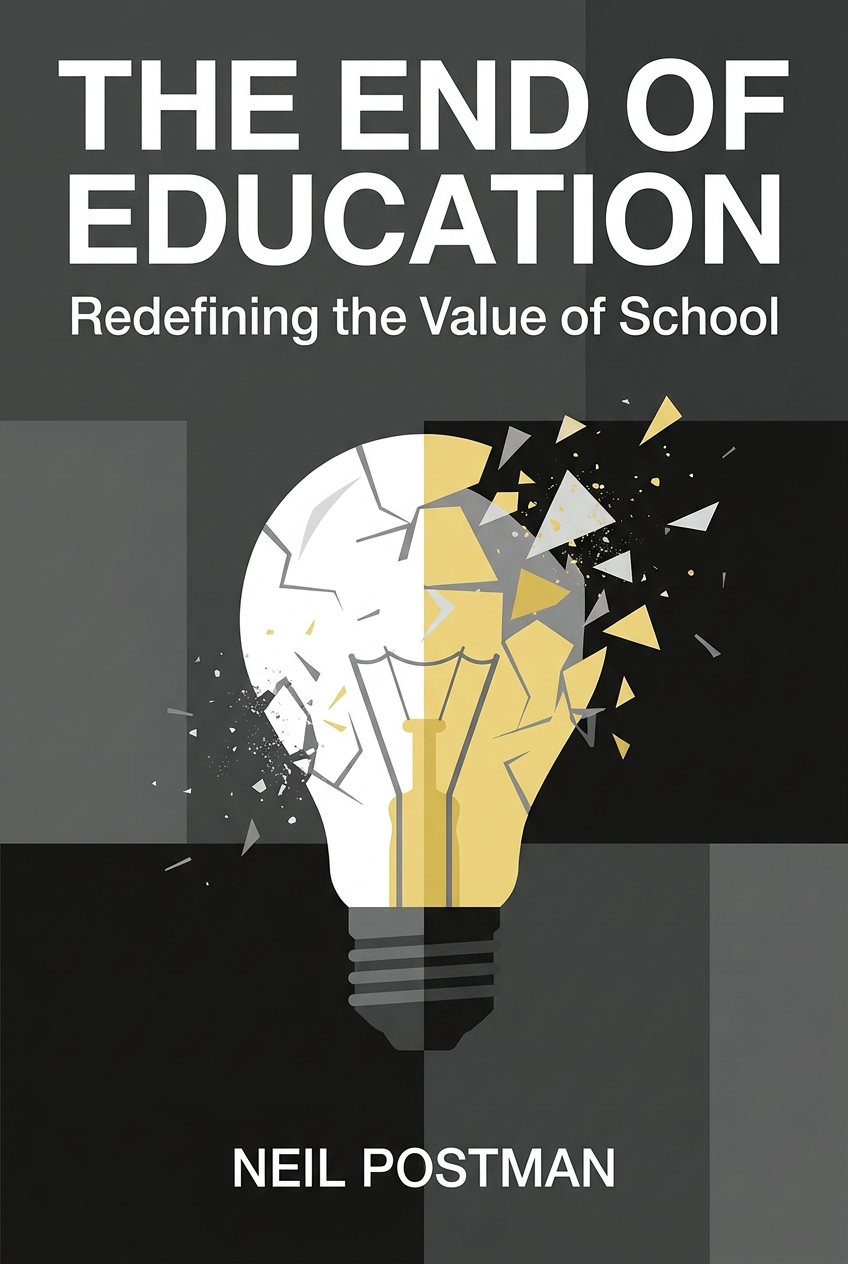
The End of Education book cover

The Script

Think of the most important lessons you've learned. Chances are, they weren't delivered in a 50-minute block, followed by a bell. They didn't come with a worksheet or a multiple-choice test. The truly formative moments—the ones that shaped your character, your worldview, your sense of purpose—arrived without a syllabus. They were born from stories, from shared struggles, from grappling with the big, messy questions of what it means to be human. Yet, we've built a multi-trillion-dollar global education system that treats these foundational experiences as an extracurricular activity, a soft-skill bonus if there’s time left over after the 'real' learning is done.

This system is obsessed with the 'how' of learning: standardized tests, new technologies, and curriculum frameworks. It relentlessly measures information retention and technical competence. But it remains eerily silent on the 'why.' Without a compelling reason to learn—a grand, unifying story about our place in the world—the entire enterprise becomes a hollow exercise in credentialing. Students learn how to pass the test, get the grade, and secure the job, but they are left starving for meaning. This is a crisis of purpose that leaves graduates technically skilled but spiritually adrift.

Neil Postman, a distinguished cultural critic and educator, saw this hollowing-out process firsthand from his vantage point as a university professor for over four decades. He watched as the grand narratives that once gave public education its soul—stories of democratic progress, of melting-pot assimilation, of divine purpose—withered and died, leaving a vacuum filled by the thin, uninspiring goal of economic utility. He wrote "The End of Education" as an urgent plea to find new, sustaining reasons for school to exist at all. For Postman, the central question was how to save our schools from their own success at becoming meaningless.

Module 1: The Gods That Failed

Postman argues that every great culture is built on a powerful story. A unifying narrative. This narrative gives life meaning. It gives direction. And it gives education its purpose. For centuries, the Judeo-Christian story provided this foundation in the West. Schools were built to teach people how to read the Bible. Universities were founded to train ministers. The purpose was clear. The "why" was answered. But over time, these traditional narratives began to crumble.

Postman charts their decline. Intellectual revolutions systematically dismantled old sources of meaning. Think of Darwin. His theory of evolution challenged the story of divine creation. Freud questioned the very idea of human rationality. Einstein’s work revealed a universe far less certain than Newton’s. These were seismic shocks to our collective stories. They left a void. A "psychic trauma."

Into this void rushed new, often destructive narratives. Communism promised a historical destiny. It failed spectacularly. Nazism offered a Thousand-Year Reich. It lasted twelve years and ended in ruin. In America, our own foundational stories have been wounded. The narrative of democracy feels hollow with low voter turnout and political cynicism. The "melting pot" story rings false when entire communities remain marginalized. Even our sacred symbols have been trivialized. Lincoln’s face sells bedsheets. The Statue of Liberty promotes airlines. So here's the thing. When our guiding stories weaken, society fragments.

This brings us to the new gods of our time. Schools now serve weak and uninspiring narratives, chiefly the god of Economic Utility. This is the story we tell students today. Go to school. Get good grades. Get a good job. Your value is your future earning potential. Postman finds this narrative deeply flawed. First, there's little evidence linking school quality to national economic success. Second, it reduces students to a single dimension: future employees. It’s profoundly uninspiring. A good education might lead to a good job. But that should be a byproduct, not the central goal.

Finally, there's the god of Consumership. A society driven by technology often elevates consumerism to a moral imperative. This narrative teaches a simple creed. Whoever dies with the most toys, wins. Goodness is found in acquisition. Television commercials function as modern religious parables. They present a problem, a "sin" like bad breath or a slow computer. Then they offer a product as the path to salvation. Schools have even become complicit. Postman points to programs like Channel One. This service gave free video equipment to schools. The catch? Students were required to watch two minutes of commercials every day. Education became explicitly tied to the worship of consumerism. These narratives are not just weak. They are soul-crushing. They fail to offer a transcendent purpose for learning.

Read More