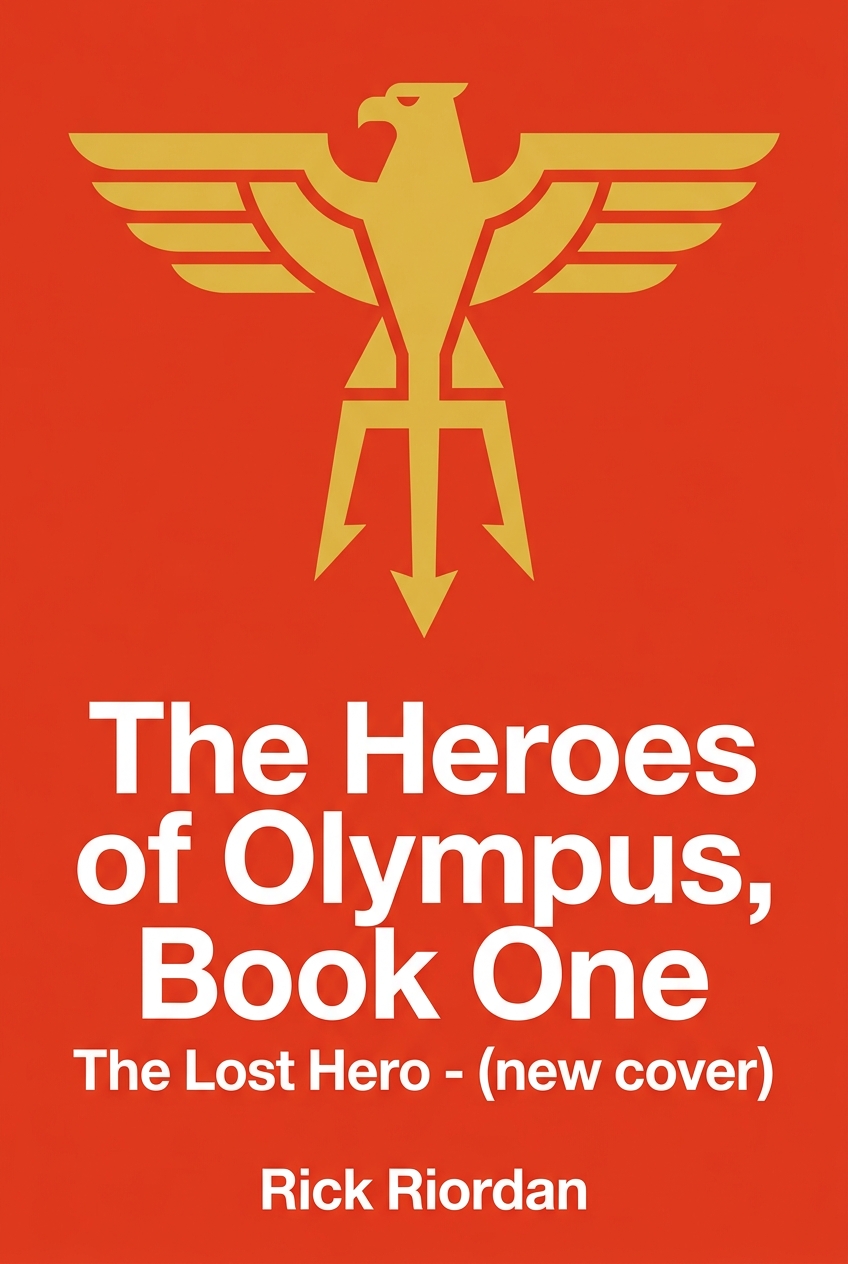
The Heroes of Olympus, Book One
The Lost Hero - (new cover)
What's it about
What would you do if you woke up with no memory, surrounded by people who claim to be your friends, and told you're the son of a god? Discover how to navigate a dangerous new world and piece together your identity, even when you can't trust your own mind. You'll join Jason, a boy with amnesia, as he's thrust into Camp Half-Blood, a training ground for demigods. Alongside his new companions, Piper and Leo, he'll uncover a terrifying prophecy, battle ancient monsters, and embark on a perilous quest to rescue a kidnapped goddess, all while searching for the hero who has mysteriously vanished: Percy Jackson.
Meet the author
Rick Riordan is the 1 New York Times bestselling author of over twenty novels for young readers, including the Percy Jackson and the Olympians series. A former middle school teacher of English and history, Riordan spent fifteen years sharing his love for Greek mythology with his students. This passion, combined with stories he created for his own son, inspired him to craft the modern mythological worlds that have captivated millions of readers and made him a global literary phenomenon.
Opens the App Store to download Voxbrief

The Script
You wake up on a school bus, sitting next to a girl who claims to be your girlfriend and a guy who says he's your best friend. They know your name—Jason—but you don't. You don't know them, you don't know where you are, and you don't know who you are. The only thing that feels remotely familiar is the gold coin in your pocket, cold and heavy with a history you can't access. Everyone else on the bus seems to know their place, chattering about a field trip to the Grand Canyon. For them, it's just another Tuesday. For you, it's day one of a life that feels like it was stolen from someone else. This is a total system wipe. Your memories, your identity, your past—all gone, replaced by a gnawing void and the unsettling certainty that you are in the wrong place, at the wrong time, and in the wrong body.
This feeling of being a stranger in your own story, of having a fundamental piece of your world suddenly and inexplicably yanked away, is precisely the territory Rick Riordan wanted to explore after concluding his blockbuster Percy Jackson series. Having spent five books building a beloved world and a set of characters readers knew intimately, he faced a creative challenge: how to make that world feel new and dangerous again? He found the answer by taking something away from the reader themselves—their anchor. By starting with a hero who has no memory, Riordan puts the reader in the same disoriented state, forcing them to rediscover the rules of gods and monsters right alongside Jason. A former middle school teacher of English and mythology, Riordan used this narrative device to brilliantly reboot his universe, creating a fresh entry point for new readers while deepening the mystery for loyal fans who know just how much is missing.
Module 1: The Crisis of Identity and the Power of Instinct
The story opens with a profound crisis. A teenager named Jason wakes up on a school bus, holding hands with a girl he doesn't know, next to a friend who calls him his best bud. He has total amnesia. He doesn't know his name, his past, or why he's there. This is a powerful exploration of a core professional anxiety. How do you operate when your institutional knowledge is wiped clean? How do you lead when you don't even know who you are?
Here's the first insight. When memory fails, rely on muscle memory and instinct. Jason has no conscious memory. But when a platoon of storm spirits attacks, his body knows exactly what to do. A gold coin in his pocket transforms into a sword. He speaks fluent Latin, a dead language, to identify the monsters. He instinctively knows how to fight, how to lead, and how to protect the people around him. His instincts are a repository of his lost experience. For a professional, this is a reminder that our deepest skills are embedded in our habits and reflexes, forged through years of practice. When you're thrown into a new role or a crisis hits, your instincts are your most reliable asset.
But this leads to a second, more complicated point. Your perceived identity is a powerful, and dangerous, social construct. Piper, the girl holding his hand, believes she's his girlfriend. Leo, his supposed best friend, has months of shared memories with him. They have constructed an identity for Jason that he can't recognize. At Camp Half-Blood, the demigod training ground, this intensifies. He is immediately seen as a leader, a potential hero. Yet inside, he feels like a fraud. This disconnect is a source of immense tension. It shows that the expectations others place on us can become a cage. We are often forced to perform a role we didn't choose, based on a history we may not even own.
And it doesn't stop there. True identity is often revealed through unexpected connections. Jason's breakthrough comes when he discovers a photo of Thalia Grace, a legendary hero from Camp Half-Blood. He learns her last name and a piece of his own puzzle clicks into place. She is his sister. This external link is the first real anchor for his identity. It proves that we don't define ourselves in a vacuum. Our identity is relational. It's found in the people we are connected to, the families we belong to, and the teams we are a part of. Finding your place often means finding your people first.