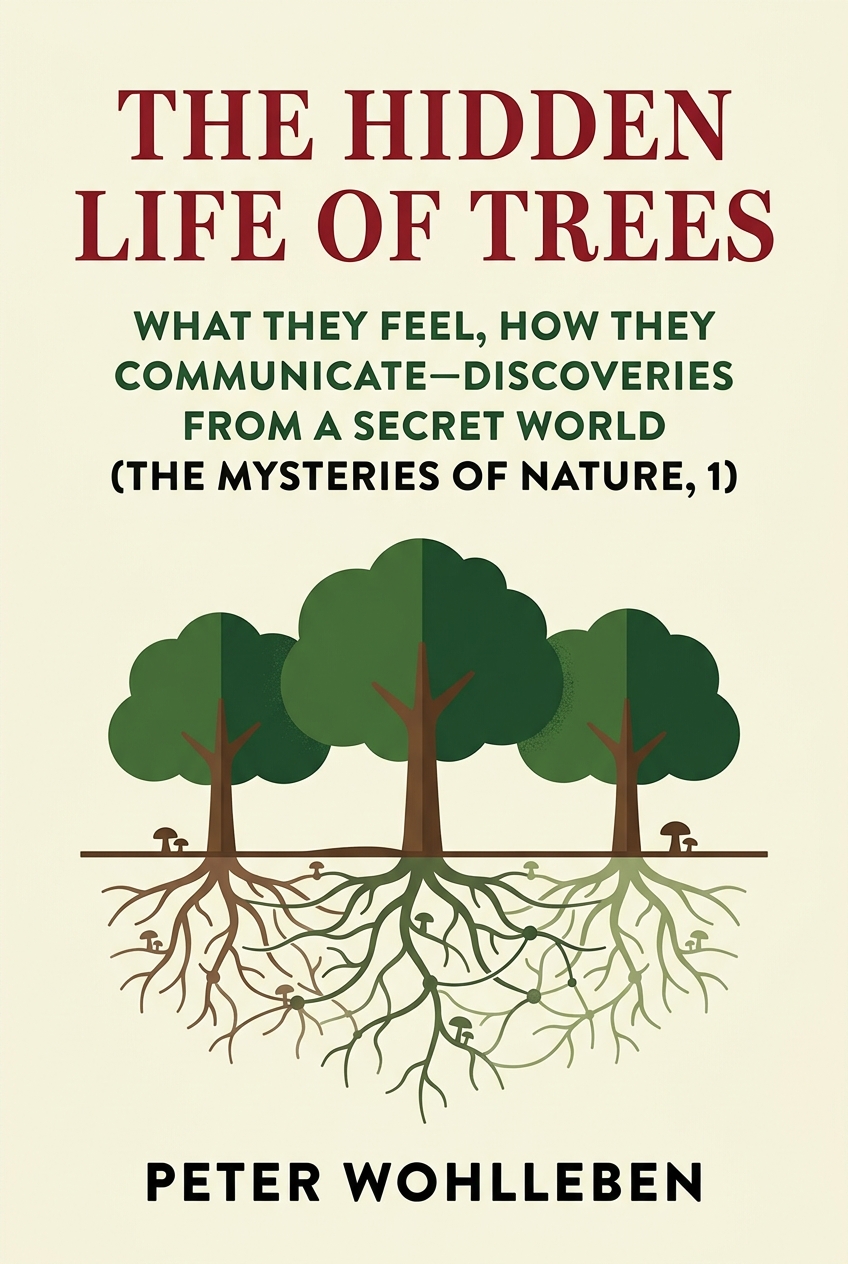
The Hidden Life of Trees
What They Feel, How They Communicate―Discoveries from A Secret World (The Mysteries of Nature, 1)
What's it about
Ever wondered what trees are really doing when you walk through a forest? You're about to discover a hidden world beneath the bark, where trees aren't just silent giants but are part of a complex social network, communicating, sharing, and even caring for each other. Learn how trees use a "wood wide web" of fungi to send warnings and share nutrients with their neighbors. You'll uncover the secrets of how they support their young, defend against predators, and function as a superorganism, completely changing how you see the natural world.
Meet the author
Peter Wohlleben is a German forester who has spent over twenty years working for the forestry commission before leaving to put his ecological ideas into practice. He now runs an environmentally-friendly woodland in Germany, where he works for the return of primeval forests and cares for both wild and domestic animals. His observations from decades spent living and working in the woods led to the groundbreaking insights about tree communication and social networks shared in his international bestseller.
The Script
We tend to see a forest as a collection of silent, solitary individuals. Each tree stands alone, a stoic competitor vying for its own patch of sunlight, its own share of water, its own space to grow. This view frames the natural world as a relentless arena of individual struggle, where the strong survive and the weak are shaded out, starved, and left to rot. It’s a vision of nature that conveniently mirrors our own myths about rugged individualism and cutthroat competition. But what if this entire picture is wrong? What if the forest is a bustling, ancient metropolis? What if the trees we see as isolated combatants are actually deeply social beings, engaged in a constant, complex exchange of information, nutrients, and warnings—a community operating on principles that look more like cooperation than conflict?
This radical reframing of the forest comes from a man who spent his life managing them. Peter Wohlleben was a German forester, trained to see trees as timber—as economic units to be cultivated and harvested efficiently. Yet, day after day, walking the same ancient beech forests, he began to notice things that his training couldn't explain. He saw strange, moss-covered stumps that should have been dead for centuries but were still green with life, fed by the roots of their neighbors. He observed parent trees deliberately restricting their own canopy to allow sunlight to reach their offspring. His professional worldview, built on the logic of individual competition, crumbled in the face of this undeniable evidence of a hidden social network. He wrote "The Hidden Life of Trees" as a report from the front lines, sharing the astonishing discoveries that forced him to unlearn everything he thought he knew about the silent world he worked in.
Module 1: The Social Network of the Forest
We often think of trees as solitary giants. They stand alone, competing for sunlight and soil. But Wohlleben argues this is a profound misunderstanding. The forest is less like a competitive marketplace and more like a deeply connected social network.
The central insight here is that trees form cooperative communities that share resources and support each other. This is a biological reality. Wohlleben's most compelling evidence is the story of an ancient beech stump he found. The stump was cut down hundreds of years ago. It had no leaves for photosynthesis. Yet, it was still alive. How? The surrounding beech trees were pumping sugars and nutrients through their interconnected roots to keep it alive. They were nursing their fallen elder. This isn't an isolated case. On exposed roadsides, you can see root systems of the same species physically fused together.
This underground connection is facilitated by a vast fungal network. Scientists call it a mycorrhizal network. Wohlleben calls it the "Wood Wide Web." This network of fungal threads connects the roots of different trees, sometimes across different species. It acts as a super-fast communication and resource-sharing system. Trees use this underground network to send warnings and redistribute nutrients. A strong tree with excess sugar can send it to a weaker, struggling neighbor. When a tree is attacked by insects, it can send chemical signals through this network. These signals warn other trees to activate their defenses before the threat arrives. It's a forest-wide immune response.
This social behavior extends above ground. Wohlleben observes what he calls "canopy etiquette." Trees in a friendship, ones that have grown up together, are careful not to block each other's light. Trees in established friendships will avoid growing thick branches toward each other. They reinforce their branches in other directions. This cooperative behavior minimizes conflict and ensures the whole community thrives. A dense, interconnected forest creates its own microclimate. It moderates temperature, stores massive amounts of water, and maintains high humidity. This protected environment allows trees to live far longer than isolated individuals. In contrast, planted forests with damaged roots act like "loners." They can't form these networks. They are less resilient and rarely reach old age.