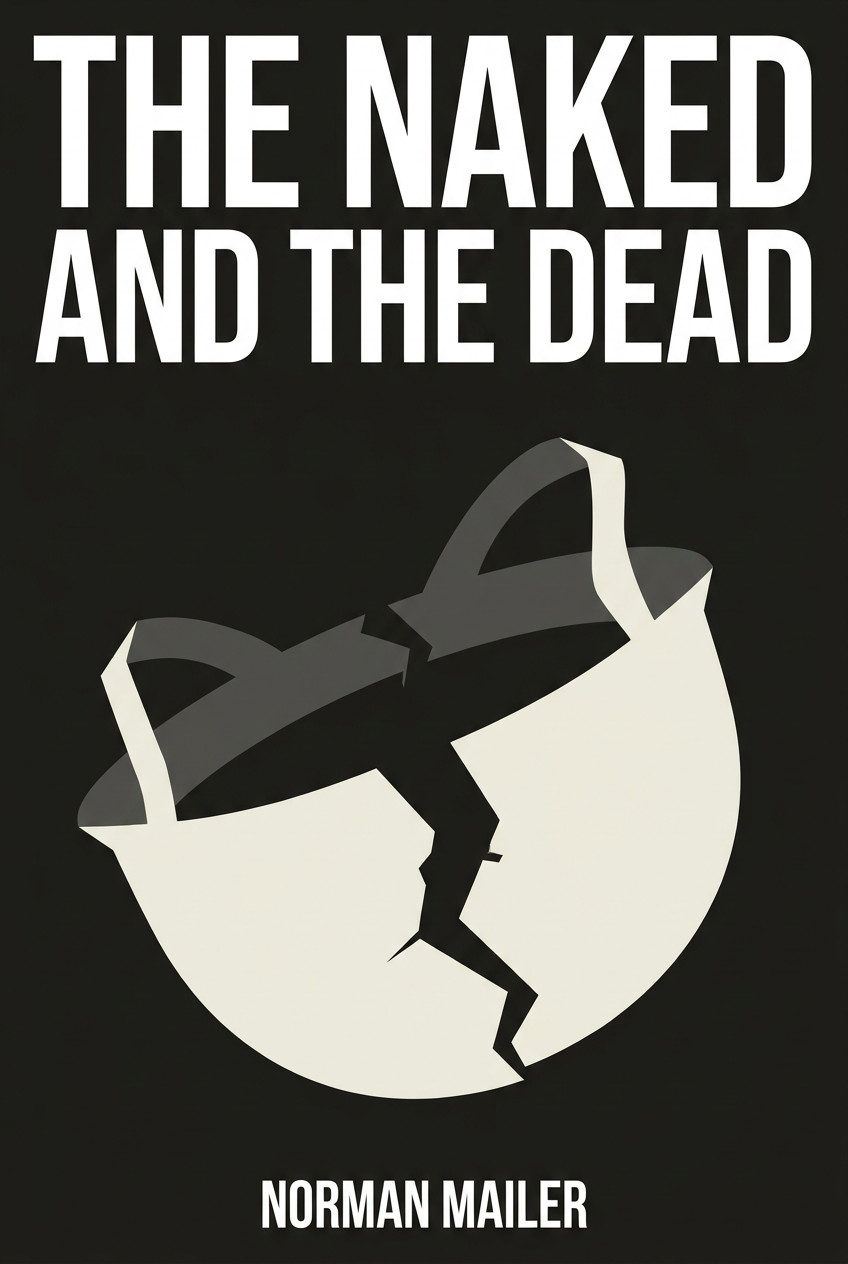
The naked and the Dead
What's it about
Ever wondered what truly happens to men pushed to their absolute limits? This summary plunges you into the brutal reality of war, revealing how extreme pressure strips away every pretense, exposing the raw, core nature of humanity. Get ready to confront the unvarnished truth about power, fear, and survival. You'll march alongside a platoon of American soldiers on a Pacific island, witnessing their intense internal and external battles. Through their eyes, you'll uncover the complex web of class, ambition, and prejudice that defines them. Discover how the grim crucible of combat forges, breaks, and ultimately reveals the men they truly are, far from the world they once knew.
Meet the author
A towering figure in 20th-century American literature, Norman Mailer catapulted to fame with his debut novel, The Naked and the Dead, based on his own WWII experiences. Drafted into the U.S. Army at age 21, he served in the Philippines, gathering the raw, unflinching material that would define his masterpiece. This firsthand account of combat's psychological brutality and human cost established Mailer as a major voice of his generation, blending journalism, fiction, and fearless social commentary.
Opens the App Store to download Voxbrief

The Script
Two infantrymen are tasked with identical missions: cross a river, secure the opposite bank. The first soldier, a career officer, sees the objective as a geometry problem. He consults his map, calculates the current's velocity, identifies the optimal crossing point based on topographical advantages, and plots a precise, efficient route. His mind is a grid of angles, distances, and kill zones. The second soldier, a young draftee, sees only the river. He feels the mud sucking at his boots, smells the rot of unseen things in the water, and hears the unnatural quiet that precedes an ambush. For him, the mission is a terrifying, physical ordeal measured in heartbeats and the weight of his fear. Both men are given the same order, the same equipment, and face the same enemy. Yet, they are fighting two completely different wars: one ofabstract strategy, the other of visceral survival.
This chasm between the grand, detached machinery of war and the brutal, personal reality of the men caught in its gears is the territory Norman Mailer set out to claim. After graduating from Harvard, Mailer was drafted into the U.S. Army in 1944. He served in the Philippines as a cook and a rifleman on reconnaissance patrols, rather than as a frontline hero. He saw firsthand how the immense, impersonal forces of command and strategy were experienced as terror, boredom, and a desperate struggle for meaning by the individual soldiers on the ground. Mailer began taking meticulous notes, driven by a fierce ambition to write the great American novel of the war, one that would strip away the patriotic gloss and expose the raw, psychological truth of combat. He wanted to capture the internal wars raging inside every man.
Module 1: War as a Psychological Grind
Mailer's first major point is that war is a relentless, exhausting routine. It grinds men down through physical labor, fear, and boredom. The real enemy is often the psychological and emotional toll, not the opposing army.
The campaign on the fictional island of Anopopei begins with tedious, soul-crushing labor. The men of the reconnaissance platoon find themselves assigned to "beach detail." They unload boats. They haul crates. They build roads far from the front. This isn't what they expected. This leads to a key insight: War is primarily an experience of monotony and absurdity, not constant heroism. The soldiers are trapped in a "bearable rut" of pointless tasks and petty discomforts. One character, Red Valsen, reflects that there would be this campaign, then another, and another. It would never end. This feeling of an endless, meaningless loop is central to the soldier's psychological state.
This grind erodes the individual. It fosters a sense of powerlessness. So what happens next? The men turn inward, but not for reflection. They turn to their pasts. This is because a soldier's identity is forged by their civilian life long before they see combat. Mailer makes this explicit. The men are products of their wives, their jobs, their farms, and their social backgrounds. War is just an "activating agent." It brings their ingrained traits to the surface. For example, Sergeant Brown is consumed by anxiety. He fears his wife is cheating on him back home. This civilian insecurity dominates his thoughts, even during a high-stakes poker game before an invasion. Gallagher, another soldier, is filled with bitterness. His anger is tied to his Boston Irish background and his deep worry about his pregnant wife. The war reveals who they always were, under immense pressure.
And here's the thing. In this environment of absurdity and anxiety, survival feels like a matter of pure luck. The book argues that death in war is random, unheroic, and often meaningless. There is no justice. There is no controlled destiny. Take the death of Hennessey. He's a soldier who carefully follows the rules. He prepares meticulously for the landing. He even inflates his life belt. But he is killed by a random mortar shell while on a mundane errand. His preparation meant nothing. His death is sudden and anticlimactic. It underscores a brutal truth. Following the rules offers no protection against the arbitrary violence of war. Life and death are a coin flip.
This brings us to the social fabric of the army itself. The military is a microcosm of American society, complete with its own rigid class structures and prejudices. Mailer shows us the stark divide between officers and enlisted men. Officers sleep in staterooms. Enlisted men are jammed in the hold "like pigs." Officers eat on plates. Enlisted men eat on their haunches. This breeds deep resentment. But the tension doesn't stop there. Anti-Semitism and racism are rampant. Soldiers openly use slurs. Goldstein, a Jewish soldier, overhears that his company is "where they stick the goddam Jewboys." This fills him with a hopeless rage. The internal conflicts within the platoon are often as intense as the fight against the Japanese.
Module 2: The Brutal Nature of Power and Leadership
Now let's turn to the theme of leadership. Mailer presents a cold, pragmatic view of command. Effective leadership is about intelligence, relentless will, and a sometimes cruel understanding of human nature. Moral scruples are a liability.
At the highest level, we have General Cummings. He is a brilliant tactician. He thinks in terms of power, statistics, and control. He tells his aide, "The trick is to make yourself an instrument of your own policy." Cummings embodies the idea that effective leadership requires a ruthless, pragmatic application of power. He leads through manipulation and fear. In one chilling scene, he explains his "fear ladder" philosophy. He believes that to make an army work, you must fit every man into a ladder of fear. Enlisted men must fear their sergeants. Sergeants must fear their lieutenants. Lieutenants must fear their captains, and so on, all the way up to him. He deliberately fosters resentment between officers and enlisted men, for example, by giving officers better food rations. He believes this resentment makes them better soldiers.
This philosophy of power trickles down the chain of command. At the platoon level, we meet Sergeant Croft. He is described as being "made of iron." He loves combat. He is the best platoon sergeant in the army, and also the meanest. After landing on the island, he immediately establishes his dominance. He brutally quells a soldier who complains about the noise from a poker game. Like Cummings, Croft understands that control is maintained through the strategic use of intimidation and violence. In a later scene, Croft captures a surrendering Japanese soldier. After a brief, almost friendly interaction where they share cigarettes, Croft calmly executes the unarmed prisoner. His motives are vague. The act seems driven by a cold desire for completion and dominance. This is a calculated act of power.
But what happens when this kind of power is challenged? The relationship between General Cummings and his aide, Lieutenant Hearn, provides the answer. Hearn is an intellectual, a liberal who is both fascinated and repulsed by Cummings's philosophy. Cummings sees Hearn as an intellectual sparring partner, but he never lets Hearn forget who is in charge. This leads to a critical insight: Individual will is ultimately crushed by the absolute authority of the military hierarchy. Cummings engages in a series of humiliating power plays to break Hearn's spirit. The final test is simple. Cummings throws a cigarette on the floor and orders Hearn to pick it up. Hearn resists. But Cummings calmly explains that he can ruin Hearn's life with a court-martial that will last for years. Hearn submits. He picks up the cigarette. It's a devastating moment. It shows that personal conviction and intellectual resistance mean nothing in the face of raw, institutional power.