All Books
Self-Growth
Business & Career
Health & Wellness
Society & Culture
Money & Finance
Relationships
Science & Tech
Fiction
Topics
Blog
Download on the App Store

The Phantom of Manhattan

16 minFrederick Forsyth

What's it about

What if the Phantom of the Opera didn't die? What if his story continued, not in the shadows of Paris, but in the dazzling, cutthroat world of early 20th-century New York? This summary reveals the untold story of the Phantom's survival and his rise to power in a new city. Discover the secrets behind his new empire, built on genius, manipulation, and a lingering obsession. You'll learn how he amassed a fortune, the new identity he created, and the desperate, decades-long search for Christine. Uncover a hidden history of love, revenge, and the dark choices made in the pursuit of a ghost.

Meet the author

Frederick Forsyth is a master of the political thriller, renowned for iconic, meticulously researched bestsellers like The Day of the Jackal and The Odessa File. A former RAF pilot and investigative journalist, his real-world experience in espionage and international affairs infuses his fiction with unparalleled authenticity. For The Phantom of Manhattan, Forsyth channeled his storytelling prowess into a compelling sequel, exploring the untold story of the Phantom's life after the opera house, a challenge he embraced with his signature narrative drive.
Listen Now

Opens the App Store to download Voxbrief

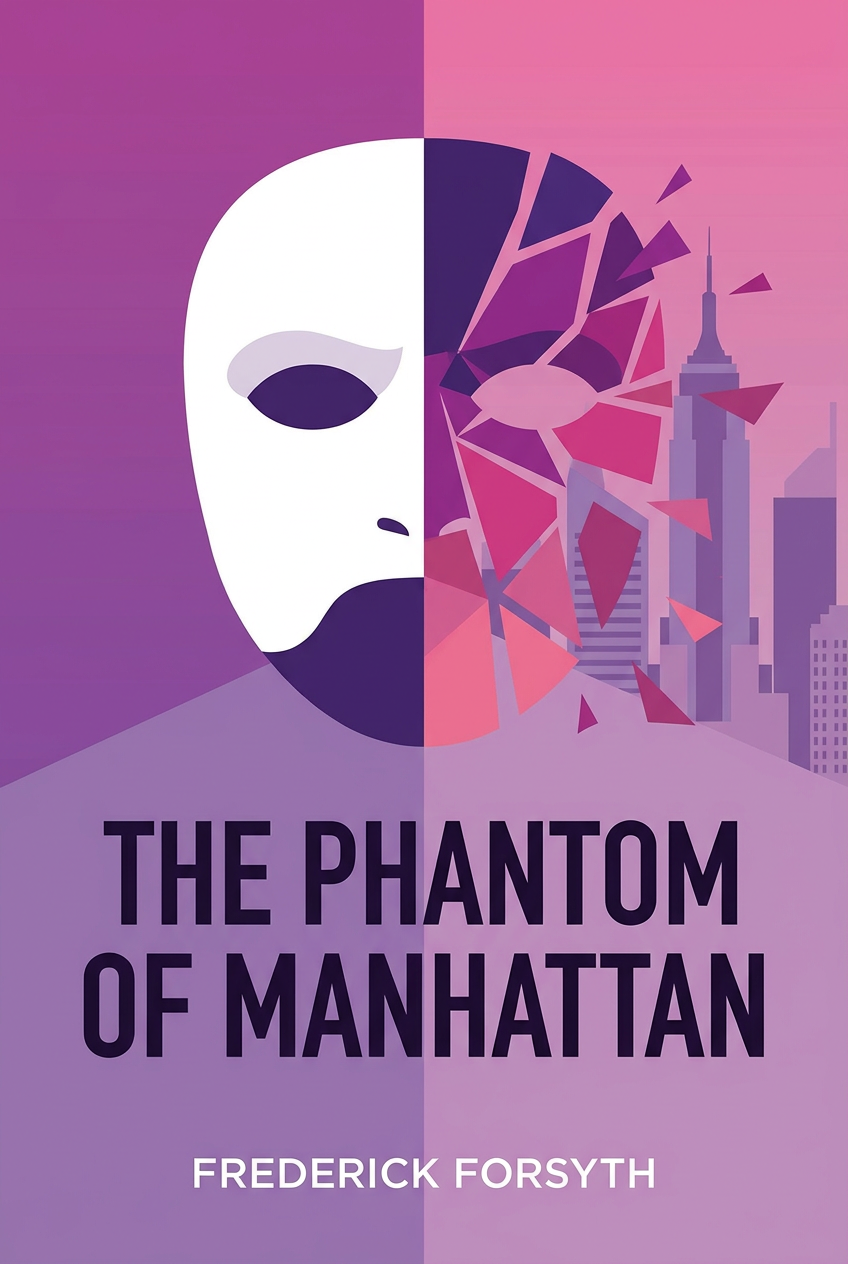
The Phantom of Manhattan book cover

The Script

Sometimes, the story doesn't end where we think it does. A curtain falls, a final note hangs in the air, and we are left to imagine the fate of those we’ve come to know. We tell ourselves that the lovers ride off into the sunset, or that the villain receives his final, just punishment. But what if the story we accepted as the definitive ending was merely an intermission? What if the Phantom, broken and presumed dead beneath the Paris Opera House, didn't perish in the shadows? What if he survived, escaped, and, fueled by genius and bitterness, crossed an ocean to forge a new empire in the steel-and-steam jungle of turn-of-the-century Manhattan?

This lingering question of “what happened next” is precisely what intrigued Frederick Forsyth. Known for his meticulously researched thrillers like The Day of the Jackal, Forsyth wasn't just a novelist; he was a master of plausible, intricate plots grounded in reality. He came to this particular story as a friend, not as a fiction writer looking for a sequel. Forsyth had been discussing the enduring legacy of The Phantom of the Opera with its most famous modern interpreter, composer Andrew Lloyd Webber. Together, they imagined a continuation, a second act that could resolve the original’s lingering chords of love, obsession, and revenge. Forsyth, applying his signature journalistic precision to this world of high romance and tragedy, set out to write the novel that would serve as the narrative bedrock for a new musical, crafting a plausible and compelling answer to what became of the ghost after the opera.

Module 1: The Making of the Legend and the Man

Before we get to Manhattan, we have to understand where the Phantom came from. The story we know isn't exactly the one that was first written. The original 1911 novel by Gaston Leroux was a bit of a flop. It was a strange, rambling book that quickly faded into obscurity. The legend was truly born in Hollywood.

The first key insight is that the Phantom legend was created by cinema, not literature. In 1922, a film producer named Carl Laemmle stumbled upon the forgotten book. He saw its potential as a horror story for the silent film star Lon Chaney. The resulting 1925 film terrified audiences. It was this cinematic monster, this creature of the shadows, that captured the public imagination and spawned decades of remakes. The book was just the spark; the silver screen fanned it into an enduring flame.

This brings us to a pivotal reinterpretation. Andrew Lloyd Webber saw something different. He read the book and concluded that Leroux had missed his own point. The true essence of the story is a tragedy of unrequited love. Lloyd Webber stripped away the book's inconsistencies and cruelty. He focused on the core human drama: a disfigured, isolated genius who falls in love with a young singer, coaches her to stardom, and is ultimately rejected. This focus on obsessive, tragic love became the foundation for the most successful musical in history. It's this version of the Phantom—the romantic anti-hero—that Forsyth uses as his starting point.

So what's the real story behind the man? The book suggests a more plausible, grounded origin. Let's forget the supernatural elements for a moment. The narrative presents a compelling argument that the Phantom was a real, tragically human figure shaped by extreme cruelty and profound compassion. The story begins with a young boy named Erik, born with a horrific facial deformity. He's sold by his own father to a freak show, where he lives in a cage, abused and tormented. His first taste of kindness comes from a young ballet girl, Antoinette Giry, who risks everything to rescue him. She hides him in the labyrinthine cellars of the Paris Opera House. This becomes his sanctuary and his prison. Here, surrounded by books and solitude, his genius flourishes. He learns architecture, engineering, and music, becoming the secret master of the building. This backstory establishes him as a product of a cruel world, saved by a single act of grace. His identity as "the Phantom" is born from secrecy, a survival mechanism in a world that would not accept him.

Module 2: The Escape to America and the Worship of Mammon

We've explored his origins. Now, let's turn to his reinvention. After the tragic events at the Paris Opera—the abduction of Christine, the manhunt, the loss of his sanctuary—Erik doesn't die. He escapes. With Antoinette Giry's help, he flees France and stows away on a ship to America. This journey marks a profound shift in his character and motivations.

His arrival in New York is brutal. He jumps ship to avoid being rejected at immigration, finding his first refuge among other outcasts in the grim shantytowns near Coney Island. This experience hardens him. It solidifies a deep-seated hatred for a society that has only ever rejected him. Here's where we see a new philosophy take root. The protagonist’s rise to power is fueled by trauma, hatred, and a ruthless pursuit of revenge against the human race. He wants to dominate. He wants the power to make the world that scorned him crawl.

To achieve this, he needs a new god. He finds one in the raw, unregulated capitalism of early New York. In Coney Island, a place of spectacle and scams, he partners with a fugitive murderer named Darius. Erik provides the brains; Darius provides the presentable face. Together, they embrace a new creed. This leads to the next major point: The accumulation of capital is adopted as a form of worship, completely devoid of morality. Erik is converted to the worship of "Mammon," the god of gold. This philosophy permits no mercy, no charity, and no scruples. His early schemes are small-time cons, but they quickly escalate. He rigs boxing matches, engages in insider trading, and builds a massive corporation, E.M. Corp. He crushes widows and orphans for profit, out of a cold, religious devotion to wealth. Money is the entire point. It's the ultimate revenge.

And it doesn't stop there. As his wealth grows, so does his need for control and isolation. He can't walk among people, but he can rise above them. Ultimate power is expressed through architectural dominance and absolute invisibility. He builds the E.M. Tower, the tallest skyscraper in New York. From his penthouse—his "eyrie in the sky"—he can look down on the city, unseen and unmasked. He has transformed his cellar prison into a palace in the clouds. He is now the invisible king in the tower, pulling the strings of finance and culture, a phantom financier orchestrating his revenge on a world he despises. He even funds a rival opera house for the purpose of spiting the city's elite who once snubbed him.

Read More