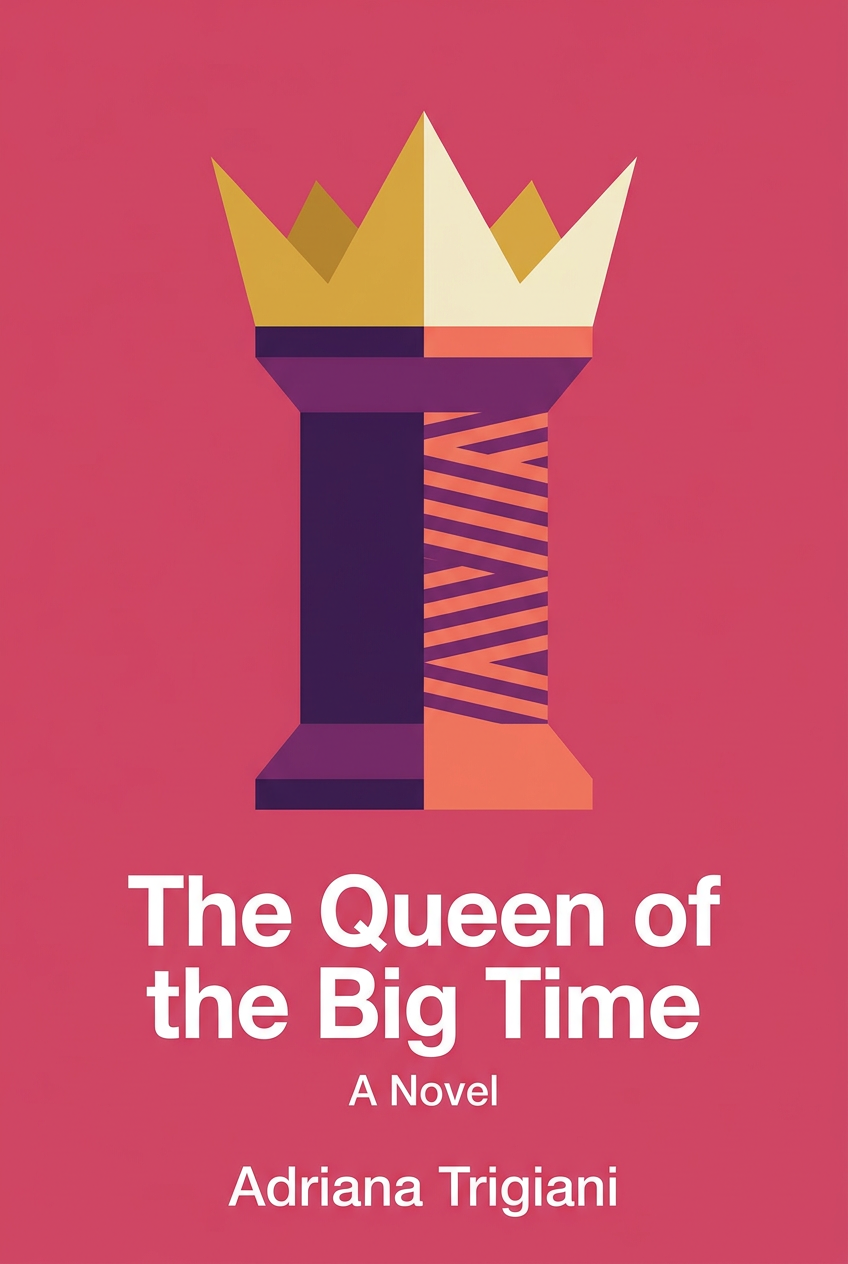
The Queen of the Big Time
A Novel
What's it about
Ever wonder if your true calling is waiting for you back home? Imagine leaving the big city's glamour behind for the simple, profound beauty of your roots. This story explores how the grandest life might not be the one you chase, but the one you were born into. You'll follow Nella, a young woman who trades the dazzling lights of 1920s New York for her tight-knit Italian-American community in the mountains of Pennsylvania. Discover how she navigates love, loss, and family duty to build a life richer than any skyscraper and become the unexpected heart of her town.
Meet the author
Adriana Trigiani is an award-winning playwright, television writer, and documentary filmmaker, and the New York Times bestselling author of twenty books in fiction and nonfiction. Drawing from her own Italian-American heritage and the storied lives of her grandmothers, Trigiani crafts novels rich with the authentic details of family, faith, and work. Her upbringing in a small Virginia town, surrounded by a vibrant immigrant community, provides the heartfelt inspiration for the unforgettable characters and settings found within her beloved stories.
Opens the App Store to download Voxbrief

The Script
When a family immigrates, they carry two sets of luggage. The first is packed with the things they can touch: a wedding ring, a worn-out dress, a handful of seeds from the old country's soil. This luggage gets unpacked, its contents finding new homes on shelves and in drawers, becoming part of the new landscape. But the second set of luggage is invisible, packed with the stories, expectations, and unspoken dreams that couldn't be left behind. This is the luggage of destiny, and it’s heavier than anything made of leather and brass.
For a daughter in that family, this invisible inheritance can feel like a beautiful, hand-embroidered gown that doesn't quite fit. The community sees her in it, a perfect picture of tradition and duty. They admire the stitching, the history, the way it connects her to everyone who came before. But inside the gown, she feels the pull of a different future, a life tailored by her own quiet ambitions. Every choice becomes a negotiation: honor the legacy woven into the fabric, or risk tearing it to chase a life that is truly her own?
This tension between the inherited dream and the personal one is the very heart of Adriana Trigiani's own family story. Growing up in a tight-knit Italian-American community in Big Stone Gap, Virginia, she was surrounded by powerful women whose lives were rich with love and tradition, but also hemmed in by expectation. Trigiani, a celebrated novelist and former television writer, found herself wanting to capture the specific magic and heartache of that world—the world of her grandmothers. She wrote The Queen of the Big Time as a tribute, a way to give voice to the women who stitched the beautiful, complicated gown of her own heritage.
Module 1: The Tug-of-War Between Duty and Dreams
The story opens on a fundamental conflict for immigrant families. It's the constant tension between what you owe your family and what you desire for yourself. For Nella Castelluca, the protagonist, this isn't an abstract idea. It's her daily reality. She is a brilliant student with a fierce hunger for education. Her teacher sees her potential. She dreams of becoming a teacher, a noble profession in her eyes. But she is also the daughter of poor Italian farmers in rural Pennsylvania. Her family needs her labor. This sets up the central theme: Your personal ambition will always be in conflict with your familial obligations.
Nella’s dream requires a sacrifice from everyone. Her older sister Elena offers to walk the three miles to the new school with her, a selfless act of support. But her eldest sister, Assunta, sees it as an opportunity. Assunta agrees to help only if Nella promises to serve as her personal maid for a year after she marries. This is the world Nella inhabits. Every step forward comes at a cost, negotiated within the complex web of family loyalty and resentment.
Furthermore, the book shows how education is a rare and powerful tool for social mobility. For Nella, reading Moby-Dick and Jane Eyre is a lifeline to a world beyond the farm's rocky soil. She believes that a good job will allow her to give her mother "pretty dishes and soft rugs," comforts that their hardscrabble life can't provide. Education represents a tangible path to a better life. It’s a chance to break the cycle of poverty and physical labor that defines her parents' existence.
And here's the thing. This struggle is about identity. Nella feels the stark contrast between her world and the world she wants to join. Roseto, the nearby Italian-American town, is a "fairy-tale" of neat lawns and prosperous families. Her own farm is a place of "pits and holes" and wild dandelions. This contrast fuels her ambition. So, the first lesson from Nella’s journey is clear. You must understand the forces pulling you in different directions. Acknowledge the duties you have to your family and community. But also, fiercely protect the dreams that are yours alone. They are your engine for change.
Module 2: The Power of Place and Community
Now, let's turn to the world these characters inhabit. Trigiani makes it clear that where you come from shapes who you are. The novel paints a vivid picture of Roseto, Pennsylvania. It’s a character in its own right, a sanctuary built by immigrants who were rejected elsewhere. They pooled their money, bought a hillside, and recreated their Italian hometown, brick by brick. This gives us a powerful insight: A strong, self-sufficient community is your greatest buffer against hardship.
The people of Roseto are fiercely interconnected. They have traditions like "La Passeggiata," a nightly stroll where the whole town gathers to socialize and share gossip. This is the social fabric that holds them together. They celebrate together at the "Big Time" festival, a weeklong religious and cultural event. They mourn together. And they support each other. The book even references a real-life medical study. The Roseto Heart Study found that the town's residents had remarkably low rates of heart disease. The reason was the community itself. The lack of stress, the deep family ties, and the certainty that you would always be cared for created a powerful protective effect.
However, this tight-knit community also creates intense social pressure. Your reputation is currency in a small town, and gossip is its stock market. Nella’s sister Elena hesitates to marry her deceased sister’s widower, Alessandro. She fears the whispers on Garibaldi Avenue. Nella herself feels the weight of social judgment. She feels out of place at her new school in her homemade clothes. She is intensely self-conscious when she meets Renato Lanzara, the handsome college graduate she adores, smelling of sausage and peppers from the festival.
From this foundation, we see how community both lifts you up and holds you in place. It offers unparalleled support. But it also demands a degree of conformity. The lesson here is about finding balance. You need to draw strength from your community. But you also need the courage to defy its expectations when they conflict with your own path. Find your people, but don't let them define you completely.