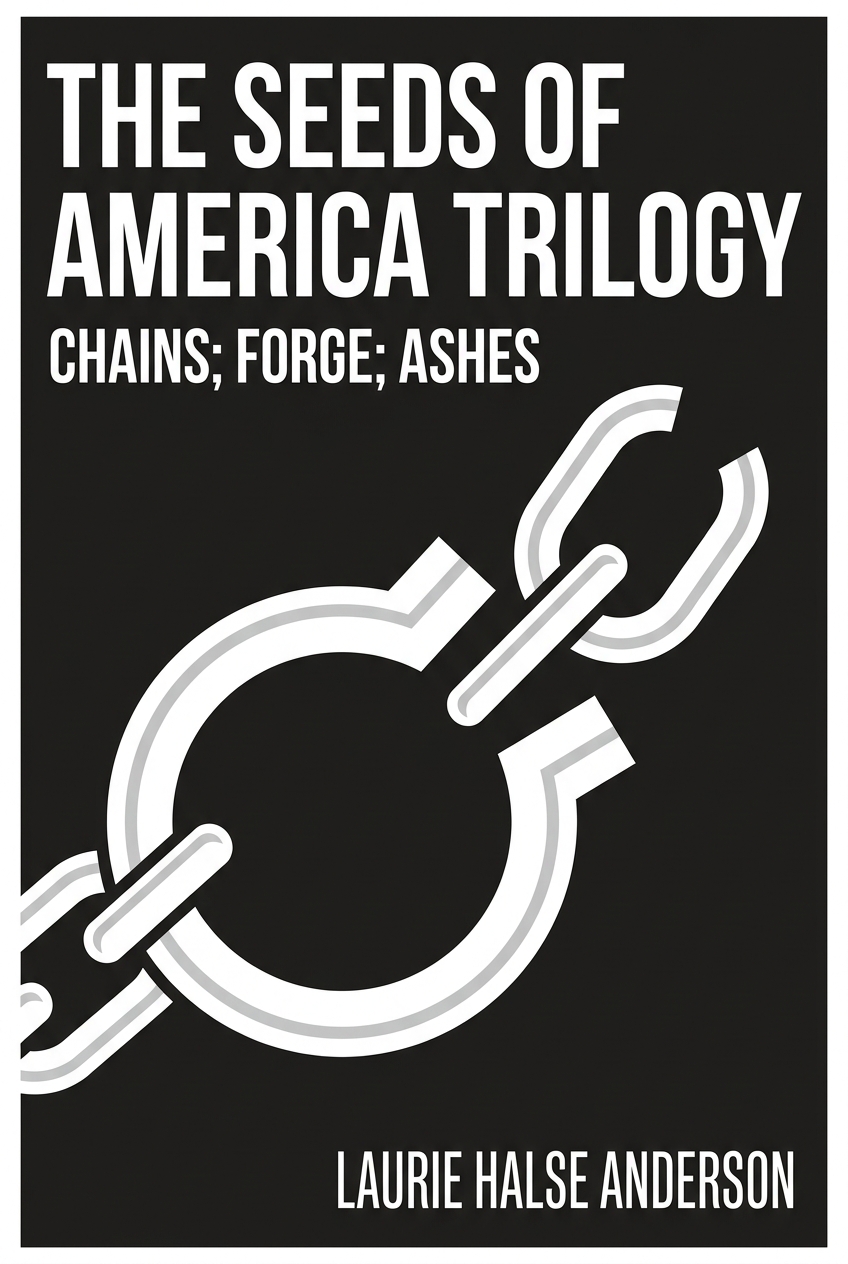
The Seeds of America Trilogy
Chains; Forge; Ashes
What's it about
What if the fight for America's freedom was also your fight for personal freedom? Discover the untold story of the American Revolution through the eyes of an enslaved girl, Isabel, as she battles for her own liberty amidst a nation's birth. You'll follow Isabel's harrowing journey from a loyalist household in New York to the brutal front lines of the war. Experience her courage as she spies for the Patriots, endures unimaginable hardship, and risks everything for the promise of a future where she and those she loves can finally be free.
Meet the author
Laurie Halse Anderson is a New York Times bestselling author whose groundbreaking historical fiction, including the National Book Award Finalist novel Chains, has earned her international acclaim. A descendant of Revolutionary War soldiers, Anderson was inspired by the hidden stories of enslaved Americans from that era. She dedicated years to meticulous archival research, driven by a passion to give voice to the forgotten patriots who fought for a freedom they were cruelly denied, crafting a trilogy that powerfully redefines American history.
Opens the App Store to download Voxbrief

The Script
Two people are given identical, unfinished quilts. One sees a set of instructions, a diagram of stitches to be learned, and a pre-determined pattern to follow for warmth. They learn the proper knots, measure the thread, and produce a perfectly functional, if impersonal, cover. The other person sees a story waiting to be told. They gather scraps from worn-out shirts, pieces of a wedding dress, and the faded corner of a baby’s blanket. Their stitches are sometimes uneven, their pattern shifts to accommodate the stories held in the fabric. The result is a living history, a map of a life with all its joys, tears, and ragged edges.
This is the difference between the official history of a nation—the dates, battles, and famous names—and its real, human story. For America, the story of its birth is often told like the first quilt: a neat pattern of founding fathers and glorious victories. But what about the messy, vital, and often painful stories stitched into its foundation by those whose names were left off the official records? This question of America’s unwritten history became an obsession for Laurie Halse Anderson. While researching the Revolutionary War for another project, she stumbled upon the startling fact that thousands of enslaved African Americans fought for their freedom on both sides of the conflict. This discovery felt like finding a whole section of the national quilt that had been deliberately cut out and discarded. A National Book Award finalist known for giving voice to the silenced, Anderson realized she had to tell this story, to re-stitch these lost threads back into the fabric of American history as central figures with their own hopes, dreams, and battles for liberty.
Module 1: The Hypocrisy of a Revolution
The American Revolution presents a deep, unsettling contradiction. It was a war for liberty fought by men who enslaved others. This trilogy forces us to look directly at this hypocrisy as the central, defining conflict of the era. The story opens with a quote from English writer Samuel Johnson, who asked, "How is it that we hear the loudest yelps for liberty among the drivers of Negroes?" This question hangs over every scene.
We see this conflict through the eyes of Isabel, an enslaved girl who is promised freedom in her owner's will. Yet that legal document is worthless. The new heir, Mr. Robert Finch, dismisses it, claiming, "Slaves don't read." He plans to sell her and her sister, Ruth. The law is a tool for the powerful. Even Pastor Weeks, who knows Isabel can read, advises her to "remember your place." The very structures meant to provide order are weaponized to maintain oppression. This is a recurring pattern where systems fail those they are not designed to protect.
As the story moves to New York City, the hypocrisy only deepens. Isabel is forced to serve a wealthy Loyalist family, the Locktons. At the same time, she is recruited by a young enslaved boy named Curzon to spy for the Patriots. Curzon’s argument is simple and devastatingly logical. He points out that the rebels are fighting for freedom from people just like the Locktons. He tells Isabel that her invisibility as an enslaved girl is actually a strategic advantage. "You are a slave, not a person," he explains. "They’ll say things in front of you they won’t say in front of the white servants. ’Cause you don’t count to them." Your perceived weakness can be your greatest strategic asset. This insight is a powerful lesson for anyone navigating complex power dynamics. Being underestimated gives you access to information and opportunities others don't have. You can observe, listen, and plan while others ignore you.
From this foundation, Isabel witnesses the highest levels of conspiracy. While serving wine in the Locktons' library, she overhears a plot to assassinate General George Washington. She becomes a living repository of secrets. The men in the room discuss bribery and treason, completely oblivious to her presence. They see her as furniture. This invisibility allows her to gather critical intelligence. The story makes it clear: Information is the currency of power, especially for the disenfranchised. For Isabel, a piece of information is a potential key to her freedom. She realizes she can trade what she knows for a chance at a life she was promised. This turns her from a passive victim into an active agent in her own liberation.
And here's the thing. Isabel's fight isn't for a grand political cause. Her loyalty is transactional, born from a desperate need to survive. She tells Curzon, "I’m just fighting for me and Ruth." Her allegiance isn't to the British or the Patriots. It's to her own small family unit. This highlights a crucial truth. Grand ideals mean nothing without personal security. For those at the bottom, survival is the only ideology that matters. The Patriots offer slogans about liberty, but the Locktons offer food and a roof. Isabel must constantly calculate which side offers a better, albeit slim, chance of keeping her sister safe. This pragmatic, survival-driven mindset is a powerful lens for understanding motivation in any high-stakes environment.
Module 2: The Currency of Resilience
How do you survive when the world is designed to crush you? The trilogy offers a powerful study in resilience as an active, daily practice. It’s a quiet war waged inside the mind and through small, deliberate actions. For Isabel, this resilience is built on three pillars: memory, community, and secret acts of defiance.
First, memory becomes a lifeline. When Isabel and Ruth are sold and torn from their home, Isabel takes a handful of "mystery seeds" from her mother's garden. This small act is a rebellion. It's a way to carry her past, her heritage, and a sliver of hope into an uncertain future. The seeds represent a connection to her roots that cannot be broken by sale or displacement. You must intentionally preserve your identity when external forces try to erase it. This is a survival tactic. Later, Madam Lockton tries to strip Isabel of her identity by renaming her "Sal Lockton." But Isabel holds onto her real name, Isabel Finch, as a private anchor. She knows who she is, even when her enslaver tries to redefine her.
Next, we see that resilience is rarely a solo act. It's nurtured through community and fleeting moments of solidarity. At the Tea Water Pump, a daily hub for the city's enslaved population, Isabel finds a sense of kinship. She meets an old man with a country mark, a traditional African scarification pattern, just like her father's. This silent recognition is a powerful moment. It reminds her she is part of a larger story, a shared heritage. Find your tribe, even if it's just for a moment. These brief connections provide the strength to endure long periods of isolation. Even the housekeeper, Becky, offers pragmatic advice and small kindnesses that help Isabel navigate the treacherous household. These moments of shared humanity are the essential fuel for a long fight.
But flip the coin. What happens when these supports fail? After Isabel is brutally branded with the letter "I" for "Insolence," she spirals into a deep depression. Her hope is gone. The revolutionary rhetoric of "liberty" makes her want to spit. It’s another enslaved man, the old one called Grandfather, who pulls her back. He reframes her scar. He tells her it's a mark of strength, a "sign of a survivor." He forces her to see her trauma as evidence of her endurance. This brings us to a crucial insight. You have the power to redefine your scars. They can become symbols of your strength. This mental shift is the turning point for Isabel. It gives her the fortitude to continue her fight.
Finally, resilience is built through small, hidden acts of agency. Isabel secretly learns to read Thomas Paine's Common Sense. She hides the book under a floorboard, absorbing its radical ideas about freedom and equality in the dead of night. This act of intellectual defiance is deeply empowering. She also begins to secretly carry food scraps to the American prisoners of war, including Curzon, held in the horrific Bridewell prison. Small, consistent acts of defiance build the muscle for larger rebellion. These actions may seem minor, but they are monumental. They are Isabel's way of asserting her humanity in a system that denies it. Each stolen moment of reading, each scrap of food delivered, is a declaration that her soul is still her own.