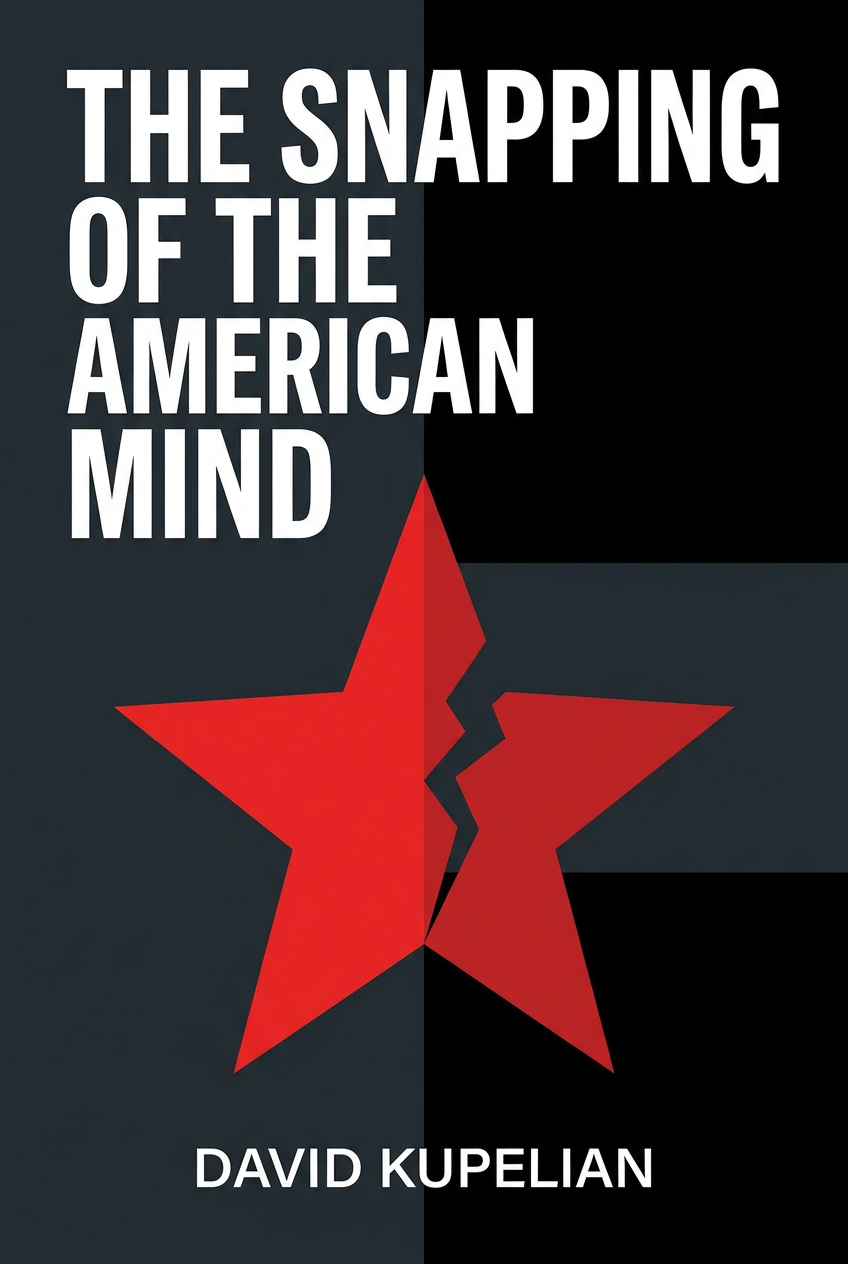
The Snapping of the American Mind
Healing a Nation Broken by a Lawless Government and Godless Culture
What's it about
Ever wonder why so many people seem to be losing their minds? This summary reveals the hidden forces driving today's widespread anxiety, anger, and division, showing you how to reclaim your sanity and clarity in a world that feels increasingly chaotic and irrational. You'll discover how a "lawless government and godless culture" are fundamentally reprogramming how you think and feel. Kupelian exposes the psychological tactics at play in modern media and politics, offering a powerful, step-by-step guide to protect your own mental well-being and help heal a fractured nation.
Meet the author
David Kupelian is the award-winning managing editor of WND.com, one of America's original independent news websites, and the acclaimed monthly newsmagazine, Whistleblower. His three decades of experience as a journalist and editor gave him a unique vantage point from which to observe the societal trends and political shifts that culminated in his groundbreaking analysis. Kupelian’s work explores the psychological and spiritual battles facing modern Americans, offering a path toward national and personal renewal.
Opens the App Store to download Voxbrief

The Script
Think of a nation's collective psyche as a vast, frozen lake. For generations, it seems impenetrably strong, capable of supporting immense weight. We skate across its surface, build our lives upon it, and trust its permanence. But beneath the ice, unseen currents—subtle shifts in temperature, slow erosions of belief, and the relentless pressure of forgotten grievances—are always at work. The danger is a slow, metabolic decay from within. The cracks don't appear all at once; they start as tiny, hairline fissures that spread silently, connecting in a web of fragility until the entire structure is compromised. The most terrifying moment is the quiet period just before the collapse, when the surface still looks whole but has lost all its integrity.
This process of slow, internal fracturing became the central obsession of David Kupelian. As an award-winning journalist and the managing editor of WorldNetDaily, he spent decades documenting the symptoms of this societal stress—the rising rates of depression, addiction, and extreme political polarization. He saw these as interconnected consequences of a deeper psychological shift. He realized that the public conversation was focused on the political and economic battles taking place on the surface of the ice, while almost completely ignoring the invisible, corrosive forces melting it from below. "The Snapping of the American Mind" was his attempt to make those hidden currents visible, to explain how a society's shared sanity can be systematically dismantled by a slow, deliberate poisoning of its core beliefs.
Module 1: The Architecture of Chaos
The book opens with a jarring claim. The stress and anxiety riddling modern America are features, not bugs, of a fast-paced world. Kupelian argues that certain political movements have weaponized chaos. They thrive on public discontent and fear.
A key part of this is what the author calls the Cloward-Piven strategy. This is a political tactic developed in the 1960s by two sociologists. The idea is simple. You intentionally overload public systems—like welfare, immigration, or healthcare. You push them to the breaking point. The goal is to create a systemic collapse. When the system fails, the public panics. They become desperate for a solution, any solution. And that desperation creates an opening for radical, government-centric reforms that would never be accepted in normal times.
This leads to the first major insight: Crisis is intentionally manufactured to justify radical change. Kupelian points to several examples from the Obama administration. He argues that refusing to enforce federal immigration laws was a deliberate move to overwhelm border security and social services. He frames the chaotic rollout of the Affordable Care Act, which caused millions to lose their existing health plans, as an act of "epic deceit" designed to break the private insurance market. The goal was to create a crisis so severe that a single-payer, government-run system would seem like the only logical next step.
So what does this mean for us? It means we must learn to see crises through a different lens. Instead of reacting with immediate fear or anger, we should ask: Who benefits from this chaos? Is this breakdown organic, or is it being engineered? This leads to another critical point. Psychological manipulation is used to make the public more compliant. The author draws on the work of psychiatrist William Sargant, who studied brainwashing techniques. Sargant found that inducing high levels of fear, anger, and anxiety makes people highly suggestible. They become easier to control.
Kupelian argues that modern political tactics exploit this. The tax code, for example, is presented as a mechanism of fear. Its complexity and the threat of an audit condition citizens into a state of submission. Similarly, he contends that constant accusations of racism or homophobia are used to manipulate historical guilt. This keeps the population divided and defensive, unable to unite against a larger agenda. The author points to Saul Alinsky, a radical community organizer whose work heavily influenced modern progressive activists. Alinsky's core rule was to "make the enemy live up to its own book of rules." You find a vulnerability, you create pressure, and you exploit the reaction. The real action, Alinsky said, is in the enemy's reaction.
And here's the thing. The ultimate goal is a fundamental transformation of society's values. The destruction of the traditional family is a central objective of this transformation. The author argues that the nuclear family is the bedrock of a self-reliant, Judeo-Christian culture. It's a barrier to state control. By weakening it, you create a population that is more dependent on the government for financial support, moral guidance, and personal identity. He points to the staggering rise in children born to unmarried mothers—from 4% in 1950 to over 41% today. He argues this is the successful outcome of a long-term ideological project that benefits a political class seeking to expand its own power.
Module 2: The War on Words and Reality
We've explored how chaos is engineered. Now, let's turn to the primary weapon used in this war: language. Kupelian argues that the most effective subversion happens with words. If you can control the language, you can control thought.
The first step in this process is simple. Redefine words to invert their meaning and control the narrative. The author calls this "Newspeak," borrowing from George Orwell's 1984. Consider the term "social justice." In classic terms, justice means equal rights under the law. But "social justice," he argues, has been redefined to mean equality of outcome. This new definition is used to justify policies that confiscate wealth from one group and redistribute it to another, which he frames as institutionalized theft under the banner of fairness. Another example is "affirmative action." It's presented as a tool for justice. But in practice, it involves discriminating based on race, the very thing it was supposed to prevent.
Building on that idea, the author argues that political correctness is a totalitarian philosophy that enforces ideological conformity. It’s about making certain thoughts unsayable. Once a thought is unsayable, it eventually becomes unthinkable. He points to college campuses, which he describes as "small ivy-covered North Koreas." Professors have been driven from their jobs for questioning affirmative action. Students are shouted down for expressing conservative views. This creates a climate of fear where dissent is silenced. The goal is to establish a new orthodoxy, a set of beliefs that cannot be challenged.
But flip the coin. It's also about laundering lies until they become truth. The mainstream media often acts as a "launderer" of disinformation, giving false narratives the appearance of fact. The author provides a powerful historical example. Dr. Bernard Nathanson, a co-founder of NARAL, later admitted that he and his colleagues completely fabricated statistics to legalize abortion in the 1970s. They claimed up to 10,000 women died from illegal abortions each year. The real number was closer to 250. They fed these false numbers to a compliant media, which reported them as fact. The public, horrified by the fake statistics, shifted its opinion, and the Supreme Court legalized abortion. The lie achieved its political goal.
So here's what that means for us today. When we hear emotionally charged terms like "equality," "diversity," or "tolerance," we need to pause. We must ask: What does this word mean in this specific context? Is it being used according to its traditional definition, or has it been redefined to serve an agenda? The author argues that "tolerance," for instance, now often means you must celebrate and affirm beliefs you may find morally wrong. Refusal to celebrate is branded as "intolerance." This linguistic jujitsu turns defenders of traditional values into aggressors. It's a powerful tool for psychological control.