The Tragedy of American Diplomacy
What's it about
Ever wonder why American foreign policy, despite its good intentions, often seems to create more problems than it solves? Discover the provocative idea that America's quest for economic opportunity abroad, disguised as a mission for democracy, has ironically undermined its own ideals and led to perpetual conflict. You'll learn about the "Open Door Policy" and how this economic-first strategy shaped over a century of US diplomacy, from the Spanish-American War to the Cold War. Williams argues that by prioritizing market access over genuine self-determination for other nations, America created a tragic cycle of intervention and instability.
Meet the author
William Appleman Williams was a distinguished American historian and the intellectual leader of the "Wisconsin School" of diplomatic history, fundamentally reshaping the study of U.S. foreign policy. A graduate of the U.S. Naval Academy who served in the Pacific, his firsthand experience with American power informed his critical analysis. This unique perspective, blending military service with rigorous academic inquiry, led him to challenge conventional narratives and expose the economic motivations behind America's expansionist diplomacy, culminating in his groundbreaking work.
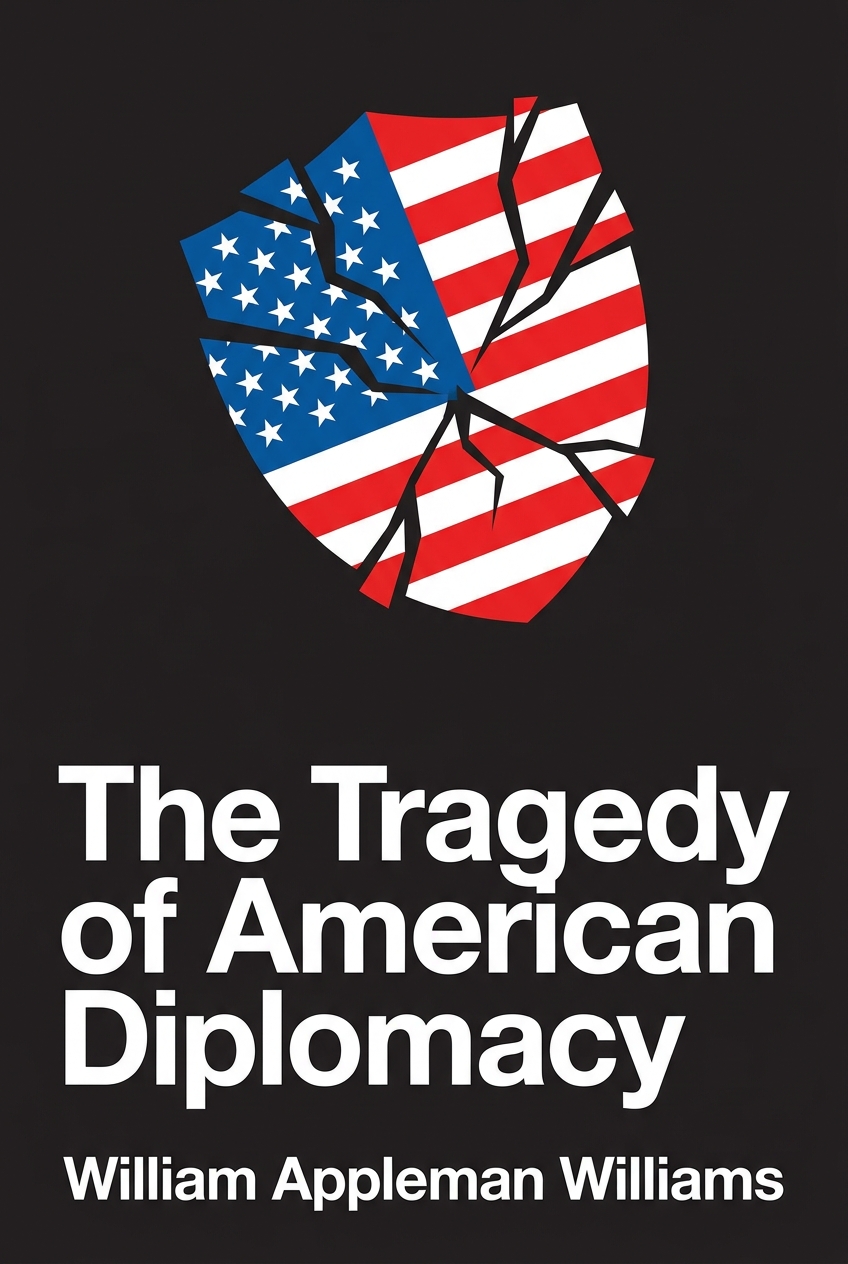
The Script
We tend to see national generosity as a straightforward virtue, much like personal charity. When a powerful, wealthy nation extends aid, opens trade, and exports its way of life, it appears to be an act of benevolence—a gift to the world. We assume the primary motive is to lift others up, to share the wealth, and to spread freedom. The recipient, in this view, is the clear beneficiary. But what if this entire framework is inverted? What if the relentless drive to 'help'—to create open markets and export a specific economic model—is a desperate, structural necessity for the giver? This view suggests that the most seemingly generous acts on the world stage are actually a form of self-interest so profound, it becomes a trap. The 'benefactor' nation becomes dependent on the world needing its help, creating a cycle where true independence for others is a threat to its own stability.
This unsettling perspective emerged from the meticulous work of a historian who felt a deep sense of unease with the celebratory narrative of post-war American power. William Appleman Williams, a graduate of the U.S. Naval Academy and a veteran of the Pacific Theater, witnessed the machinery of American influence firsthand. After the war, as a professor at the University of Wisconsin, he began to trace a single, powerful idea through a century of American foreign policy documents. He saw that the celebrated 'Open Door' policy was a brilliant, tragic solution to America's own internal economic pressures. He wrote 'The Tragedy of American Diplomacy' to reveal the hidden logic that he believed was leading it, with the best of intentions, toward endless global entanglement and crisis.
Module 1: The Gospel of the Open Door
The central argument of the book is built on a single, powerful concept: the Open Door Policy. We often think of this as a dusty footnote about trade in China. Williams argues it's the master key to understanding all of American foreign policy. It's an ideology, a complete worldview.
The story begins in the 1890s. The American frontier had closed. The economy was sputtering. A consensus formed among farmers, industrialists, and politicians. They believed America's prosperity, and even its democracy, depended on one thing: overseas economic expansion. The country was producing more than it could consume. Without foreign markets for its surplus goods, they feared economic collapse and social revolution at home.
This brings us to the first critical idea. American leaders defined national prosperity as dependent on continuous access to foreign markets. This was the core belief of policymakers like future President William McKinley and Secretary of State John Hay. They saw a world where European powers were carving up continents into exclusive colonial empires. These closed systems were a direct threat to America's economic future. The U.S. needed a different approach. It needed a way to pry open the world for its goods without building a formal, European-style empire that violated its anti-colonial identity.
So, what did they do? In 1899 and 1900, Secretary Hay issued the Open Door Notes. These notes declared that all nations should have equal access to trade with China. On the surface, it sounded fair and anti-imperial. But Williams reveals the brilliant, and tragic, strategy underneath. The Open Door Policy was a form of "imperial anti-colonialism," designed to use America's superior economic power to dominate global markets without the costs of a formal empire. The U.S. didn't need to own a territory if it could control its markets. By demanding an "open door" for everyone, America was ensuring that its own highly efficient economy would naturally win the competition. It was a blueprint for an informal economic empire.
This strategy quickly became the default for American foreign relations. It was applied far beyond China. It shaped interventions in Latin America. It guided policy toward Europe. And here's the kicker. This expansion was always framed in idealistic terms. The pursuit of economic dominance was justified by a messianic idealism that sought to remake the world in America's image. Leaders like Woodrow Wilson genuinely believed they were spreading democracy and freedom. But this "imperialism of idealism" had a condition. Other nations were free to choose their own path, as long as that path was a capitalist, democratic one that remained open to American influence and trade. Any nation that chose a different model, especially a revolutionary or socialist one, was seen as a threat to the entire system. This set the stage for a century of conflict.