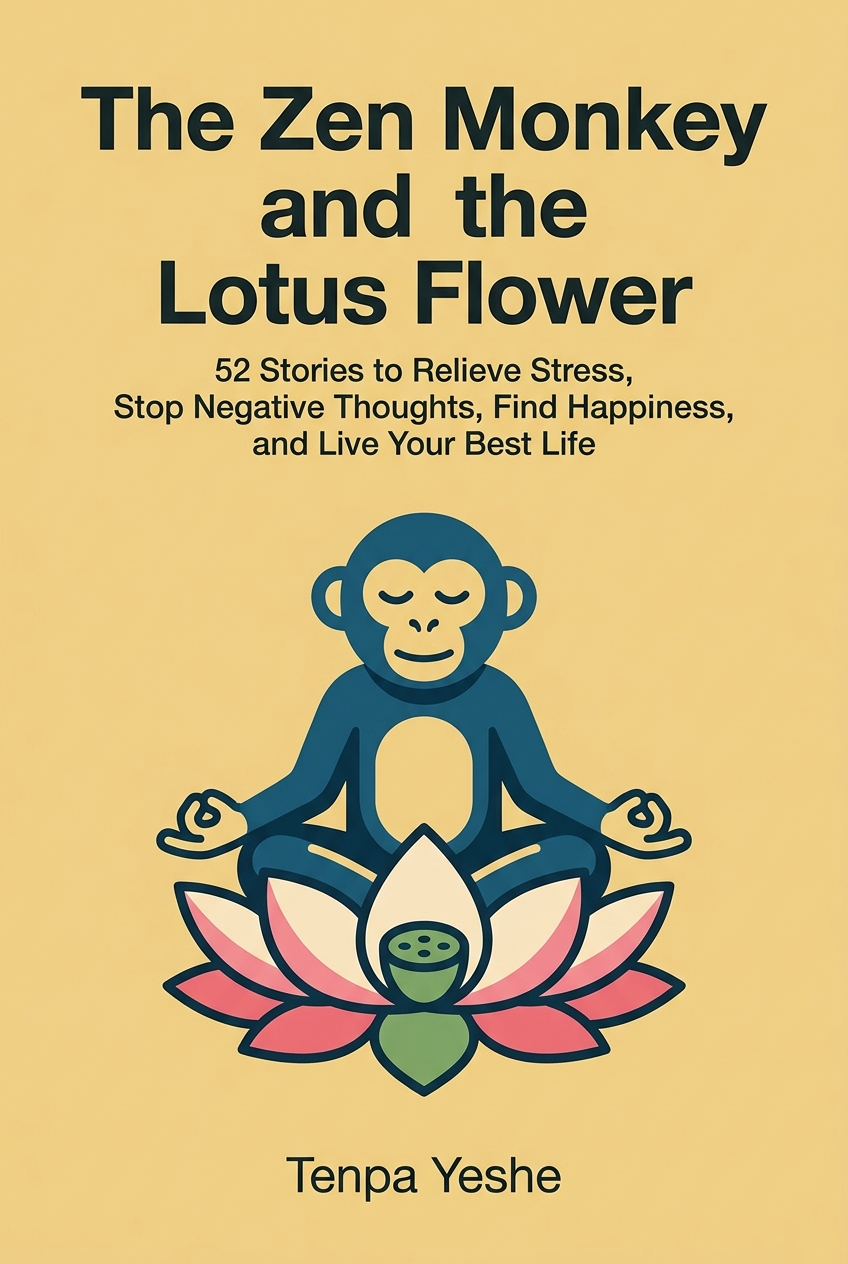
The Zen Monkey and the Lotus Flower
52 Stories to Relieve Stress, Stop Negative Thoughts, Find Happiness, and Live Your Best Life
What's it about
Tired of your mind racing with negative thoughts and stress? What if you could calm the chaos and find lasting happiness with a few simple stories? This summary offers 52 ancient Zen parables, each a key to unlocking a more peaceful and fulfilling life. Discover how to tame your "monkey mind" and transform everyday challenges into opportunities for growth. You'll learn practical techniques rooted in timeless wisdom to stop overthinking, relieve anxiety, and cultivate a deep sense of joy. It’s time to live your best life, one story at a time.
Meet the author
Tenpa Yeshe is a former Buddhist monk who spent over fifteen years living and studying in Himalayan monasteries under the guidance of renowned Zen masters. This profound immersion into ancient wisdom, combined with his later work as a mindfulness coach for Silicon Valley executives, allowed him to translate timeless teachings into practical stories. His unique journey from sacred temples to bustling boardrooms inspired him to create accessible tools for finding peace and clarity in the modern world.
The Script
In the world of rare book restoration, two apprentices are given identical tasks: to repair a medieval manuscript ravaged by water and time. Both have access to the same fine glues, the same delicate rice papers, the same threads of spun gold. The first apprentice, methodical and precise, focuses on the damage. He sees only the torn pages, the faded ink, the brittle spine. His work is a battle against imperfection, and with every meticulous repair, he feels the weight of the book’s brokenness, his own frustration mounting with each flaw he must conquer.
The second apprentice approaches his bench and sees a survivor. He feels the texture of the vellum, imagines the scribe who first laid ink to page centuries ago, and senses the journey the book has endured. His hands move with a quiet reverence, coaxing the pages. He doesn't just fix the tears; he integrates the repairs into the book’s history, making the mended places part of its story. His work is a conversation. One apprentice finishes the day drained and agitated, his mind a storm of imperfection. The other finishes calm and centered, having spent his day in communion with his task. The difference was in the mind holding the tools.
This exact distinction—between battling the mind and befriending it—is what drove Tenpa Yeshe to write The Zen Monkey and the Lotus Flower. After a successful but deeply unfulfilling career as a litigator, where his mind was trained to be a weapon of argument and relentless analysis, he found himself exhausted and spiritually adrift. He left his practice for a pilgrimage to the quiet monasteries of the Himalayas. Over two decades of study and practice as a monk, he learned to understand his 'monkey mind's' nature with the same gentle curiosity as the second apprentice. This book is the result of that journey, offering the wisdom he gathered on how to transform the mind from a source of constant agitation into a place of quiet strength.
Module 1: Unmasking the Overthinking Engine
Overthinking is a specific, destructive pattern. The author describes it as "mental diarrhea." It's an aimless churning of thoughts that saps your energy without moving you toward a solution. It keeps you stuck. To break free, you first have to understand what's driving it.
The primary driver is a deep-seated need for control and perfection. When faced with uncertainty, the mind enters "analysis mode." It tries to game out every possible future to reduce anxiety. But this quickly becomes a trap. Perfectionism fuels overthinking by creating an intense fear of failure and judgment. Think of Laura, a designer asked to write a blog post. She wanted it to be perfect. This desire triggered a cascade of worries. She overanalyzed who to ask for advice. She feared being seen as unqualified. She agonized over every sentence. The result? She was completely paralyzed, unable to even start. Her focus on a flawless outcome prevented any outcome at all.
This brings us to a key insight. Overthinking isn't some isolated habit. It's deeply connected to our emotional and psychological state. Overthinking is often a symptom of unresolved anxiety, trauma, and self-doubt. The author explains that while overthinking isn't a formal mental disorder, it creates a vicious cycle with conditions like anxiety and depression. Anxiety causes overthinking, which then heightens anxiety. It's a feedback loop. For example, someone who experienced neglect in childhood might develop hypervigilance. Their brain stays in a fight-or-flight state, constantly scanning for threats. This translates into obsessive thoughts and chronic overthinking in adulthood.
So where do these patterns come from? They are rooted in our subconscious programming. From a young age, we absorb messages from our environment. These messages become limiting beliefs. Your subconscious mind runs on old, limiting beliefs that you must consciously challenge and rewrite. A belief like "no one can make a living from art" can become an internal script: "I can't be a musician." This script then fuels endless overthinking about career choices and self-worth. Your conscious mind, however, can act as a gatekeeper. It has the power to observe these old stories, question them, and choose new, empowering ones. By becoming aware of the belief, you can start to unlearn it.
And it doesn't stop there. Recognizing the pattern in real-time is crucial. You need to know the signs. Key indicators of overthinking include problem-focused rumination, catastrophizing, and social anxiety. Rumination is when you obsess over a past mistake without learning from it. You just replay the failure. Catastrophizing is assuming the worst-case scenario. You fail a test and immediately believe you'll be unemployed for life. Social anxiety involves endlessly analyzing interactions, worrying about what others think. These are red flags that your mind is stuck in a disempowering loop.