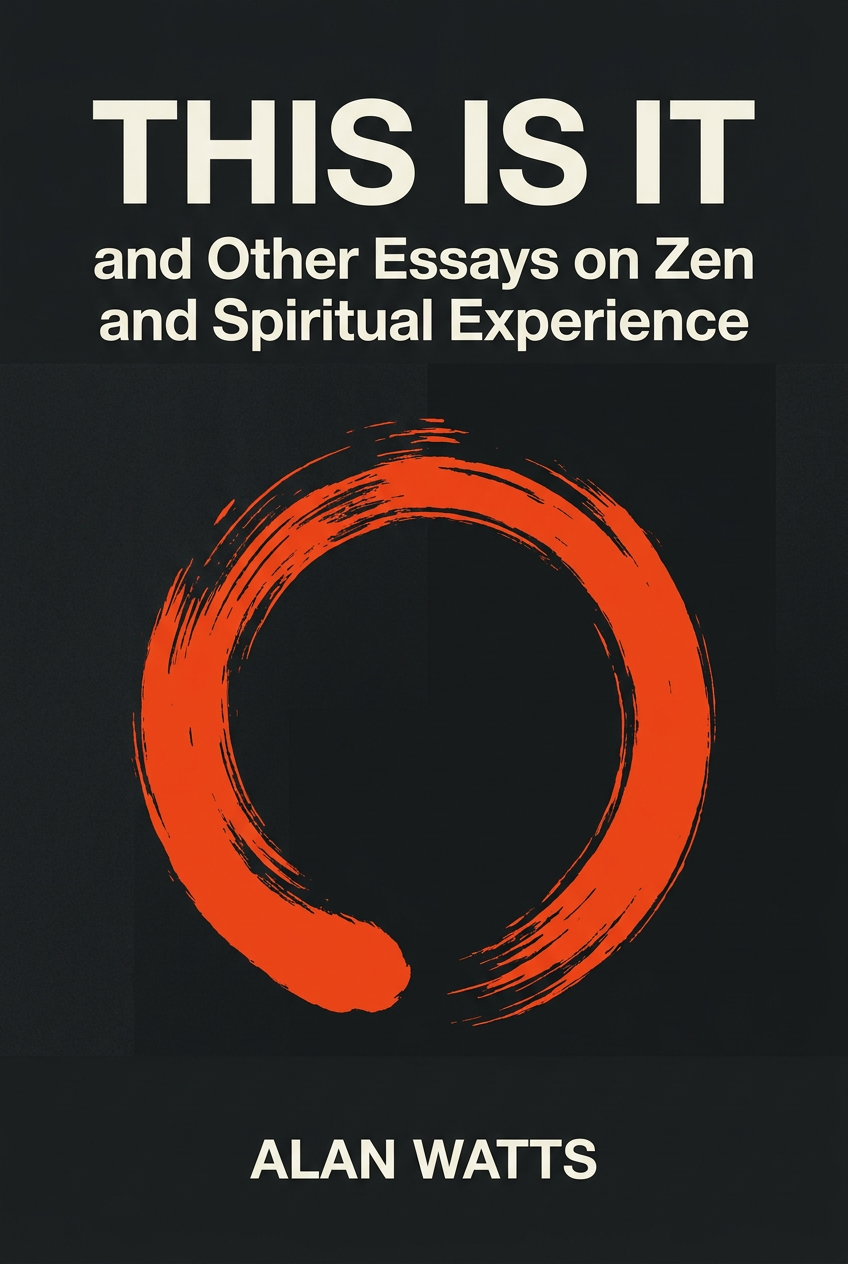
This is It
Essays on Zen and Spiritual Experience
What's it about
Are you constantly chasing the next big thing, hoping it will finally bring you peace? This is It reveals the profound secret to finding fulfillment not in some future goal, but in the vibrant, immediate reality of your present moment. It's about ending the frantic search. You'll learn how to break free from the illusion of the separate self and experience the world with fresh, unfiltered awareness. Watts guides you through Zen principles and mind-altering insights to help you stop striving and start living, discovering that the ultimate spiritual experience is already here.
Meet the author
Alan W. Watts was a preeminent British philosopher, writer, and speaker, renowned for being one of the first and most influential interpreters of Eastern philosophy for a Western audience. Holding a master's degree in theology and an honorary doctorate, his unique journey as a former Episcopal priest gave him a distinctive perspective on spirituality. This background enabled him to bridge the gap between Christian mysticism and Zen Buddhism, making profound spiritual concepts accessible and relevant to modern life in works like This is It.
Opens the App Store to download Voxbrief
The Script
We treat the present moment like a perpetually malfunctioning entryway. It’s a place we are always trying to rush through on our way to a more important room—the future where we’ll finally be happy, secure, or fulfilled. We decorate this future in our minds, arranging the furniture of our ambitions and polishing our expectations, all while ignoring the profound reality of where we are actually standing. We have become experts at living for a tomorrow that never arrives, treating our immediate experience as a mere stepping stone, a problem to be endured or a task to be completed. This frantic focus on the next thing is the very architecture of our dissatisfaction, a self-imposed exile from the only life we ever truly have.
The constant effort to escape the now in search of a better then creates a tension that is both exhausting and futile. What if the door we’re so desperately trying to open leads back to the very room we’re trying to leave? This profound and unsettling possibility was the central preoccupation of a man who found himself at a unique crossroads of Eastern and Western thought. Alan Watts, a former Anglican priest turned independent philosopher and interpreter of Zen Buddhism, saw this widespread spiritual impatience as the core malady of the modern mind. He wrote “This is It” as a series of essays designed to stop us in our tracks, to dissolve the illusion that fulfillment is anywhere but here. For Watts, enlightenment was a sudden, shocking recognition of the reality we’ve been overlooking all along.
Module 1: The Trap of the Divided Self
We live our lives as if we are split in two. There's the "I" who thinks and feels, and the "me" that needs to be controlled, improved, and disciplined. This creates a constant internal war. Watts argues this division is an illusion, a trick of the mind that generates endless anxiety. The first step is to see this illusion for what it is.
Watts points out that our language and culture reinforce this split. We talk about fighting our demons, conquering our fears, and mastering our impulses. This sets up a battle we can never win. Why? Because the controller and the controlled are the same person. It's like trying to bite your own teeth. This leads to a state Watts calls the "double-bind." This is a situation where you're given a command that's impossible to follow without creating a contradiction. A classic example is being told, "You must be spontaneous!" or "You need to relax!" The very act of trying to force spontaneity or relaxation makes it impossible. Our entire culture of self-improvement is built on this paradox. We strive to be natural. We work hard to be effortless. And the harder we try, the more tense and self-conscious we become.
So, the first core insight is this: You cannot solve the problem of self-control by trying harder. The speaker who tries too hard to be eloquent becomes a stumbling, self-conscious wreck. The society that creates more laws to regulate freedom finds itself paralyzed in bureaucratic knots. Watts gives the example of a university department where spending twenty-five dollars required a form with twelve carbon copies. The system of control became more of a problem than the action it was meant to manage. This endless loop of self-correction leads to paralysis.
The solution is to see the game for what it is. This brings us to a second, crucial insight. True liberation comes from accepting your whole self, including the parts you judge. Watts references a powerful Turkish proverb: "He who sleeps on the floor will not fall out of bed." This is a metaphor for radical self-acceptance. When you stop trying to live up to an idealized, "higher" version of yourself, you can't fail. You find a sense of stability and authenticity. You are no longer in conflict. This is about dropping the internal fight, not about giving up or becoming passive.
So what does this mean in practice? It means recognizing that the so-called "animal" and "angel" within you are not enemies. They are two poles of a single being. Society pressures us to choose a side. Be spiritual and deny the flesh. Or be sensual and forget the spirit. Watts says this is a false choice. He argues that a person who fully embraces both their spiritual hunger and their earthly, sensual nature is a more complete human being. A mystic's appreciation for the material world can be more refined and sensuous than that of a pure hedonist. Their "animality" is enriched by spirit, not denied by it. This leads to the final insight in this module. Integration, not suppression, is the path to wholeness. The goal is for the angel and the animal to dance together. When you stop fighting yourself, you free up an immense amount of energy.
Module 2: The Illusion of Separation
We've explored the division within ourselves. Now, let's zoom out to the division between ourselves and the world. From a young age, we are taught to see the world as a collection of separate objects. There's me, and there's you. There's the tree, and there's the space around it. Our intelligence is trained to categorize, label, and divide reality to understand and control it. This is useful, but it comes at a cost. It creates a profound sense of loneliness and alienation. We feel like isolated egos trapped inside our skin, confronting a world that is "other" and often hostile.
Watts argues this is a profound misunderstanding of reality. The first insight here is a big one: The spiritual and the material are the same thing. This is the central message of the book. The title, This is It, refers to the realization that the ultimate point of existence is in the immediate, concrete, physical experience of the present moment. The "unheeded miracles" of nature, the feeling of breath in your lungs, the taste of water—this is where the sacred is found. Seeking a "spiritual" experience separate from ordinary life is like trying to find the ocean while you're already swimming in it.
This leads to the next step. If spirit and matter are one, then the self and the world are also inseparable. You are the universe experiencing itself. This is a description of a felt reality, not just a poetic phrase. Watts draws on the principles of ecology. A century ago, biology focused on classifying separate species. Now, we understand that you can't understand a species without understanding its entire environment. The organism and its environment are a single process. In the same way, you are not a noun—a fixed, separate thing. You are a verb. You are an event. You are a "humaning" that is happening in relationship with the entire cosmos.
Think about it this way. You can't have a front without a back. You can't have a buyer without a seller. You can't have a solid without a space. These opposites seem to be in conflict, but they are mutually dependent. They arise together. Watts suggests that our entire experience of reality is like this. Good and evil, pleasure and pain, life and death are the inseparable poles of a single reality. The Taoist symbol of yin and yang perfectly illustrates this. The black and white don't just sit next to each other; each contains the seed of the other, and they are defined by the dance between them.
This brings us to a mind-bending conclusion. The world is a self-moving process that happens without a separate agent. Our language forces us to use nouns and verbs. "A man walks." This implies there is a "man" who is separate from the action of "walking." Watts invites us to consider that there is just "walking." The man and the walk are one event. Under the influence of LSD, Watts described this sensation directly. He felt that events happened "of themselves." The world was a symphony of verbs, a dance without a separate dancer. This dissolves the anxiety of being the one who has to make everything happen. You realize you are the whole show, not just the puppet master of your life.