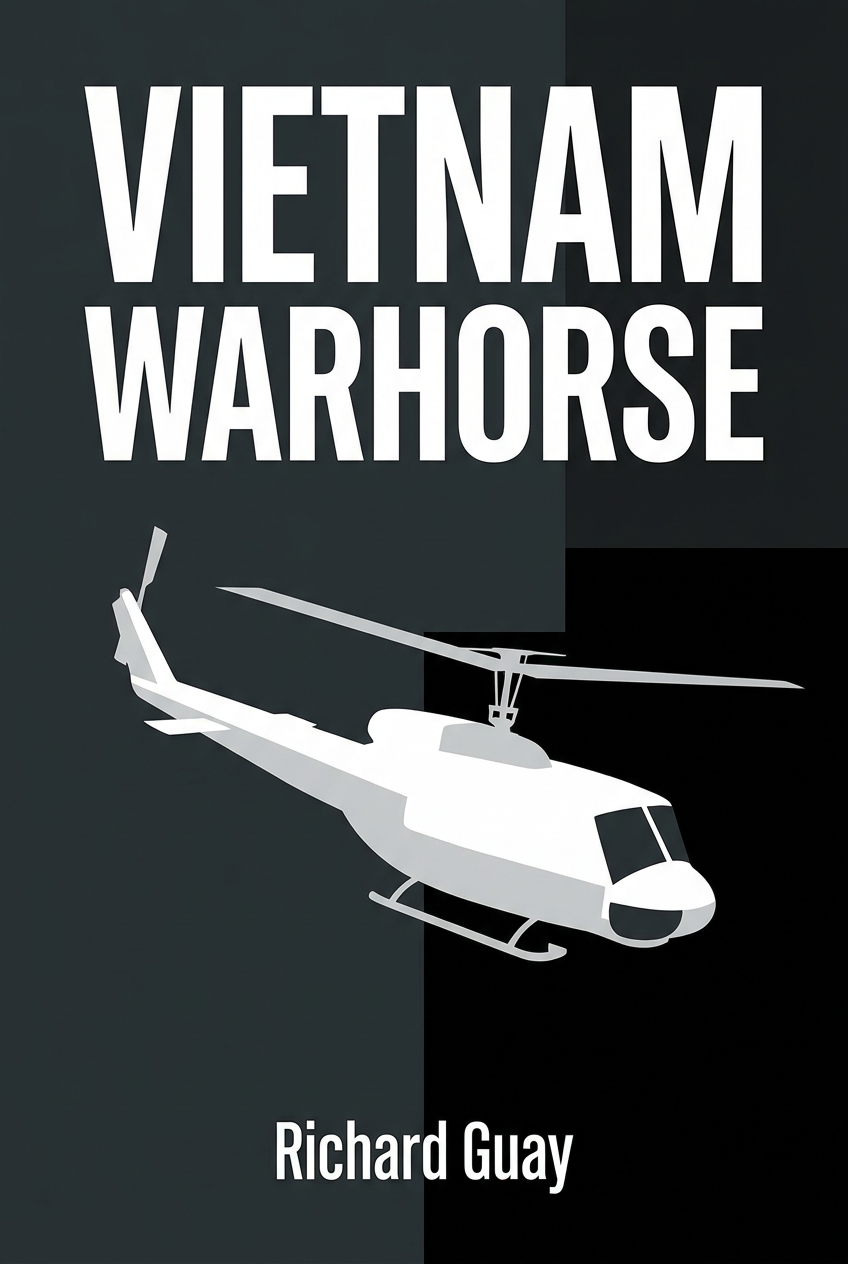
VIETNAM WARHORSE
A HUEY PILOTS MEMOIRS: TOLD BY A TWO-TOUR US ARMY IRIQUOIS ('HUEY') PILOT DURING THE VIETNAM WAR. A TRIBUTE TO THE MANY WHO FLEW THIS WONDERFUL WARHORSE.
What's it about
Ever wondered what it was really like to fly a Huey helicopter into the heart of the Vietnam War? Get ready to strap into the pilot's seat and experience the intense reality of combat, rescue missions, and the unbreakable bond between soldiers and their machine. Discover the untold stories of a two-tour pilot as you learn about the "Huey" Iroquois—the legendary workhorse of the war. You’ll hear firsthand accounts of harrowing flights, the unique camaraderie of the flight crews, and the incredible resilience required to survive in the skies over Vietnam.
Meet the author
Richard Guay is a decorated US Army pilot who flew the iconic Iroquois 'Huey' helicopter for two combat tours during the height of the Vietnam War. His firsthand experience logging countless flight hours on perilous missions provides an unparalleled perspective on the aircraft and the brave crews who flew them. This book is his tribute to the legendary 'Warhorse' and the soldiers whose lives depended on it, born from a desire to preserve their shared history and sacrifice.
Opens the App Store to download Voxbrief

The Script
In the skies over Vietnam, two men could be flying the same UH-1 Huey helicopter, part of the same squadron, even on the same day. One is a pilot, his hands on the cyclic and collective, his world framed by the armored glass of the cockpit. His universe is one of instruments, altitudes, airspeeds, and the constant, thrumming vibration of the rotor mast traveling up his spine. He feels the machine as a living thing, a partner in a deadly dance governed by physics and fuel. His job is to fly the mission, to get from point A to point B, to deliver and extract, to engage and survive. His focus is on the horizon, the landing zone, the mechanical health of his bird.
On that very same helicopter is the door gunner. He stands in the open door, tethered to the fuselage, his world violently exposed. His universe is one of senses—the rotor wash whipping his face, the smell of jet fuel and cordite, the deafening roar of the machine gun in his hands. He scans the tree line below for the flash of a muzzle or the subtle shift in the jungle canopy that signals danger. He is the mission's fragile, human edge, the first and last line of defense. For him, the helicopter is a vibrating steel platform, a vantage point from which he must protect the men inside and fight the war on the ground, one terrifying second at a time.
That door gunner was Richard Guay. For years after the war, he found that every story, every film, every book seemed to focus on the pilots in the cockpit or the infantry on the ground, leaving the door gunner’s reality untold. He wrote Vietnam Warhorse to finally place the reader in that open doorway, to share the visceral, overlooked experience of the men who hung out of the sides of helicopters, fighting a uniquely personal war between the sky and the earth. As a crew chief and door gunner with the 170th Assault Helicopter Company, Guay flew over one thousand combat hours, and this book is his testimony—the story he had to tell because no one else was telling it.
Module 1: The Crucible of Basic Training
The journey from civilian to soldier begins with a shock. It's a deliberate process designed to strip away individuality. New recruits arrive at Fort Polk and are immediately met by screaming drill sergeants. The goal is to establish absolute dominance. Guay describes a confrontation designed to shock and disorient him. This is the first step in forging a new, collective identity.
The next step is standardization. The Army systematically removes personal identity to build a unified fighting force. Recruits get the same GI haircut, a very short, standardized style. They are issued identical gear. Daily routines are rigid and unforgiving. Wake-up is at 0500 hours. Formation is at 0530. Any deviation results in immediate punishment, like fifty push-ups on the spot. This process erases civilian habits and instills military discipline.
Within this rigid structure, subtle social hierarchies emerge. For instance, volunteer status created a social advantage over draftees. Those who enlisted voluntarily were called "RA" for Regular Army. Draftees were identified as "US." Guay noticed that drill sergeants would often smile when he announced his RA status. In contrast, draftees were harassed at almost every stage. They might be hazed or sent to the back of the line. This distinction created a clear divide within the ranks.
Interestingly, unwritten rules were just as powerful as formal regulations. Creative punishments enforced unwritten social norms and crushed individualism. Recruits were expected to shower every night and shave every morning. One trainee, a former airline pilot, broke this rule by shaving at night. His drill sergeant staged a public spectacle. The man was forced to hop on one leg while singing "The Star-Spangled Banner" and attempting to shave. The humiliation worked. He became a more humble and sociable member of the platoon.
And here's the thing: shared suffering forges powerful bonds. The recruits endured eight weeks of constant stress together. They were pushed to their physical and psychological limits. This intense, communal experience created a deep familiarity. They learned to rely on each other. It was the first step in building the camaraderie that would be essential for survival in combat.
Module 2: The Pressure Cooker of Flight School
After basic training, the pressure intensifies. The author moves to Fort Wolters, Texas, the primary training base for Army helicopter pilots. The environment is designed to weed out those who can't handle the stress. This process begins the moment they arrive. Screaming TAC officers, who are Training, Advising, and Counseling officers, create an atmosphere of absolute chaos. They smash handrails and herd candidates off the bus. This shock is meant to break down any remaining civilian attitudes.
From this foundation, the training program relentlessly tests every candidate. The primary goal of early flight training is to identify and eliminate anyone who might crack under pressure. A commander would begin daily formations by loudly asking, "Who wants to quit?" Hands would go up. Those men were immediately removed from the program. They were often reassigned to the infantry. The training involved constant harassment and hazing. You never knew what was coming next. This unpredictable pressure was a filter. It revealed who had the mental fortitude to fly in combat.
This intense discipline extended to every aspect of life. Nothing was mundane. Military control was exerted over every minute detail of daily life to build automatic obedience. For example, candidates were taught to eat a "square meal." This involved moving utensils in precise, ninety-degree angles. TAC officers would stand over them, correcting every mistake. Even walking down a hallway required a specific protocol. If a TAC officer approached, you had to brace against the wall and shout a formal greeting. The control was absolute. Guay was once punished for smiling at an inopportune moment. His punishment? He had to stand and smile into a mirror for three hours.
But flip the coin. Beneath the harassment was a world-class education. The academic curriculum was rigorous, focused, and directly relevant to a pilot's career. The instructors were combat veterans. They taught essential subjects like applied physics, mathematics, and advanced map reading. The coursework was university-level. It focused solely on topics necessary for flight and officer training. This combination of psychological pressure and high-quality education forged highly competent pilots.
And it doesn't stop there. The first true test is mastering the helicopter itself. Learning to hover is described as the most difficult, counter-intuitive skill a pilot must learn. Guay's instructor told him, "It's like trying to stand on a soccer ball!" A new pilot's instinct is to overcorrect. This leads to a violent, oscillating motion called the pendular effect. It only stops when the instructor takes back control. This experience leaves the student pilot physically and emotionally drained. Mastering the counter-intuitive skill of hovering is the first great filter for a student pilot. It requires a level of fine motor control and coordination that some people simply cannot develop. Overcoming this hurdle is a huge step toward earning your wings.