All Books
Self-Growth
Business & Career
Health & Wellness
Society & Culture
Money & Finance
Relationships
Science & Tech
Fiction
Topics
Blog
Download on the App Store

Walking in the Shade

Volume Two of My Autobiography―1949-1962 – An Extraordinary Memoir of Intellectual and Political Life in Postwar London

12 minDoris Lessing

What's it about

Ever wonder what it takes to forge your own path amid political chaos and personal upheaval? Discover how one of the 20th century's greatest writers navigated the turbulent landscape of postwar London, balancing single motherhood with a burgeoning literary and political life. You'll gain a raw, intimate look into Doris Lessing's world—from her disillusionment with communism to her struggles as an artist and intellectual powerhouse. Learn how she transformed profound personal and political challenges into the creative fuel that shaped a generation.

Meet the author

Winner of the 2007 Nobel Prize in Literature, Doris Lessing was celebrated as the epicist of the female experience who captured the social and political upheavals of the 20th century. Drawing on her own journey from Southern Rhodesia to London, she became a fearless and influential voice in postwar intellectual life. Her firsthand involvement in communist and anti-apartheid movements, combined with her sharp, unflinching observations of society, provides the extraordinary foundation for this powerful and deeply personal memoir of a formative era.
Listen Now

Opens the App Store to download Voxbrief

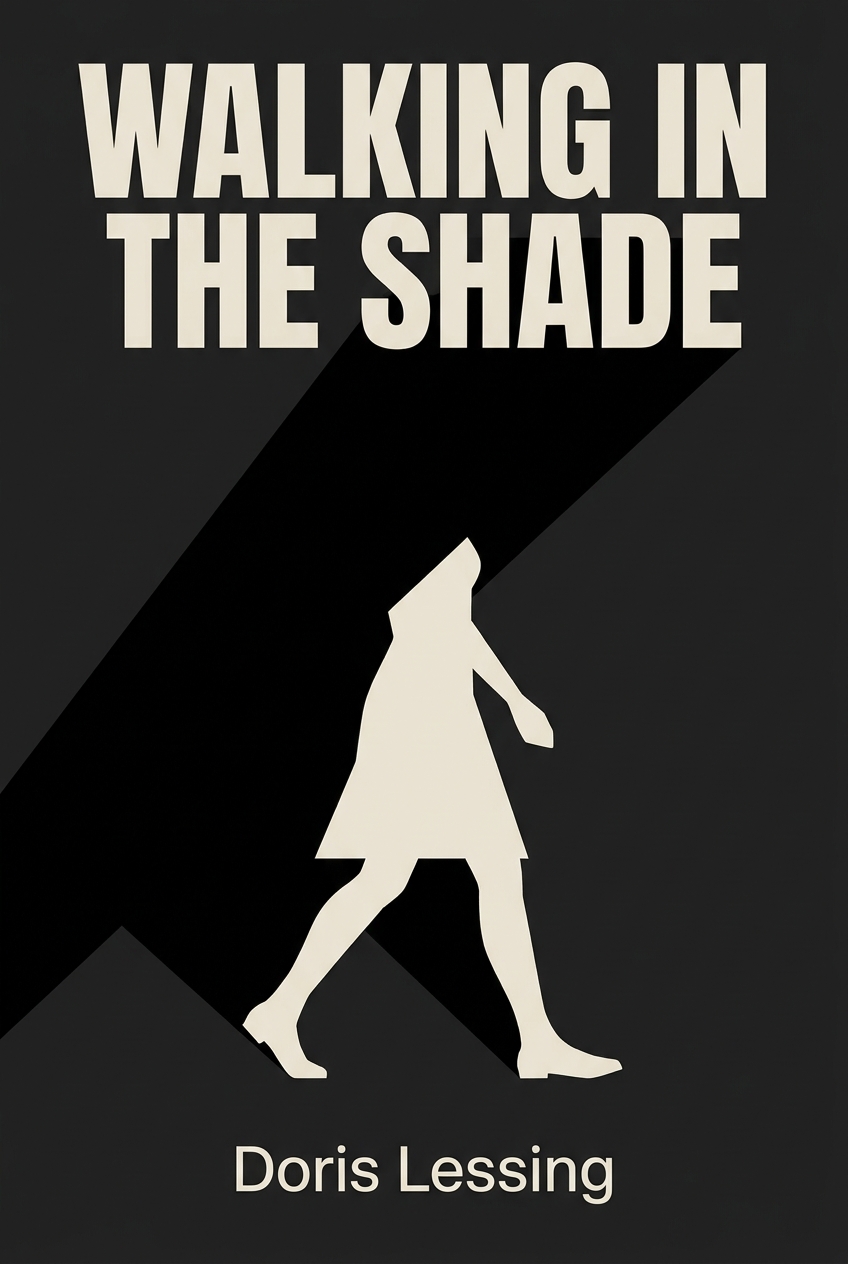
Walking in the Shade book cover

The Script

Think of a person who has become a living archive of a century’s ideals and upheavals. They are a participant, a node through which the great political and artistic currents of their time have passed. Now imagine this person in their later years, sitting down to sort through the raw, unprocessed footage of their life. They are surrounded by reels of film, some labeled ‘Hope,’ others ‘Disillusionment,’ others still simply marked with the name of a lover or a city. The task is to find the through-line, to understand how the idealistic young activist on one reel became the wary, skeptical observer on another.

This process of sorting through a life’s contradictory evidence is precisely what Nobel laureate Doris Lessing undertakes in Walking in the Shade. This second volume of her autobiography covers the years after she arrived in London from Southern Rhodesia, a single mother with a son and a manuscript, fueled by communist ideals. Lessing was performing a forensic accounting of her own consciousness and that of her generation. She charts her immersion into the heart of British leftist circles, the slow, painful erosion of her political faith, and the personal and creative reckonings that followed. It is the story of a woman refusing to let the official narrative of her life—or of the movements she was part of—stand, choosing instead to examine the messy, often uncomfortable, truth of experience.

Module 1: The Writer's Crucible — Forging an Identity in Post-War London

Lessing’s arrival in London in 1949 was a rebirth. She stepped off a ship from Southern Rhodesia with her young son, less than £150, and a fierce determination to start her "real life." The city she found was a shock. It was a bleak, war-scarred landscape of grey, unpainted buildings and ration-book austerity. This was not the vibrant heart of the empire she had imagined. Yet, within this grim setting, she began to forge her identity as a writer and an individual. Her early years were a constant battle. A writer's first priority is to fiercely protect their creative energy and time. Lessing worked a grueling secretarial job, cared for her son, and found herself too exhausted to write. She quickly realized this was unsustainable. She quit the job, choosing the precarious life of a full-time writer over the security of a steady paycheck. This decision was fundamental. It taught her that the real work of a writer is managing your life to create the mental space where creativity can happen.

This commitment to her craft was immediately tested by the publishing world. Her first novel, The Grass Is Singing, was a success, but it came with pressures. Her American publisher, Alfred Knopf, demanded she add an explicit rape scene to satisfy market expectations. And here's the thing: Lessing refused. Maintaining artistic integrity often requires saying 'no' to lucrative but compromising demands. She understood that the novel’s power lay in its subtlety, its exploration of unspoken racial taboos. Making it explicit would betray the entire point. Supported by her agent, she held her ground, establishing a principle that would guide her entire career: never write a word you don't believe in.

But the challenges weren't just professional. They were deeply personal. Lessing struggled to find housing that would accept a single mother with a child. She eventually found a room in a chaotic, working-class Italian household. This experience revealed the deep class divisions of British society. Her middle-class friends viewed her living situation as a quaint artistic experiment, failing to grasp the daily reality of her struggle. This leads to a crucial insight. To understand a system, you must experience it from the inside. Her time in that household gave her a raw, unfiltered view of post-war life, exposing the hypocrisy of a society that claimed its police weren't corrupt while her landlady bribed them for extra rations. This direct experience, far from being a "whimsical foray," became the raw material for her art and her worldview.

Read More