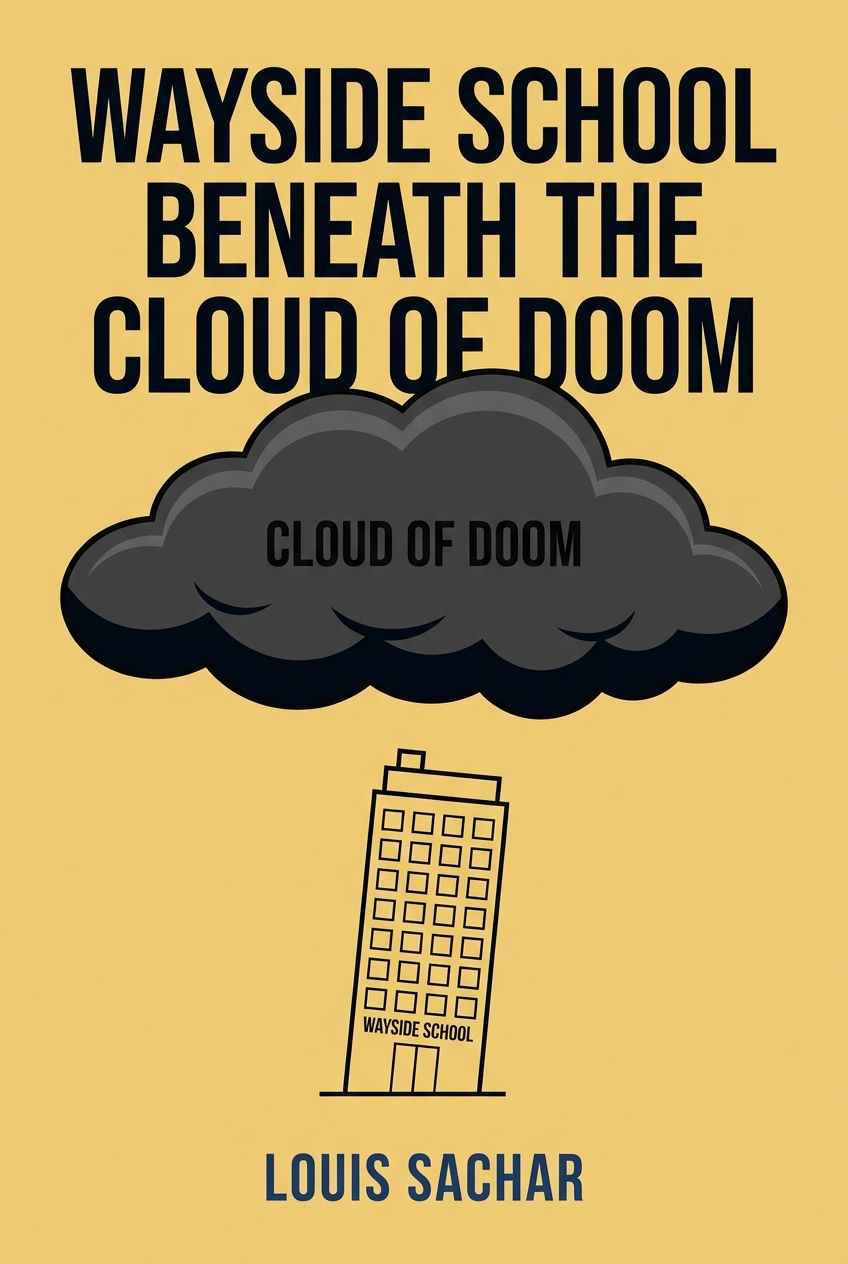
Wayside School Beneath the Cloud of Doom
What's it about
Ever feel like a giant, gloomy cloud is following you around? At Wayside School, that's not just a feeling—it's a real Cloud of Doom! Discover how the wacky students on the thirtieth floor turn their biggest anxieties into their greatest adventures. You'll learn how to face your own "Cloud of Doom," whether it's a tough test, a new friendship, or just a bad mood. Get ready for hilarious lessons on resilience, the power of a positive attitude, and why sometimes the silliest solution is the smartest one.
Meet the author
Louis Sachar is the celebrated, Newbery Medal-winning author of Holes, renowned for crafting uniquely witty and heartfelt stories that have captivated millions of young readers worldwide. His iconic Wayside School series was born from his experiences as a lunchtime supervisor at an elementary school, where he transformed real students and quirky playground events into the unforgettable characters and absurd situations that fill the halls of the thirty-story school, inspiring a generation to love reading.
Opens the App Store to download Voxbrief

The Script
At the school bake sale, there are two tables. One is covered in a crisp white cloth, displaying perfectly frosted cupcakes, each a miniature work of art. The other table is a jumble of slightly lopsided cookies, brownies with one corner mysteriously missing, and a cake that leans like it’s had a long day. A child, clutching a dollar bill, walks past the perfect cupcakes without a second glance and heads straight for the lopsided cookies. Why? Because the perfect cupcakes are for looking at. The messy, imperfect treats are for eating. They have a story. They feel real.
This same feeling—that the strange, the messy, and the wonderfully illogical are often more true than the neat and tidy—is what fueled Louis Sachar’s creation of Wayside School. A former elementary school aide, Sachar spent his days on the playground, a job he called 'the best job I ever had.' He was drawn to the kids with the tangled shoelaces, the wild stories, and the perplexing questions. He saw the absurdity and brilliance in their everyday logic. He wrote down the funny and bizarre things they said and did to capture the chaotic, joyful, and sometimes anxious energy of being a kid. The result was a thirty-story-high building of pure, unfiltered childhood, where the strangest things make the most sense.
Module 1: Thriving in Absurd Systems
The world of Wayside School is governed by systems that are often illogical and arbitrary. Success is about mastering the specific, quirky rules of the game. This is a powerful metaphor for any organization with legacy processes or a unique internal culture.
The first lesson is that you must learn the unwritten rules of your environment to survive. At Wayside, this is literal. The school has a complex bell system. A WHOOP-WHOOP! means you have sixteen minutes. A series of CLANG!s tells you how many minutes are left. But a different number of clangs might signal a porcupine on the loose or a helicopter landing. Students who don't learn this system face consequences. Todd knows if he's late, his name goes on the "DISCIPLINE" board. His frantic dash to class is an active adaptation to a high-stakes, nonsensical system. For us, this means paying attention to the "bells" in our own organizations. It's about understanding which communication channels matter, whose feedback carries weight, and what rituals signal important shifts, even if they seem irrational from the outside.
But what happens when the rules themselves are the problem? Sachar shows that authority is often driven by arbitrary and self-serving motives. The school building itself is absurd. It's thirty stories high but has no nineteenth floor. The principal, Mr. Kidswatter, gets his greatest joy from banging the giant gong to end the day. A special bell, ching-a-ling, alerts everyone that the teachers' lounge is out of doughnuts. This is treated with the same procedural gravity as a fire drill. Recognizing this absurdity is key. It allows you to depersonalize frustrating directives. When you see that a strange new mandate might be more about a leader's pet project than a grand strategy, you can navigate it with less emotional friction.
And here's the thing. Even in the most rigid systems, there are moments of grace. Rare, positive disruptions can reset the entire system. At Wayside, there is a legendary bell: the Ping...PONG!. It's the "Erase-the-Blackboard bell." When it rings, all homework is canceled. The dreaded "Ultimate Test" is erased. Names are wiped from the discipline list. It's a system-wide reboot that brings universal relief. This highlights the power of a well-timed, positive intervention. In a corporate setting, this could be a surprise day off after a tough quarter, a "no meetings" week, or a sudden decision to cancel a failing project. These actions can do more for morale and focus than a dozen motivational speeches. They show that the system can be bent toward benevolence.
Finally, the book suggests that sometimes breaking a small rule leads to a big solution. A student named Terrence gets in trouble for clipping his toenails in class. It's gross. It's against the rules. But the teacher, Mrs. Jewls, is trying to help the class grasp the concept of "a million." They need to collect a million of something. Terrence's toenail clipping becomes the first item. His minor transgression provides the perfect, tangible starting point for an abstract project. This is a reminder to look for opportunities in unexpected places. Sometimes, a team member's "mistake" or unconventional approach can unlock a breakthrough that a formal process never would.
Module 2: The Psychology of a Team Under Pressure
We've explored the system. Now let's move to the people within it. The Cloud of Doom is a psychological presence. It creates an atmosphere of anxiety that changes how people think, act, and interact. This is a masterclass in managing team dynamics during a prolonged crisis.
First, Sachar illustrates how external stress amplifies personal quirks and creates new problems. The Cloud of Doom doesn't just make people sad. It causes fingernails to grow at an alarming rate. It makes a student's funny face get permanently stuck. It causes a simple attempt to inflate a kickball to result in a massive explosion. These are metaphors for how chronic stress makes mundane challenges feel insurmountable. A small bug becomes a system-wide crash. A minor disagreement escalates into a team-breaking conflict. As a leader, you must recognize that under pressure, your team isn't just dealing with the main crisis. They are dealing with a hundred small, bizarre side effects. Your job is to provide the stability and resources to manage this amplified chaos.
Amidst this chaos, it becomes clear that maintaining routines provides a vital psychological anchor. The students are terrified of the Cloud of Doom. One asks, "What's the point?" of doing any work if they're all doomed. Mrs. Jewls's response is simple and profound. She insists on continuing their spelling lesson. She says, "we can try to do our best, cloud or no cloud." She even adds the word "hope" to the spelling list after a loud thunderclap. This is a critical insight. During times of uncertainty, the most powerful thing a leader can do is maintain a sense of normalcy. Continuing with one-on-ones, celebrating small wins, and sticking to project cadences are acts of defiance against despair. They create a structure of purpose when the bigger picture is frighteningly unclear.
But what about individual performance? The book shows that anxiety is paralyzing, but simple, direct support can break the freeze. A student named Stephen is chosen for the great honor of ringing the end-of-day gong. Instead of joy, he is frozen with fear. He imagines all the ways he could fail. He can't move. He can't think. His classmates and teacher don't give him a pep talk. They give him a simple, repeated instruction: "Breathe." When it's time to go, he's still frozen. Two friends physically lift him from his chair and guide his first steps. This is a beautiful illustration of effective support. It is about providing concrete, actionable, and sometimes physical help to get a teammate unstuck. Sometimes the best advice is simply, "Breathe. Now take one step."
Ultimately, the story reveals that true friendship is tested more by success than by failure. After a series of grueling academic contests, one student, Maurecia, emerges as the champion. She gets a giant trophy and media attention. The book notes that it's easy for friends to rally around someone who is down. But the "ultimate test" is sticking by a friend who is "up." Her friends celebrate her success with her. They wait for her by the flagpole to celebrate with her. In a competitive environment like Silicon Valley, this is a powerful reminder. Celebrating a colleague's promotion, amplifying their work, and showing up for them in their moment of victory is the hallmark of a truly supportive and high-functioning team culture. It fights the zero-sum thinking that can poison an organization.