All Books
Self-Growth
Business & Career
Health & Wellness
Society & Culture
Money & Finance
Relationships
Science & Tech
Fiction
Topics
Blog
Download on the App Store

Wayside School Is Falling Down

13 minLouis Sachar

What's it about

Ever feel like your school day is just a little too normal? Get ready to question everything you know about classrooms. This summary unlocks the secrets of Wayside School, a thirty-story-high building where logic takes a vacation and the wonderfully weird is an everyday lesson. You'll discover a world of zany teachers and even zanier students. Learn about a teacher who hypnotizes her class with a magic pickle, a boy who turns into a rat, and a cow that somehow wanders into the classroom on the nineteenth floor. It's a hilarious adventure that celebrates the joy of the unexpected.

Meet the author

Louis Sachar is a Newbery Medal-winning and National Book Award-winning author, celebrated for his quirky, insightful, and profoundly beloved contributions to children's literature. Before becoming a full-time writer, Sachar worked as a lunchtime supervisor at an elementary school, an experience that directly inspired the wacky and wonderful world of Wayside School. His unique ability to capture the logic and humor of childhood has made his stories, including the modern classic Holes, a treasured part of growing up for millions of readers.
Listen Now

Opens the App Store to download Voxbrief

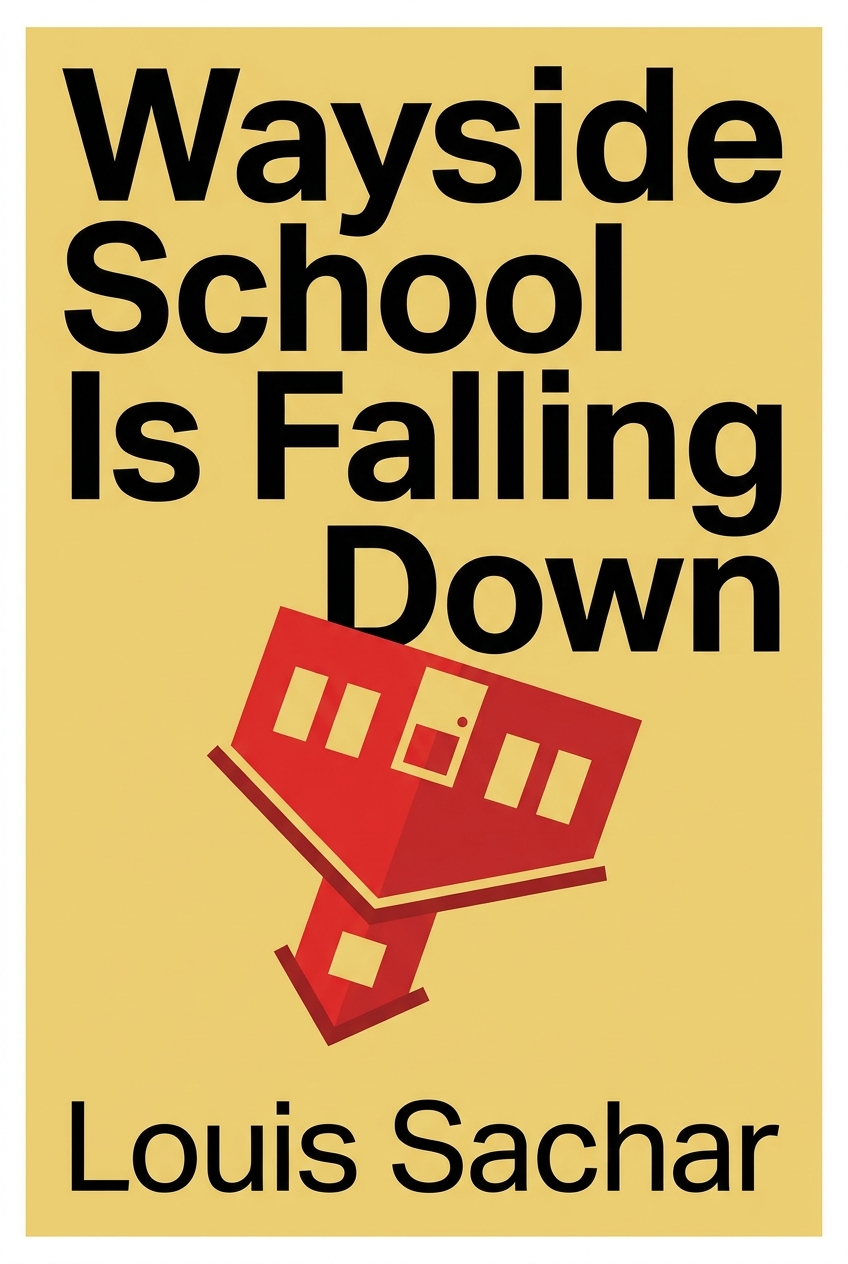
Wayside School Is Falling Down book cover

The Script

Think about the last time you followed a recipe. You gather the flour, sugar, and eggs, measure them precisely, and follow the steps in order. A + B + C should equal a cake. Now, imagine a different kind of recipe, one where the instructions are… alive. You follow step one, and suddenly the flour starts floating. You crack an egg, and a tiny, fully-cooked chicken pops out. The sugar, when measured, decides it would rather be salt today. This is a world where the fundamental rules of cause and effect have been replaced by pure, joyful chaos. The goal is the absurd journey of trying to make a cake when reality itself is playing a prank on you.

This delightful embrace of the illogical is the specialty of Louis Sachar. Before he became a household name with his award-winning novel Holes, Sachar was exploring the wonderfully weird world of Wayside School. He began writing these stories while working as a playground supervisor at an elementary school, an experience that gave him a direct line to the surreal logic and boundless imagination of children. He saw that kids didn't always need a neat, tidy lesson. Sometimes, they just needed to laugh at a world turned upside down, where a school could be built sideways and a dead rat could wear a rainbow wig. Wayside School Is Falling Down was written to celebrate the simple, profound joy of the absurd.

Module 1: The Fallacy of Rigid Systems

The world of Wayside School operates on a set of rules. Yet these rules rarely produce the intended outcomes. They often create more problems than they solve. This is a powerful lesson for leaders who rely too heavily on process and policy.

The narrative immediately reveals a core flaw in rigid thinking. For instance, Mrs. Jewls receives a brand-new computer. It's an expensive tool meant to accelerate learning. Instead of using it, she promptly throws it out the window of her thirtieth-story classroom. Her reason? To demonstrate gravity. This is a perfect, if extreme, example of a recurring theme: misapplying tools and processes defeats their purpose. The computer was a solution, but the teacher’s rigid focus on a single, immediate lesson—gravity—rendered the long-term tool useless. In a business context, this is the team that buys expensive project management software but only uses it to track vacation days. The tool's potential is wasted because it's forced to serve a purpose it wasn't designed for.

Building on that idea, the book shows how bureaucracy can actively hinder progress. Louis, the yard teacher, is struggling to carry a heavy package up to the thirtieth floor. He needs someone to open the door. Mrs. Jewls sees him, but instead of helping, she decides to hold a full spelling bee to determine which student gets the honor of opening the door. Her adherence to a "teachable moment" overrules common sense and empathy. This leads to a second critical insight: prioritizing process over people creates bottlenecks and breeds resentment. While Louis waits, the system—in this case, the spelling bee—is working perfectly as designed. But it's failing the person it's supposed to serve. We see this in organizations with cumbersome expense report policies or multi-level approval chains for trivial decisions. The process becomes more important than the outcome.

And here's the thing. The people enforcing these rules often recognize their absurdity. Early in the story, Louis refuses to pick up garbage on the playground. He states, "It wasn’t his job." He's technically correct. His job description doesn't include janitorial duties. But a moment later, he does it anyway because he cares about the children and the environment. This reveals a fundamental tension. Effective people often succeed by working around the system, not within it. Louis's initial stance represents adherence to a job description. His eventual action represents a commitment to the mission. Great team members instinctively know when to break a small rule to achieve a larger goal. Leaders who punish this behavior in the name of consistency are stifling the very initiative they claim to want. The Wayside School stories suggest that the best systems allow for human judgment and flexibility.

Module 2: The Architecture of Misunderstanding

Wayside School is a hotbed of miscommunication, false assumptions, and flawed perception. These chapters offer a masterclass in how easily we misread situations, misjudge people, and make decisions based on incomplete or just plain wrong information.

A new student, Benjamin Nushmutt, arrives. But Mrs. Jewls introduces him as "Mark Miller." Benjamin is too scared to correct her. He fears being seen as a "weirdo" for contradicting a teacher. This small, seemingly harmless error spirals. Benjamin starts living as Mark Miller. He even completes his worksheets under the false name. This scenario gives us a powerful insight into team dynamics: silence in the face of error is a sign of fear, not agreement. When team members don't speak up against a flawed plan or incorrect data, it's rarely because they agree. It's because the culture has made it unsafe to be the one to point out the leader is wrong. Benjamin’s fear of being labeled a "weirdo" is the same fear an engineer has of being labeled "not a team player" for questioning a deadline.

From this foundation, we see how these initial assumptions become entrenched. Bebe Gunn is a talented artist, but her homework is always covered in insulting messages. She blames her baby brother, Ray. Mrs. Jewls, however, assumes Bebe is lying. Her parents do the same at home, always blaming Bebe for Ray's mischief. They see Ray as their "little angel." This leads to a crucial observation for anyone in a management role: preconceived notions about individuals lead to confirmation bias and unfair blame. Mrs. Jewls and Bebe's parents have already decided who is the troublemaker and who is the angel. All incoming data is filtered through that lens. When a project fails, do we blame the person with a track record of past mistakes, or do we conduct an honest post-mortem? The book warns that our narratives about people are powerful, and often wrong. The twist, of course, is that Bebe's mother has no idea who Ray is, suggesting Bebe invented him. This doesn't invalidate the principle; it deepens it. It shows the lengths people will go to—even creating fictional scapegoats—to cope in a system they feel is fundamentally unfair.

Now, let's turn to how perception shapes reality in a more tangible way. Todd brings a toy puppy to class. It looks adorable. Everyone calls it "cute" and "precious." When Mrs. Jewls sees it, her anger melts. She kisses the toy and gives Todd a reward instead of a punishment. But the toy has a secret. When you crank its tail, it transforms into a "mean, hungry, man-eating wolf." This delightful detail illustrates a profound business truth: we reward appealing presentations, often ignoring the hidden risks. A startup with a slick pitch deck gets funding. A project with a charismatic lead gets greenlit. We are swayed by the "cute puppy." We often don't bother to check if it can turn into a wolf. Joy, another student, sees Todd get rewarded and immediately plots to steal the toy, believing it’s a magical object that prevents trouble. She only sees the positive outcome, not the underlying mechanism. She steals the puppy, gets bitten by the wolf, and learns the hard way that appearances are deceiving.

Read More