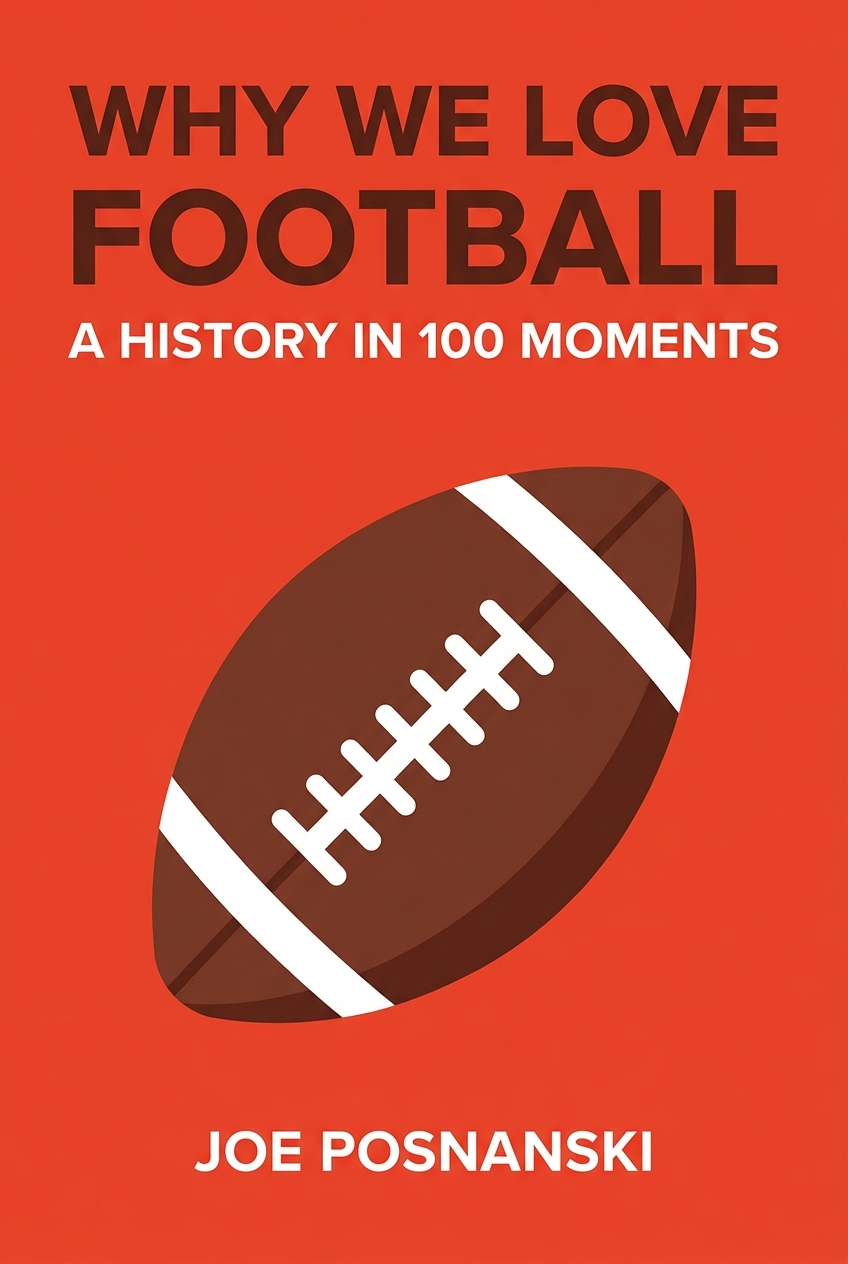
Why We Love Football
A History in 100 Moments
What's it about
Ever wonder what truly makes football America's favorite sport? Go beyond the stats and get to the heart of the game’s most electrifying moments. This is your chance to understand the raw emotion, legendary players, and unforgettable plays that define our love for the gridiron. Discover the stories behind 100 pivotal moments, from "The Catch" to the "Immaculate Reception." You'll learn how these iconic events shaped the game's strategy, created its heroes, and cemented its place in American culture, giving you a whole new appreciation for every single down.
Meet the author
Joe Posnanski is a two-time National Sportswriter of the Year and New York Times bestselling author celebrated for his deeply human approach to sports journalism. A lifelong fan, his unparalleled career is built on finding the heart and soul within the game, transforming legendary plays and forgotten moments into unforgettable stories. This passion for storytelling is the driving force behind his quest to capture the essence of why we love football.
Opens the App Store to download Voxbrief

The Script
It’s Sunday afternoon. A father and son are on the couch. The son, barely seven, is more interested in the colored pencils and the blank sheet of paper in front of him than the game on the television. The father, meanwhile, is a bundle of nervous energy, his whole world compressed into the 100 yards of green turf on the screen. He leans forward on a third down, groans at an incomplete pass, and yells at a referee who is a thousand miles away and cannot hear him. The son looks up from his drawing, not at the screen, but at his dad. He sees the frustration, the hope, the sudden, explosive joy of a touchdown. He doesn’t understand the rules of the game, but he understands the rules of his father’s heart. He sees that this strange, violent ballet on the screen is a source of profound emotion, a language his father speaks with a fluency he rarely shows elsewhere.
He puts down his pencil and starts to watch the game to understand his dad. He learns the rhythm of the house on game day, the specific snacks that are required, the jersey that must be worn, the way a shared groan after a fumble can feel like a hug. This experience, this quiet transmission of love and loyalty from one generation to the next, is a scene that has played out in millions of homes, creating a bond that feels both deeply personal and universally understood. It’s this very phenomenon that puzzled legendary sportswriter Joe Posnanski for years. After covering countless games and interviewing hundreds of players and fans for outlets like Sports Illustrated and The Athletic, he realized that the statistics and game analysis he was paid to write about never quite captured the core of the sport. He set out to write 'Why We Love Football' to explore the emotional inheritance passed down on couches and in backyards, attempting to finally put words to the powerful, often unspoken, reasons the game matters so much to so many.
Module 1: The Anatomy of a Legend
Football forges legends. These are figures who transcend the game itself, becoming symbols of something more. The book shows that this legendary status is a mix of on-field dominance, a compelling persona, and often, a single, unforgettable moment.
First, a player’s public persona is often a mask for a more complex reality. Take Dick Butkus. On the field, he was one of the most violent, feared linebackers in history. His reputation was terrifying. But after his career, he became a successful actor, known for his humor and charm. His co-star Raquel Welch was shocked by how funny and personable he was. This reveals a core truth: the ferocious competitor we see on Sunday is rarely the whole person. Yet, that on-field identity sticks. A crew member on one of Butkus’s films once warned him, "Don't pick up a football." The warning implied his football persona could resurface at any moment.
Next, true greatness is often built on an obsessive, almost inhuman work ethic. Jerry Rice is the undisputed greatest wide receiver of all time. His records are staggering. His legend was forged in practice. From his very first day as a rookie, he ran every single pass route to the end zone. Every single one. Veterans thought he was showing off. He wasn't. He was programming perfection into his muscle memory. This dedication created an almost supernatural awareness. In one Pro Bowl practice, quarterback Troy Aikman threw a pass too early. It was aimed right at Rice's head. Without flinching, Rice caught it. His focus was so absolute that he could anticipate and react to anything.
Finally, a single, iconic play can define a career and change the game itself. Lawrence Taylor, or LT, was a force of nature. He was so dominant that he changed the fundamental strategy of football. Before LT, the offensive left tackle was just another position. After LT started terrorizing quarterbacks from their blind side, the left tackle became one of the most important, highest-paid players on the field. Teams had to invent new blocking schemes just to slow him down. His impact was in forcing the entire league to evolve around his singular, disruptive genius.
Module 2: The Miracle and the Meltdown
Football is a game of extremes. It delivers moments of pure, unadulterated joy. It also delivers soul-crushing heartbreak. Posnanski argues that these two poles, the miracle and the meltdown, are two sides of the same coin. The possibility of one is what gives the other its power.
One of the most powerful insights is that football’s most iconic moments are often born from chaos and imperfection. Think of the "Immaculate Reception." In 1972, the Pittsburgh Steelers were seconds away from losing a playoff game. Quarterback Terry Bradshaw threw a desperate pass. The ball ricocheted off a collision between two players. It flew backward. Steelers rookie Franco Harris, who wasn't even supposed to be part of the play, instinctively ran to the ball. He scooped it up just inches from the turf and ran for the game-winning touchdown. The play was messy. It was controversial. But its chaotic, improbable nature is precisely what makes it legendary. The play was a perfect football moment.
But flip the coin. The same unpredictability that creates miracles also engineers unforgettable heartbreak. The book revisits the infamous 1978 game known as the "Miracle at the Meadowlands." The New York Giants had the game won. All they had to do was kneel and run out the clock. But in the 1970s, kneeling was seen as cowardly. So, the offensive coordinator called a running play. A simple handoff. The snap was bad. The handoff was botched. The ball hit the turf. Eagles cornerback Herm Edwards scooped it up and ran it back for a touchdown. The Giants lost a game they had absolutely no business losing. That one disastrous play led to firings. It changed how teams end games forever. It was a meltdown born from a cultural reluctance to play it safe.
And here's the thing. These moments of triumph and disaster become permanent fixtures in a fan’s emotional history. The author, a lifelong Cleveland Browns fan, describes the 1987 AFC Championship game against the Denver Broncos. He relives "The Drive," a 98-yard march by quarterback John Elway that ripped a victory away from Cleveland. The chapter is brutally short. It’s a testament to how a single sporting event can inflict a wound that never fully heals. For every fan celebrating a miracle, there is another whose heart is being broken. That shared emotional risk is central to why we love the sport.