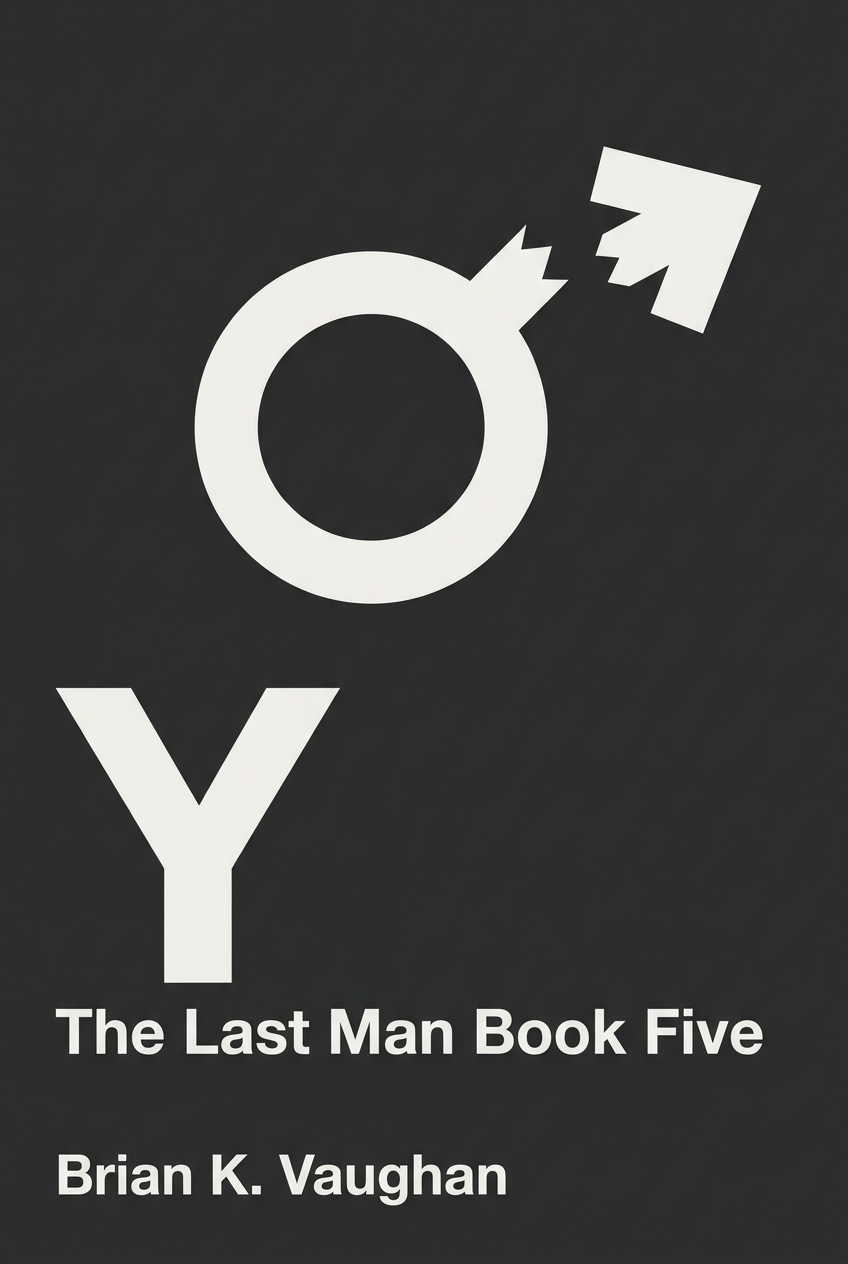
Y
The Last Man Book Five
What's it about
What if the cure for a global plague was within your grasp, but saving the world meant betraying everyone you love? Yorick Brown, the last man on Earth, faces this impossible choice as he finally reaches the one person who might hold the key to humanity's future. You'll follow Yorick's harrowing journey to Japan, where he confronts Dr. M, the geneticist behind the cloning experiment that may have caused the Gendercide. Uncover the shocking truths behind the plague, navigate treacherous new alliances, and witness the ultimate sacrifice as the epic saga hurtles toward its breathtaking conclusion.
Meet the author
Brian K. Vaughan is an Eisner and Harvey Award-winning writer often cited as one of the most innovative storytellers in modern comics. His acclaimed work on titles like Saga and Paper Girls demonstrates his mastery of blending high-concept science fiction with deeply human, character-driven narratives. This unique ability to explore grand ideas through relatable people is the very heart of his epic conclusion to Y: The Last Man, solidifying his reputation as a visionary in the medium.
Opens the App Store to download Voxbrief

The Script
The most celebrated stories of survival often feature a lone hero battling a hostile world. We admire the grit, the ingenuity, the sheer will to live against all odds. But this focus on the hero’s struggle obscures a more profound, and unsettling, truth: the greatest threat is the crushing weight of being the last of your kind. When there is no one left to validate your existence, to share your history, or to build a future with, survival itself becomes a form of psychological torture. The absence of a counterpart, a reflection, transforms the world from a landscape to be conquered into a museum dedicated to everything you've lost. The real crisis is fighting for a reason to live when you are the sole inheritor of a ghost world.
This exact question—what happens when the world’s most basic biological binary is snapped in half?—is what drove writer Brian K. Vaughan to create his seminal comic book series. Known for his work on acclaimed TV shows like Lost and his own groundbreaking comics such as Saga, Vaughan has built a career on exploring high-concept premises through deeply human characters. With Y: The Last Man, he and artist Pia Guerra were staging a massive thought experiment to dissect gender, society, and identity by asking what purpose a man serves in a world suddenly, and violently, rendered female.
Module 1: The Performance of Identity in Elite Spaces
The world of elite creative fellowships often presents itself as a meritocracy. A place where talent, regardless of background, is nurtured. But the moment Joe Goldberg steps onto the Harvard campus, he realizes this is a carefully constructed illusion. He was accepted into the prestigious Shoddy Fellowship, a program designed to find "undiscovered writers." Yet, he finds his peers are anything but. They are a clique of Ivy League graduates, already published, already connected, already speaking a language of privilege he doesn't understand.
This introduces a foundational insight of the book: In competitive environments, identity is often a performance, not an authentic expression. Joe watches a fellow student on the steps of the library. She has a vintage t-shirt, a Faulkner novel, and her phone placed face-down. He sees this as a curated image. A performance designed to signal "I prefer novels over nuisance." This observation sets the stage for the entire fellowship. The members don't connect; they compete. They engage in "humble bragging," one-upping each other with stories of their famous mentors and privileged upbringings. It’s a stage.
This leads to a tough reality. Success in these spaces often depends on mastering social codes, not just your craft. Joe feels this acutely. He lacks the shared social capital of his peers. He doesn't have a family box at Fenway Park or stories of honeymoons in Chilmark. This immediately marks him as an outsider. He feels a profound alienation, observing, "You can make one person love you, but you can’t make a group of people like you, not when they already have each other." The stated mission of inclusivity crumbles against the invisible walls of social class and pre-existing networks. The fellowship is a transactional networking platform where blurbs and Twitter endorsements are the real currency.
So what's the move? Joe quickly understands that to survive, he can't just be a good writer. He has to become a performer himself. Navigating these systems requires becoming a "double agent," balancing authenticity with strategic conformity. He and a fellow outsider, Wonder Parish, form an alliance. They bond over their shared "autodidact" status, creating an "us-against-them" mentality. But even this alliance is tested. In the workshop, Wonder downplays her intelligence to appear non-threatening. Joe softens his critiques to avoid social backlash. They become "double agents," presenting one face to the group while sharing their true, cynical thoughts in private. They learn to speak two languages: the public language of flattery and conformity, and the private language of authentic connection. This duality is the price of admission. It’s a draining, constant negotiation between who you are and who you need to be to get what you want.